




























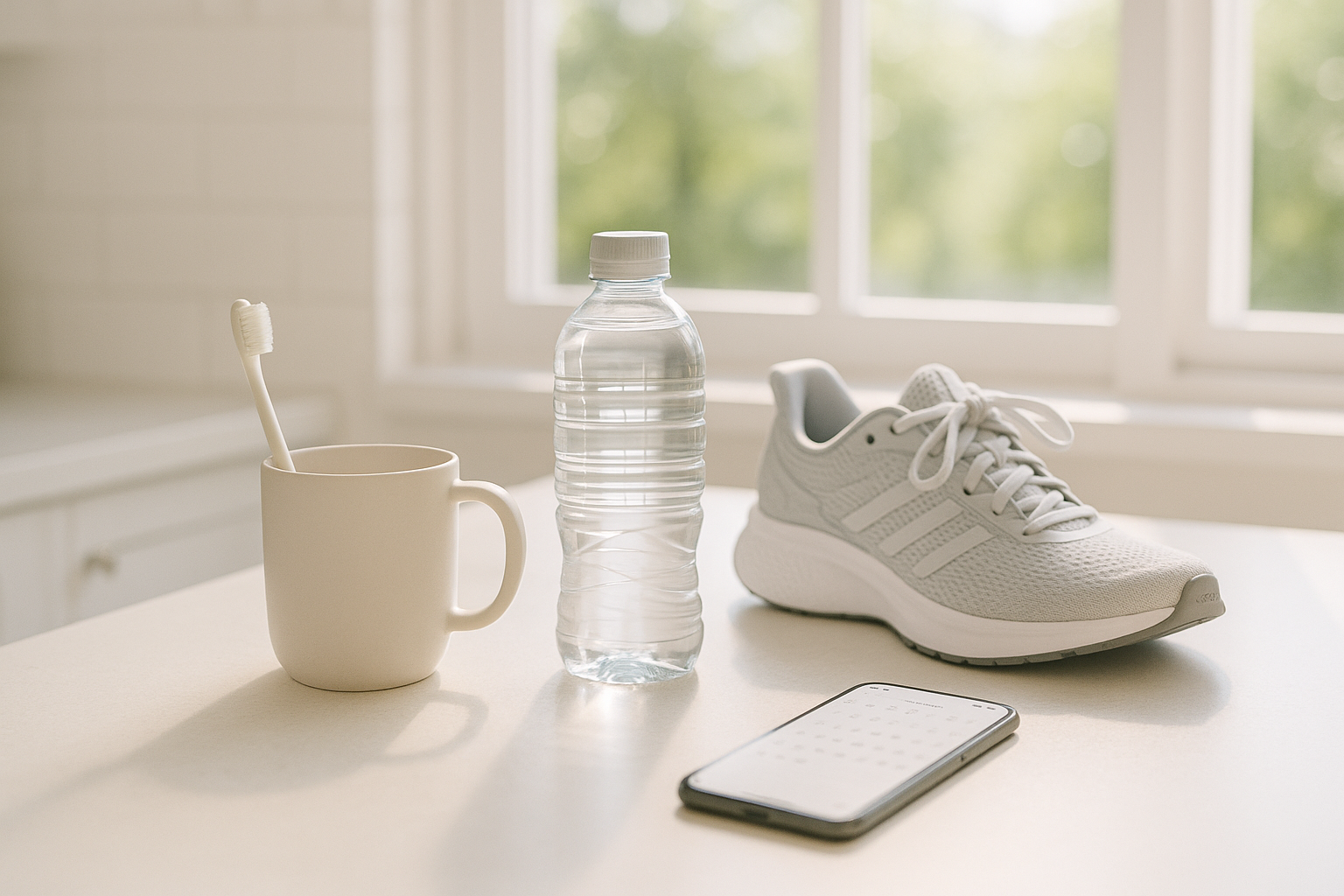
Habit stacking means attaching a new, desired behavior to an existing routine so the old habit acts as a reliable cue for the new one. Done well, it removes decision friction, reduces setup time, and makes healthy actions feel automatic rather than effortful. This guide is for busy professionals and caregivers who want to work with—not against—their schedules. You’ll learn practical stacks you can deploy around routines you already have (coffee, commute, email checks), plus science-backed techniques to keep stacks small, specific, and sustainable. Brief note: this article is educational and not medical advice; adapt any routine to your context.
Quick definition for the skimmers: Habit stacking is the practice of pairing a new behavior immediately after an existing one (e.g., “After I start the kettle, I’ll stretch my calves for 60 seconds”) so the old habit’s cue reliably triggers the new action.
Fast-start steps (30 seconds):
- Pick a solid anchor (something you already do daily).
- State the stack as “After I [anchor], I will [new action] for [duration].”
- Keep it tiny (≤2 minutes to start).
- Place props where the anchor happens.
- Track the first 7–10 reps, then review.
1. Anchor New Habits to “Rock-Solid” Routines
The most efficient stacks start with anchors you already perform without fail; strong anchors provide consistent cues that make your new behavior almost impossible to forget. Choose routines that occur at a predictable time and place—think “after I brush my teeth,” “after I sit at my desk,” or “after I pour coffee.” The aim isn’t ambition; it’s reliability. Anchoring transforms memory from a willpower task into a context cue: your environment does the reminding. Research on habit formation shows automaticity grows with consistent repetition and stabilizes over time, especially when the cue (context) is stable. In practice, that means a humble but daily anchor beats grand, sporadic intentions. Start where you’re certain you’ll be, not where you hope to be.
1.1 Why it matters
- Stable anchors trigger consistent behavior, decreasing forgetfulness and decision fatigue.
- Context-cued habits consolidate faster than “free-floating” intentions that rely on memory.
- Anchors convert routines into “if this, then that” scripts, a pattern shown to increase follow-through.
1.2 How to do it
- Audit your day: List 10–15 actions you do every day (wake, shower, coffee, commute, unlock laptop).
- Pick one anchor per goal: Avoid stacking multiple new habits on the same anchor at first.
- Write it verbatim: “After I start the kettle, I will fill my water bottle.”
- Add location detail: “After I unlock my laptop at my desk, I’ll open my calendar.”
Mini checklist
- Is the anchor daily and predictable?
- Does it happen in the same place?
- Can the new action start within 3 seconds of the anchor?
Bottom line: A dependable anchor creates a dependable stack; choose certainty over idealism.
2. Use If–Then “Implementation Intentions” for Precision
Implementation intentions are simple “if–then” plans that link a specific situation to a specific action (e.g., “If it’s 12:55 p.m. and I’ve closed my last email, then I start a 5-minute desk stretch”). This structure reduces ambiguity, which is a common failure point in habit building. Meta-analytic evidence shows that if–then planning substantially increases goal attainment by making the cue salient and the response automatic. Compared with vague resolutions, the if–then format pre-decides when and how to act, shrinking the mental gap between intention and behavior. For stacking, if–then language turns your anchor into a precise trigger.
2.1 Numbers & guardrails
- Format: If [cue], then I will [behavior] for [duration] at [location].
- Duration: Start with 30–120 seconds; scale only after 10+ successful reps.
- Scope: One if–then per stack in the early weeks to prevent overload.
2.2 Common mistakes
- Vague cues: “If I remember” isn’t a cue—“If I start the kettle” is.
- Large starting actions: Begin tiny to avoid friction.
- Multiple outcomes: One cue → one behavior (avoid branching decisions).
Quick example: If I set my mug on the counter (cue), then I’ll take my vitamin (behavior) before I pour coffee (location and timing baked in).
Bottom line: Precision beats motivation; if–then wording makes stacks fire reliably.
3. Time-Block Your Stack Inside Calendar Routines
Many people already live by their calendar—meetings, school runs, commute windows. Embedding stacks inside these existing time blocks makes your day the scaffolding for behavior change. Instead of hoping for “free time,” you piggyback on slots you must enter anyway. For example, attach a 2-minute posture reset after each meeting, or schedule a 5-minute mobility routine at the start of your lunch block. Time-blocked stacks thrive because the signal is unmistakable: the “meeting ends” bell or the calendar pop-up is your cue. This is especially helpful in office or remote-work contexts where cognitive load is high and memory is unreliable.
3.1 How to do it
- Pick a recurring block: Daily stand-up, lunch, commute, end-of-day shutdown.
- Define the micro-action: 90-second neck/shoulder reset; refill water; 10 squats.
- Use calendar nudges: Title events “Lunch (start with 2-min walk).”
- Add buffer: Block 5 minutes for the stack before/after the main event.
3.2 Tools & examples
- Calendar tools (Google Calendar/Outlook) with alerts; smartwatch haptics; web blockers to seal focus during the block.
- Example: After my 3:00 p.m. meeting ends, I start a 2-minute eye break (20-20-20 rule), then refill my water.
Synthesis: Put your stack where your time already lives; your calendar becomes your habit engine.
4. Pair “Should” Behaviors with “Want” Rewards (Temptation Bundling)
Temptation bundling ties an instantly gratifying activity (podcast, audiobook, latte art video) to a beneficial but easier-to-avoid behavior (walking, mobility work, food prep). By bundling, you reserve the “want” for the moment you perform the “should,” turning the cue into something you look forward to. Field experiments have shown this can increase exercise adherence by making the experience more enjoyable and reducing the opportunity cost of time. In everyday life, you might allow your favorite show only while prepping vegetables, or save a gripping audiobook solely for treadmill days. The trick is exclusivity: the reward happens only with the target behavior.
4.1 How to do it
- List your “wants”: Shows, playlists, novelty beverages, audiobooks.
- Match to a “should”: Walking, stretching, tidying, chopping vegetables.
- Enforce pairing: Keep the media app or item in the location of the “should.”
- Track adherence: Note whether the reward remained exclusive.
4.2 Common pitfalls
- Breaking exclusivity (“just one episode” off-routine) dilutes the pull.
- Rewards that make the task harder (e.g., messy snacks during mobility) backfire.
- Oversized rewards can encourage rushing—keep rewards parallel, not post-task bribes.
Synthesis: When your stack is also your treat, you’ll show up more often with less internal negotiation.
5. Stage Your Environment So the Next Action Is Friction-Free
Environment design is habit stacking’s silent multiplier. By pre-placing tools where the anchor occurs, you reduce setup friction to near zero. A water bottle next to the kettle, bands by the standing desk, vitamins beside your mug—these visual affordances function as both cue and convenience. Neuroscience research links habits to brain systems that encode context-action loops; deliberate staging strengthens those loops by making the desired action the easiest one available. The goal is to make the right thing obvious and the wrong thing slightly inconvenient.
5.1 How to do it
- Map your anchors: For each anchor, place one visible prop within arm’s reach.
- Use “default layouts”: Nightstand with sleep mask and book; desk with timer and posture card.
- Employ containers: A labeled “morning stack” tray on the counter prevents scatter.
- Remove friction: Pre-charge devices; pre-fill bottles; set clothes out the night before.
5.2 Mini case
- Scenario: You want 5 daily minutes of hip mobility.
- Anchor: After you start Zoom.
- Staging: Keep a mobility band looped around your office chair arm; when Zoom dials, do 60 seconds of banded hip openers before screen-share.
Synthesis: Staging transforms intention into the path of least resistance—your stack becomes the easiest move.
6. Start with “Two-Minute” Micro Versions to Build Automaticity
The smaller the starting action, the more repeatable it is—and repetition is how automaticity grows. A classic mistake is launching stacks at full size (“30-minute HIIT after emails”). Micro versions (≤2 minutes) allow consistent daily reps that wire the cue-behavior link faster. Over several weeks of consistent anchors, you scale by duration or intensity. Research on habit formation suggests early repetitions drive the steepest gains in automaticity; micro actions let you bank those reps even on chaotic days. Crucially, micro does not mean meaningless: a 90-second stretch, five deep breaths, or a brief tidy can meaningfully improve energy and focus.
6.1 Numbers & guardrails
- Duration: 30–120 seconds for the first 10–20 reps.
- Scaling rule: Only increase when you hit ≥80% success over a 2-week window.
- Ceiling test: If you’re skipping, shrink it again; consistency beats volume early.
6.2 Example stacks
- After I brush, I floss one tooth (eventually the whole mouth).
- After I open my inbox, I write one sentence of the day’s top deliverable.
- After I hang up a call, I do 10 slow shoulder rolls.
Synthesis: Tiny is not trivial—micro stacks are the on-ramp to durable, larger habits.
7. Stack Around Natural Transitions and “Edge Moments”
Transitions—doorways, commute starts, post-email, after meetings—are prime moments to insert efficient stacks because you’re already switching contexts. These “edge moments” create natural chapter breaks that, with a cue, can launch a brief, helpful behavior. For instance, attach a 60-second breathing reset after each inbox sweep, or a standing stretch the moment you end a meeting. Because transitions are frequent and rhythmic, they offer more reps per day, accelerating learning. They also reduce the risk of interference; you’re not interrupting deep work but piggybacking on a switch that’s happening anyway.
7.1 How to do it
- Identify edge moments: Sitting down, standing up, opening/closing an app, plugging in your phone.
- Match behaviors: 1–3 minute actions that require minimal setup.
- Use a verbal tag: Say softly, “Meeting → stretch,” to reinforce the link.
- Protect deep work: Avoid stacking inside focus blocks; use the edges only.
7.2 Region-specific notes
- Commute cultures: In dense cities, pair walking transfers with mobility or breathwork; in car-first regions, use fueling stops or parking as anchors.
- Prayer or meditation times: If relevant in your region, gently attach hydration or brief posture work afterward without crowding the primary practice.
Synthesis: Edge moments multiply your chances to practice—each transition becomes a cue you can trust.
8. Chain Micro-Stacks into Short Sequences (But Cap the Length)
Once single stacks are reliable, you can chain them—Anchor A triggers Action 1, which triggers Action 2. This creates momentum, turning a minute here and two minutes there into a compact, efficient routine (e.g., “After I start the kettle → fill water bottle → take vitamin → 60-second calf stretch”). The key is brevity; overly long chains increase failure points. Aim for a 3–5 step sequence that takes 3–6 total minutes. Thanks to serial cues, the end of one action becomes the beginning of the next, making the flow feel natural.
8.1 How to do it
- Lock step 1 first: Don’t chain until step 1 is a reflex.
- Design left-to-right: Lay props in the order you’ll use them.
- Use timing truths: Morning for health basics; end-of-day for shutdown rituals.
- Set a cap: Five steps max; longer chains become brittle.
8.2 Common mistakes
- Ambition creep: Adding steps before earlier ones stick.
- Non-adjacent actions: Actions in different rooms break the flow.
- Hidden props: If you can’t see it, you won’t do it.
Synthesis: Short, well-designed chains convert scattered good intentions into a swift daily flow.
9. Add Lightweight Tracking and Weekly “Stack Reviews”
Tracking isn’t about streak perfection; it’s about noticing patterns so you can adjust anchors, props, or timing. A single checkbox in a notes app, a tiny grid in your planner, or an automated habit app ping can surface which stacks fire and which fizzle. Pair tracking with a 10-minute weekly review where you ask: Did the anchor occur? Was the action too big? Do I need to re-stage the environment? Regular review prevents quiet decay and helps you swap failing stacks for better-placed ones.
9.1 Mini review template
- What worked? (Anchor reliability, ease, satisfaction)
- What failed? (Cue missed, environment cluttered, action too big)
- Tweak: (Shrink duration, move props, change anchor)
- Next week’s one experiment: (E.g., new anchor for hydration)
9.2 Tools & examples
- Apps: Habitify, Streaks, TickTick, Apple Reminders, Google Keep.
- Analog: Pocket index card with 7 boxes; mark an “X” after each stack.
- Example: A simple table—rows = stacks, columns = days—reveals which ones ride your real-life rhythm.
Synthesis: What you measure improves—tracking and reviews keep stacks adaptive, not dogmatic.
10. Build Fail-Safes: Plan for Misses, Travel, and “Bad Days”
Efficiency requires resilience. Stacks should continue—albeit in lighter form—when you travel, have guests, or hit deadlines. Pre-plan “floor versions” (the smallest acceptable action) and “travel versions” that use portable props. For example, if your mobility stack uses a band, pack a mini loop; if your water bottle is your cue, use hotel glasses as a stand-in. Also plan recovery cues: If you miss the morning anchor, you’ll trigger the action at the next available edge moment (e.g., after your first meeting). By designing fail-safes, you avoid the “broken streak spiral,” keeping momentum through real-life variability.
10.1 How to do it
- Create floor versions: 30-second stretch, 5 deep breaths, 10 desk push-ups.
- Packable props: Mini band, collapsible bottle, pill case, travel charger.
- Fallback anchors: “If I miss the brush-then-floss stack, I floss after lunch coffee.”
- Re-entry rule: After illness or travel, restart at micro size for 3–5 days.
10.2 Mini case
- Normal: After starting the kettle, you fill a 750 ml bottle and take a vitamin.
- Hotel: After the kettle clicks, you fill a glass twice and take a travel vitamin.
- Missed anchor: If breakfast is on-the-go, you run the hydration stack at your desk.
Synthesis: Flexible stacks survive chaos; resilience is the real productivity hack.
FAQs
1) What exactly counts as a good “anchor” for habit stacking?
A good anchor is a stable, daily behavior in a consistent context—brushing teeth, pouring coffee, unlocking your laptop, or ending a meeting. The best anchors happen at a predictable time and place so your brain links the cue and behavior quickly. Avoid rare or variable anchors like “if I have free time” or “after work (sometime).” If your days vary, use universal transitions (standing up, opening email) as anchors.
2) How long does it take for a stack to become automatic?
It varies widely by person and behavior. Studies of real-world habit formation suggest automaticity tends to increase with consistent repetition, with many people reaching a plateau over weeks to months rather than days. Early repetitions produce disproportionate gains, so small daily stacks that rarely miss usually solidify faster than large, sporadic ones. Expect noticeable ease in 3–8 weeks and full “I don’t think about it” status in a few months.
3) Is habit stacking just “willpower with extra steps”?
No. Stacks reduce reliance on willpower by using context cues, if–then plans, and environmental design. Instead of remembering or negotiating, you respond to a cue: “When I set my mug down, I take my vitamin.” This shrinks the cognitive cost of starting. Over time, the action feels automatic, which is the opposite of white-knuckle effort.
4) Can I stack multiple habits at the same anchor?
Eventually, yes—but not at first. Early on, one cue should trigger one new behavior to minimize decision conflict. Once that link is reliable, you can chain 3–5 micro-steps into a short routine. Keep the sequence short and co-located; if steps happen in different rooms or require complex setup, the chain becomes brittle.
5) How does temptation bundling differ from a normal reward?
With bundling, the enjoyable “want” is consumed only during the target behavior, which creates a strong positive association and anticipation for the cue. Traditional rewards often happen afterward and can be skipped or delayed. Bundling turns the task itself into a gateway to something you like, which field experiments show can improve adherence—especially for exercise.
6) What’s the best way to track stacks without getting obsessed with streaks?
Use light-touch tracking: a checkbox in your notes app, a weekly grid in your planner, or a reminder app. Focus on patterns, not perfection. During a weekly review, adjust anchors, shrink oversized actions, or re-stage props. The goal is continuous fit with your real life, not a flawless streak.
7) How do I stack at work without looking odd?
Choose discreet, low-effort behaviors that fit edge moments: refill water after meetings, 60-second posture resets when you open your laptop, a 2-minute planning note before you check messages. Stage subtle cues (a small timer, a water bottle) and set calendar nudges. Keep stacks brief to respect colleagues’ time and norms.
8) Will stacking disrupt my deep work?
It shouldn’t—if you stack at transitions. Avoid inserting stacks mid-focus; attach them to beginnings or endings of meetings, calls, or inbox sessions. If a cue fires during deep work (e.g., a reminder ping), snooze it to the next edge moment so you preserve flow.
9) I travel frequently—how do I keep stacks going?
Create travel versions with portable props (mini band, collapsible bottle) and fallback anchors (hotel kettle, elevator arrival, phone charging). Pre-pack a “stack kit” and restart at micro size for the first 3–5 days of travel. That maintains continuity without overreach.
10) Can stacking help with nutrition or sleep, not just exercise?
Absolutely. Pair water with coffee prep, add a 30-second produce check while opening the fridge, or trigger a phone “downtime” when you plug in the charger at night. Stacks shine wherever cues are strong and actions are simple—nutrition, sleep hygiene, admin, and even relationship check-ins.
11) What if my days are unpredictable?
Use universal anchors found in all schedules: standing up, sitting down, opening email, ending a call, plugging in your phone, locking your door. Focus on tiny actions and travel versions. The more varied your days, the more you rely on edge moments rather than fixed times.
12) How big should a mature stack get?
Cap most chains at 3–6 minutes and 3–5 steps. Longer sequences add failure points and invite skipping on busy days. If you want larger practices (e.g., a 30-minute workout), keep the stack as the starter (e.g., put on shoes and walk 2 minutes), then “optionally continue” when time allows.
Conclusion
Efficiency isn’t about squeezing more into your day; it’s about making the right things happen with less friction. Habit stacking does this by harnessing reliable anchors, precise if–then plans, smart environment design, and small, repeatable actions. You learned how to pick rock-solid anchors, time-block stacks inside existing calendar slots, bundle enjoyable rewards with beneficial behaviors, and stage props to remove setup costs. You also saw why micro versions and edge moments accelerate automaticity, how to chain short sequences without brittleness, and how lightweight tracking plus weekly reviews keep your stacks tuned to real life. Finally, by designing fail-safes and travel versions, you protect momentum when life gets messy. Start with one tiny stack attached to a daily anchor, review it weekly, and scale only after it sticks. Your next step: choose one anchor today and write a 15-word if–then plan you can execute in under two minutes.
References
- How to Build New Habits by Taking Advantage of Old Ones, James Clear, n.d., https://jamesclear.com/habit-stacking
- Lally, P., van Jaarsveld, C. H. M., Potts, H. W. W., & Wardle, J. (2010). How are habits formed: Modelling habit formation in the real world, European Journal of Social Psychology, 40(6), 998–1009. Wiley, https://onlinelibrary.wiley.com/doi/abs/10.1002/ejsp.674
- Gollwitzer, P. M., & Sheeran, P. (2006). Implementation intentions and goal achievement: A meta-analysis of effects and processes, Advances in Experimental Social Psychology, 38, 69–119. ScienceDirect, https://www.sciencedirect.com/science/article/pii/S0065260106380021
- Milkman, K. L., Minson, J. A., & Volpp, K. G. (2014). Holding the Hunger Games Hostage at the Gym: An evaluation of temptation bundling, Management Science, 60(2), 283–299. PubMed Central, https://pmc.ncbi.nlm.nih.gov/articles/PMC4381662/
- Fogg, B. J. (2009). A behavior model for persuasive design, Proceedings of the 4th International Conference on Persuasive Technology. ACM Digital Library, https://dl.acm.org/doi/10.1145/1541948.1541999
- Fogg Behavior Model, Stanford Behavior Design Lab, resource page (accessed Aug 2025), https://behaviordesign.stanford.edu/resources/fogg-behavior-model
- Distinctive brain pattern helps habits form, MIT News, Feb 8, 2018, https://news.mit.edu/2018/distinctive-brain-pattern-helps-habits-form-0208
- Bieleke, M., Keller, L., & Gollwitzer, P. M. (2021). If–then planning, Psychological Research on Urban Society / Social and Personality Psychology Compass (review article). Taylor & Francis Online, https://www.tandfonline.com/doi/full/10.1080/10463283.2020.1808936