

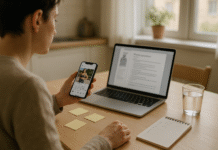










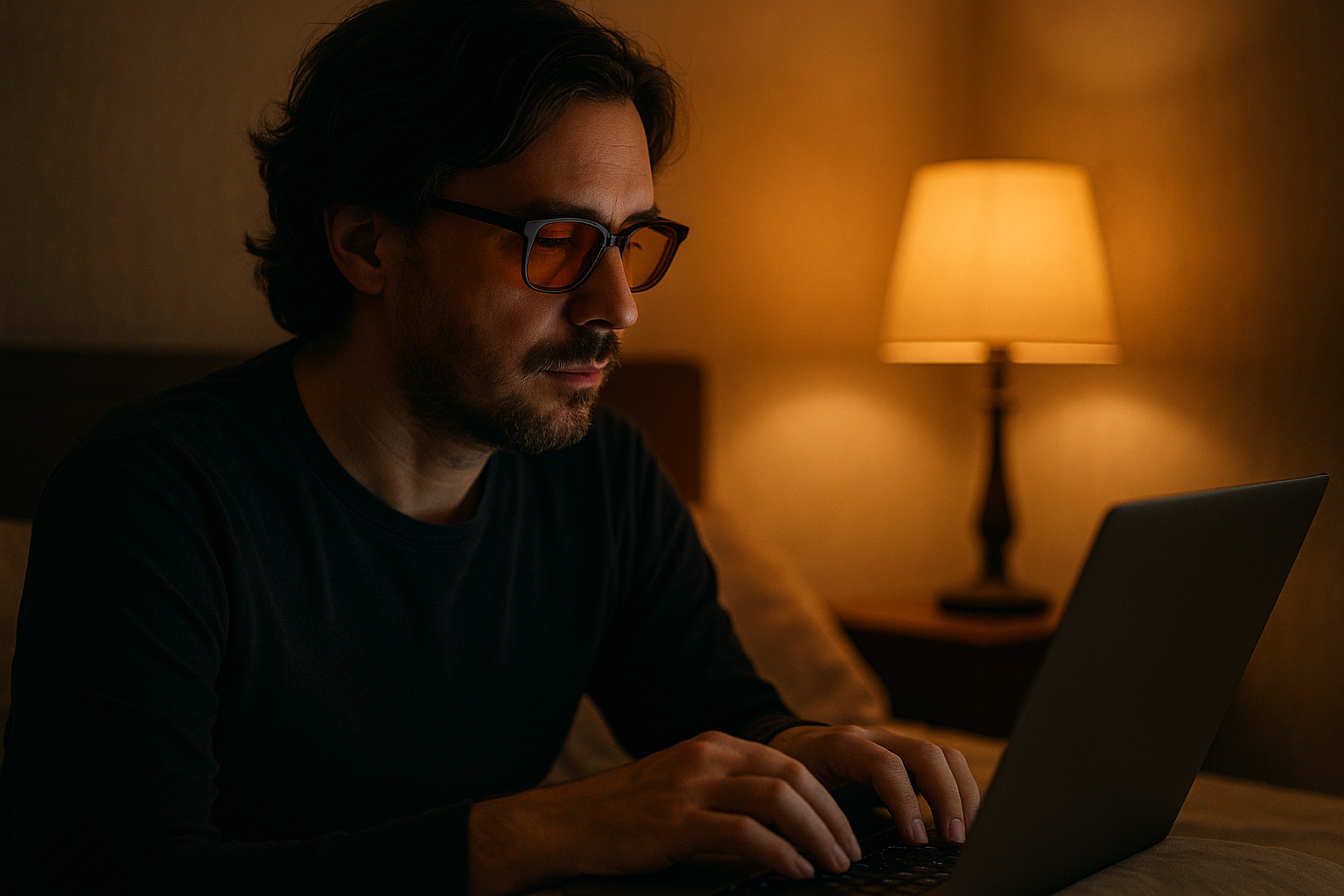
Blue-light blocking glasses promise relief from digital eye strain and better sleep—but what does solid research say? Short answer: for most people, these glasses likely don’t reduce eye strain from screens and show mixed benefits for sleep. A 2023 Cochrane review of randomized trials found little to no improvement in eye strain or sleep compared with regular lenses, though certain high-attenuation amber lenses can help specific groups before bed.
Featured-snippet answer: Blue-light blocking glasses generally do not reduce digital eye strain and show limited, context-specific sleep benefits; behavioral fixes (breaks, brightness, ergonomics) work better for eye comfort.
Medical note (not individual advice): If you have persistent eye pain, headaches, or vision changes, see an eye-care professional for a tailored evaluation.
1. Do blue-light glasses reduce digital eye strain from screens?
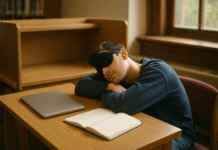
Mostly no in controlled trials. When researchers pooled randomized studies, blue-light filtering lenses did not consistently reduce symptoms such as tired eyes, headache, or blurred vision versus standard lenses over short follow-ups. Major ophthalmology groups also state that screen-related discomfort is driven more by how we use devices (long, unbroken near work, dry eye, glare) than by blue wavelengths themselves. In other words, the mechanism doesn’t match the marketing. As of August 2025, guidance still prioritizes breaks, blinking, proper prescriptions, and ergonomics over special tints.
1.1 Why it matters
Digital eye strain (a.k.a. computer vision syndrome) stems from extended near focus, reduced blink rate, and sub-optimal setup—issues that tints don’t fix. The AAO notes blue light isn’t the cause of digital eye strain, so filtering it doesn’t target the core problem.
1.2 What helps instead (quick hits)
- Follow the 20-20-20 rule: every 20 minutes, look 20 feet away for 20 seconds.
- Keep screens roughly arm’s length away; top of monitor at or just below eye level.
- Manage dry eye (blink more; consider artificial tears if recommended).
- Check your prescription; single-vision computer lenses can help some users.
- Reduce glare (matte screen protector, adjust lighting/contrast).
Bottom line: For eye comfort, habits and ergonomics beat blue-light tints.
2. Do blue-light glasses help you sleep better?
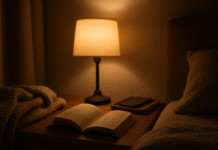
Sometimes, but results are mixed. A small randomized crossover trial in healthy adults suggested that wearing blue-blocking glasses for ~2 hours before bed improved some subjective and actigraphy sleep metrics; however, the broader 2023 Cochrane review concluded there’s little to no overall effect on sleep quality in short-term trials. This discrepancy reflects product variability (how much “melanopic” light is actually filtered), study designs, and populations.
2.1 Numbers & guardrails
- Healthy adults: mixed effects; some modest improvements in small studies, not consistent across trials.
- Mechanism: evening short-wavelength (≈460–480 nm) light suppresses melatonin and shifts circadian timing; effective lenses must meaningfully attenuate this band.
- Night modes: changing display color alone often fails to measurably improve sleep versus simply not using the phone near bedtime.
2.2 Mini-checklist for bedtime use
- Use high-attenuation amber lenses 2–3 hours before target bedtime.
- Combine with dim, warm lighting and reduced screen time.
- Keep bedroom lighting low; bright room light can suppress melatonin by ~70% before sleep.
Bottom line: Glasses can help in tightly controlled, evening-only use—especially with higher attenuation—but don’t rely on them as a standalone fix.
3. Are there groups more likely to benefit (e.g., insomnia, pregnancy, certain disorders)?
Yes—some targeted groups show signals of benefit. In people with insomnia symptoms, amber lenses worn for ~2 hours pre-bed improved sleep diaries and some actigraphy measures in a small randomized crossover trial. Pregnant participants in a randomized trial also showed favorable trends with blue-blocking use in evening/nocturnal awakenings, though effect sizes varied. Specialized psychiatric contexts (e.g., mania) and circadian rhythm disorders have also explored amber “dark therapy” as an adjunct.
3.1 How to implement (with clinician input)
- Prioritize consistent timing: same pre-bed window nightly.
- Pair with sleep hygiene (fixed wake time, dim environment, device curfew).
- Ensure lenses actually reduce melanopic input (see Section 4).
Bottom line: For specific clinical contexts, high-attenuation amber lenses can be part of a broader plan supervised by a clinician; for the general public, evidence remains limited.
4. What has to be blocked for glasses to “work” at night?
It’s not just “blue”—it’s melanopic stimulus. The circadian system is most sensitive to light around 460–480 nm via melanopsin-containing ipRGCs. The CIE S 026 framework and melanopic EDI provide a way to quantify the biologically active component. Many consumer “blue-light” coatings block only 20–40% of short wavelengths near 400–440 nm and may not meaningfully reduce melanopic input at 460–480 nm; amber lenses often attenuate more of this band. As of 2025, experts suggest reserving the term “blue blockers” for lenses that substantially reduce melanopic drive.
4.1 Practical specs to look for
- Spectral transmittance curve showing strong attenuation through ~480 nm.
- Independent lab data or melanopic daylight efficacy reductions (mDFD) rather than vague “blue filter” claims.
- Expect clear daytime lenses to cut roughly 20–40% in the 400–440 nm band; amber/tangerine tints typically block more, with color trade-offs.
Bottom line: Efficacy hinges on how much biologically active short-wavelength light is blocked, not on a generic blue label.
5. Are screens’ blue wavelengths damaging to the retina?
At everyday intensities, current evidence says no. Human-level exposures from screens and domestic LED lighting sit well below blue-light hazard limits. Reviews conclude no demonstrated retinal toxicity from normal screen use; the “blue-light hazard” relates to abnormally intense exposures (e.g., staring at the sun or operating-room endoillumination), not to phones or laptops. For long-term disease risks like AMD, the epidemiology remains inconclusive; lifestyle factors (UV outdoors, smoking, age) dominate.
5.1 Numbers & context
- Domestic lamps assessed at ~1–20% of blue-light exposure limits under extreme viewing assumptions.
- AAO: “Blue light from computers will not lead to eye disease.”
Bottom line: You don’t need special glasses to “protect” your retina from everyday screen blue light. Focus on UV protection outdoors and overall eye health.
6. If not glasses, what actually relieves screen-related discomfort?
Behavior and setup beat coatings. Clinical and occupational guidance emphasize pacing visual demand, optimizing your workstation, and managing dryness/lighting. These target the real drivers of discomfort. CDC Blogs
6.1 Mini-playbook
- 20-20-20 breaks, every 20 minutes.
- Distance & posture: arm’s-length viewing; monitor top at/below eye level. EyeWiki
- Lighting: reduce glare; use task lighting rather than bright overheads.
- Hydration/blink: consider preservative-free tears if recommended.
- Prescription check: computer-specific lenses can help some users. Taylor & Francis Online
Bottom line: These fixes consistently outperform blue-light coatings for comfort at work or school.
7. Do “Night Shift” and dark modes replace glasses?
Not reliably. Shifting screen color toward “warmer” tones doesn’t guarantee a meaningful reduction in melanopic stimulus, and trials have found no sleep improvement from Night Shift when compared with simply not using the phone near bedtime. Dimness, duration, and content (arousal/stress) still matter more than hue.
7.1 How to use displays at night
- Lower brightness dramatically; reduce contrast in dark rooms.
- Use warm, dim lamps instead of overhead lighting after dusk.
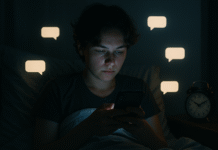
- Avoid interactive content close to bedtime (notifications, intense games).
- If you must read, prefer paper or e-ink over bright tablets; bright evening e-readers can delay circadian timing.
Bottom line: Night modes are secondary; reducing brightness and exposure is what counts.
8. What about migraines and light sensitivity—different story?
Yes, and it’s not the same product. For migraine-related photophobia and blepharospasm, FL-41 (rose/amber) tints—not generic “blue-light” coatings—have supportive evidence for reducing light sensitivity and, in some cases, attack frequency. Clinical sources suggest FL-41 for photophobia; small randomized and crossover studies report improvements in blink rate, discomfort, and daily function. These lenses target specific wavelengths linked to hypersensitivity and can be helpful between attacks.
8.1 Tools/Examples
- FL-41: rose tint filtering bands that aggravate photophobia; evidence in migraine and benign essential blepharospasm.
- Specialized notch filters: research lenses designed for ipRGC pathways; emerging evidence. PMC
Bottom line: If your goal is migraine photophobia relief, seek FL-41/specialized tints, not standard blue-light marketing lenses. Discuss with an eye-care professional.
9. If you still want blue-light glasses, how should you choose and use them?
Match the tool to the task. For daytime comfort at a desk, typical clear “blue-filter” lenses won’t fix strain; invest in ergonomics. For evening circadian goals, choose lenses that explicitly attenuate through ~480 nm and wear them consistently in the 2–3 hours before sleep—alongside lower lighting and reduced screen use.
9.1 Mini-checklist (buying & using)
- Demand a spectral transmittance report; avoid vague claims.
- Look for evidence of reduced melanopic stimulus (per CIE S 026 metrics).
- Understand that many clear coatings cut only ~20–40% of short wavelengths; amber blocks more but shifts color perception.
- For sleep, pair glasses with dim lighting and a device curfew.
- For migraines/photophobia, ask specifically about FL-41 or specialty tints.
Bottom line: Use specs and context to decide—then combine with behavior changes for best results.
FAQs
1) Are blue-light glasses safe to wear all day?
Generally yes; they’re simply filters. But for some tasks (color-critical work, sports), heavy attenuation can subtly affect color/motion perception. If you notice issues, switch to task-specific eyewear or remove the tint for daytime driving and design work.
2) Will blue-light glasses prevent macular degeneration?
No evidence supports that claim for normal screen use. Eye-disease risk reduction leans on UV protection outdoors, not indoor blue-filtering. Don’t buy them as “retina insurance.”
3) How much blue light do typical lenses block?
Many clear “blue-filter” lenses reduce roughly 20–40% in the 400–440 nm band; impact on the melanopic 460–480 nm band (most relevant for sleep) may be limited unless the lens is amber/darker. Specifications vary widely—ask for lab data.
4) Do children need blue-light glasses for online school?
Pediatric groups emphasize regular breaks, daylight exposure, and good sleep routines over special lenses. If your child has headaches or visual symptoms, seek an exam rather than relying on coatings.
5) Is Dark Mode good for my eyes at night?
It can feel gentler in dim rooms, but benefits come mainly from lower brightness and reduced exposure time. Dark Mode or Night Shift alone hasn’t consistently improved sleep outcomes.
6) What’s the difference between “blue-filter,” “blue-blocking,” and FL-41?
“Blue-filter” often means modest coating on clear lenses; “blue-blocking” is a loose term and should mean strong attenuation (often amber). FL-41 is a specific rose tint used for photophobia/migraine and isn’t the same as generic blue-filter coatings.
7) If I game or code late, will glasses fix my sleep?
They may help a little if they substantially reduce melanopic light, but you’ll still do better by dimming displays, cutting session length, and ending screens earlier. Content arousal and bright room light also delay sleep.
8) Can blue-light glasses cause harm?
Direct harm is unlikely. Potential downsides are cost, color shifts, and false security (you skip breaks or keep screens brighter/longer). For visually demanding tasks, heavy tints may alter color judgments or motion perception slightly. Nature
9) Do night-shift workers benefit?
Some protocols use amber glasses during the commute home and before daytime sleep to minimize circadian disruption. Efficacy depends on lens strength and environmental control (darkened bedroom). Discuss with a clinician if shift work affects your sleep.
10) What should I buy if migraines and light sensitivity are my main issues?
Ask your provider about FL-41 or specialized notch-filter lenses rather than generic blue-filter coatings. These have the most relevant evidence for photophobia relief.
Conclusion
Blue-light blocking glasses sit at the intersection of biology, behavior, and marketing. The best-quality evidence to date indicates that, for digital eye strain, they provide little to no benefit over standard lenses; eye comfort improves more with breaks, brightness control, and workstation ergonomics. For sleep, results are mixed: high-attenuation amber lenses worn consistently in the evening can help in some settings, but changes to light environment and device use are still the primary levers. And for photophobia/migraine, specialized tints like FL-41—not typical “blue-filter” coatings—have the most supportive data.
If you like how blue-filter lenses feel, there’s no harm in using them. But buy them for the right reasons: understand what spectral band truly matters, ask for real transmission data, and pair them with behavior that respects your eyes and your circadian clock. For most people, that means: schedule regular breaks, dim and warm your evening light, and put the phone down earlier.
CTA: Ready to build a sleep-friendly evening light routine? Start tonight: dim the room, set a 2-hour device curfew, and—only if needed—add a high-attenuation amber lens.
References
- Blue-light filtering spectacle lenses for visual performance, sleep, and macular health in adults (Cochrane Review). Cochrane Library. Aug 18, 2023. Cochrane Library
- Blue-light filtering spectacles probably make no difference to eye strain, eye health or sleep. Cochrane (News). Jul 26, 2023. Cochrane
- Digital Devices and Your Eyes. American Academy of Ophthalmology. Oct 15, 2024. American Academy of Ophthalmology
- Bigalke JA et al. Effect of evening blue light blocking glasses on subjective and objective sleep in healthy adults: A randomized control trial. Sleep Health. 2021;7(4):485–490. PubMed
- Shechter A et al. Blocking nocturnal blue light for insomnia: A randomized controlled trial. Sleep. 2018;40(2). PMC
- Liset R et al. A randomized controlled trial on the effects of blue-blocking glasses on sleep outcomes among nulliparous women. PLOS ONE. 2022. PLOS
- CIE S 026 α-opic framework (Tutorial/User Guide). International Commission on Illumination (CIE). 2020–2021. ; https://files.cie.co.at/CIE%20S%20026%20alpha-opic%20Toolbox%20User%20Guide.pdf CIE Files
- Schlangen LJM & Price LLA. The lighting environment, its metrology, and non-visual effects—introducing CIE S 026. Clocks & Sleep. 2021. PMC
- Rahmani S et al. How much of hazardous blue light is transmitted by blue-blocking coated lenses? Med Hypothesis Discov Innov Optom. 2020. PMC
- O’Hagan JB et al. Low-energy light bulbs, computers, tablets and the blue light hazard. Eye. 2016;30:230–233. PMC
- Cougnard-Grégoire A et al. Blue Light Exposure: Ocular Hazards and Prevention—A Narrative Review. Life (Basel). 2023;13(2):560. PMC
- Duraccio KM et al. Does iPhone Night Shift mitigate negative effects of smartphone use on sleep outcomes in emerging adults? Sleep Health. 2021. PubMed
- Chang A-M et al. Evening use of light-emitting eReaders negatively affects sleep, circadian timing, and next-morning alertness. PNAS. 2015. PNAS
- AAO EyeNet: What Ophthalmologists Need to Know About Migraine (FL-41 recommendation). American Academy of Ophthalmology. Sep 1, 2022. American Academy of Ophthalmology
- Blackburn MK et al. FL-41 tint improves blink frequency and light sensitivity in benign essential blepharospasm. Ophthalmology. 2009. PMC
- 20-20-20 Rule & Computer Vision Syndrome guidance. American Optometric Association. 2022–2024. ; https://www.aoa.org/AOA/Images/Patients/Eye%20Conditions/20-20-20-rule.pdf American Osteopathic Association
- Gooley JJ et al. Exposure to room light before bedtime suppresses melatonin onset. J Clin Endocrinol Metab. 2010. PMC
- Glickman GL et al. Optimizing the potential utility of blue-blocking glasses for sleep and circadian health. Transl Vis Sci Technol. 2025. https://tvst.arvojournals.org/article.aspx