

























Evenings run smoother when wind-down time is simple, screen-light friendly, and genuinely soothing. Drawing or coloring for evening relaxation means using low-stakes, no-pressure art—on paper or a dimmed, e-ink-style device—to downshift your nervous system before bed. Done right, it becomes a reliable cue: you sit, color or sketch for 10–30 minutes, breathe evenly, and the mind follows the body into calm. In the next sections, you’ll learn practical, evidence-informed ways to make this habit easy, enjoyable, and sleep-supportive.
Quick start (5 steps): choose a warm lamp (around 2700K), lay out pencils and one book or blank pad, set a 20-minute timer, breathe slowly while you color or sketch, and finish with two minutes of quiet before lights-out. Note: This guide is educational, not medical advice. If you’re dealing with persistent insomnia, anxiety, or depression, consult a qualified professional.
1. Set Up a Low-Stress Art Corner That Invites Nightly Use
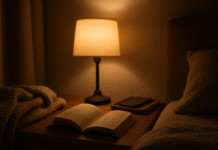
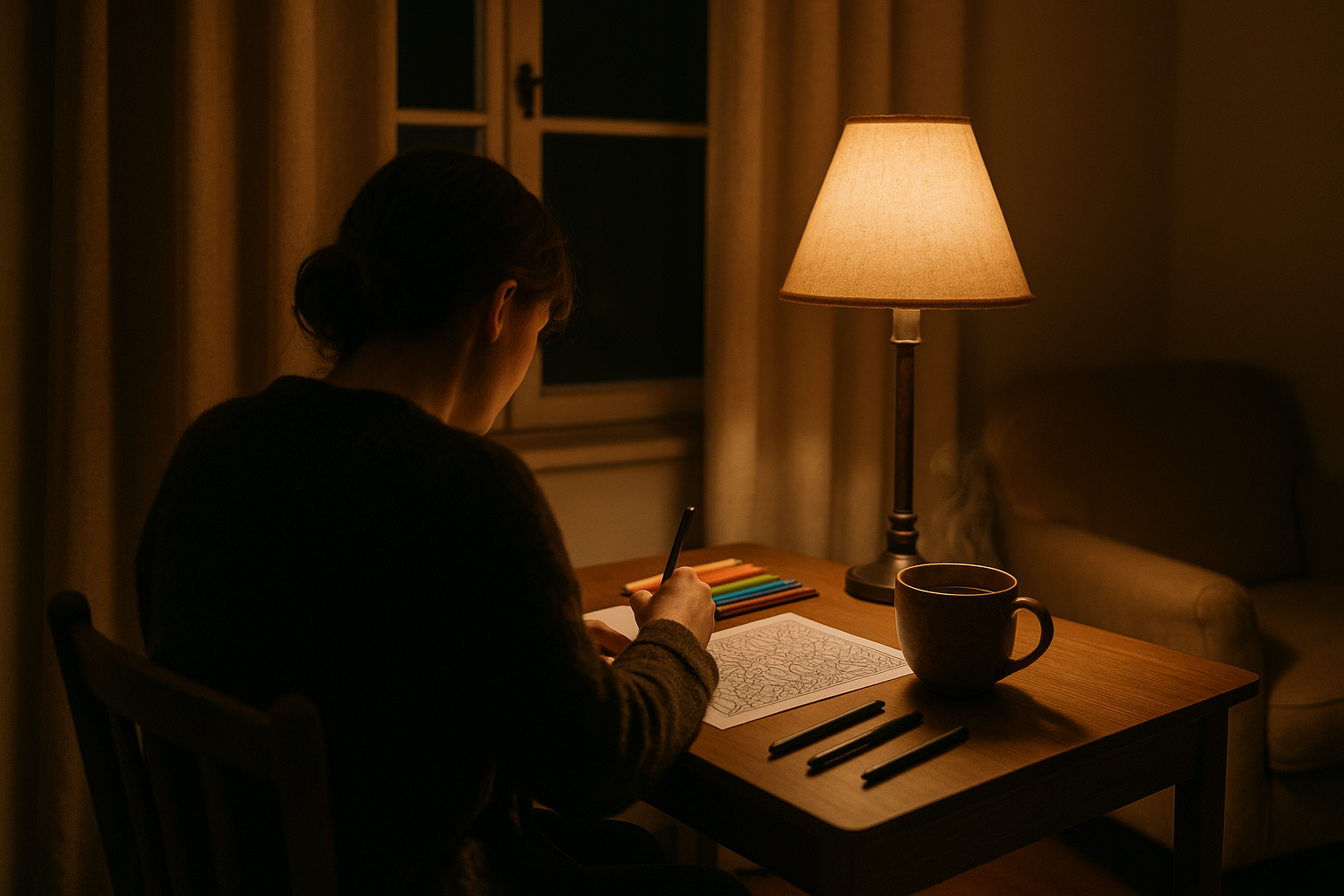
A dedicated, cozy corner removes friction and primes your brain to relax as soon as you sit down. Place a comfortable chair, a small table, and a warm (≈2700K) bedside-style lamp so you’re not bathing in bright, blue-heavy light that can delay sleep. Keep one or two materials visible—say, a coloring book and a tin of pencils—so choice overload doesn’t creep in when you’re tired. Add a small tray for a chamomile or decaf tea and consider light instrumental music at low volume. The goal isn’t artistic output; it’s creating a repeatable cue-routine that says, “the day is ending,” so your body can exhale.
1.1 Why it matters
- Habit friction is the enemy at night. If supplies are buried in a closet, you’ll skip the ritual.
- Lighting influences melatonin. Warmer, dimmer light supports wind-down better than bright, blue-rich light (as of Aug 2025, major sleep orgs still advise minimizing blue light in the hour before bed).
- Consistency teaches your nervous system: same chair, same lamp, same time = safety and predictability.
1.2 Numbers & guardrails
- Light level: aim for ~100–200 lux at the page (cozy reading-lamp territory).
- Color temperature: ~2700K (warm white).
- Materials in reach: 1 book + 1 pad + 1 set of pencils—that’s it.
- Session length: 10–30 minutes.
Mini-checklist
- Clear table surface daily.
- Keep a sharpener and eraser in a small cup.
- Put your phone in another room or on airplane mode.
- End with two slow breaths and lights off.
Finish the space with a tiny routine—switch lamp on, open the same book—to create a reliable glide path to bed.
2. Try a 20-Minute Mindful Coloring Protocol (Timer On, Mind Soft)
If you like structure, this protocol gives a clear beginning and end. Set a 20-minute timer, choose a page with medium complexity, and color slowly while noticing breath, grip, pressure, and color transitions. The aim is gentle focus, not perfection. Research suggests that both coloring and free drawing can help settle anxious arousal for many people; the key is the low-stakes, immersive nature of the task rather than artistic skill. Stop when the timer ends—even mid-leaf—to train a predictable shut-down that dovetails with bedtime.
2.1 How to do it
- Minute 0–2: Scan body; loosen jaw and shoulders; take three slow breaths.
- Minute 2–15: Color edges first, then fill; narrate sensations silently (“cool wax, steady strokes”).
- Minute 15–18: Shift to larger areas or a second color to keep flow.
- Minute 18–20: Soften grip; choose one small area to finish neatly; close the book.
2.2 Common mistakes
- Chasing completion (“I’ll just finish this page…”), which keeps you up.
- Complex designs that spike effort at night.
- Harsh self-talk about staying inside lines; reframe to “steady and slow is enough.”
Wrap up by rating calm 1–5; if it’s below 3, shorten page complexity next time.
3. Use Free Drawing to “Empty the Head” (No Rules, Just Lines)
Free drawing—blank paper, no plan—can offload mental clutter as effectively as structured coloring, and sometimes more so. Start with a date at the top of the page, then fill the paper with lines, shapes, or loose forms that match your mood. If thoughts intrude, translate them to marks (“tight zigzags” for tension, “soft curves” for relief). You’re not creating a keepsake; you’re de-pressurizing the system. Some studies find no clear superiority of mandala coloring over free drawing; both are viable pathways to calm. Choose the one that feels easiest tonight.
3.1 Tools & examples
- Pens: 0.3–0.7 mm fineliners for glide; one dark, one gray.
- Paper: A4 sketchpad or a simple notebook you don’t mind “messing up.”
- Mini case: After a long day, spend 12 minutes in looping lines, then 5 minutes shading a corner darker to “contain” left-over energy.
3.2 Mini-checklist
- Set a 15–25 min timer.
- No erasing; convert “mistakes” into texture.
- End by writing one word at the bottom: lighter, steady, or still working.
Close the pad, and let “good enough” be your last creative act for the day.
4. Explore Mandala Coloring or Pattern Repetition (With Realistic Expectations)
Repetitive motifs—mandalas, tessellations, stripes—can be soothing because they reduce decision-making and encourage rhythmic motion. Early studies reported anxiety reductions with mandala coloring, and many people find it comforting. More recent reviews suggest free drawing can be just as effective, so treat mandalas as one helpful option rather than a magic bullet. In the evening, choose mid-complex designs so your eyes and hands can move calmly without over-focusing on tiny details.
4.1 How to do it
- Pick a medium-complex mandala (not micro-detailed).
- Limit to 2–3 colors per ring to reduce decisions.
- Use light pressure; watch the pace of your hand rather than the outcome.
- Pause every 5 minutes to relax the shoulders and uncurl fingers.
4.2 Numbers & guardrails
- Duration: 15–25 minutes works well for most.
- Colors: stay with warmer palettes at night if you’re sensitive to stimulation.
- Perfection trap: a smudged line is a cue to slow down, not to redo the page.
If it feels rigid or stressful, switch to free drawing—effectiveness is personal, not universal.
5. Sketch a Memory of Nature to Bring Calm Indoors
Nature imagery often feels safe and steady, making it ideal wind-down material. You don’t need a reference photo at night; instead, sketch from memory: the curve of a local hill, the outline of a favorite tree, or waves you once watched. Memory-based sketching nudges attention inward, reduces screen use, and creates a gentle visual “mantra.” Focus on large shapes and the “gesture” of the scene rather than exact detail.
5.1 How to do it
- Close your eyes for 30 seconds and recall a specific place: the light, the air, the dominant shapes.
- Draw three big forms only (e.g., horizon line, tree mass, foreground).
- Add two textures (short dashes for grass, flowing arcs for water).
- Optional: layer one color family (ochres, olives, or soft blues) lightly over pencil.
5.2 Mini-checklist
- Keep strokes slow and long to match breath.
- Avoid tiny details after 9 p.m. if they make you chase accuracy.
- Finish by writing the location’s name; close the book, lights dim.
You’ll build a quiet mental gallery you can revisit without a screen.
6. Make Three “Gratitude Tiles” (Small, Quick, Satisfying)
When energy is low, tiny formats keep the ritual alive. Cut a page into three 5×5 cm squares (or draw three boxes), and dedicate each tile to one thing you appreciated today: a conversation, a taste, a breeze. Draw a small symbol or pattern for each—no words needed. This concentrates attention on positive micro-events, nudging mood without effort or analysis.
6.1 How to do it
- Draw three boxes; label them 1–3 in pencil.
- For each tile, add one icon (e.g., cup for tea), one pattern (dots, stripes), and one color wash.
- Keep total time to 10–12 minutes.
6.2 Common pitfalls
- Over-explaining with text (keep it visual).
- Turning tiles into a perfection project.
- Skipping on “bad days”; that’s when one tile matters most.
End by arranging the tiles side-by-side; notice the day had bright spots—even small ones.
7. Sync Lines to Breath (A Simple, Evidence-Aligned Calming Drill)
Breath-paced line drawing pairs slow respiration with repetitive marks for a doubly soothing effect. Choose a count you like (e.g., 4-in, 4-hold, 6-out) and draw a line for each phase—up on inhale, small pause dot, down on exhale. Metronomic lines and gentle breath can lower arousal and ease the shift to sleep, and breathwork in general shows small-to-moderate benefits for stress and mood in emerging research. Keep strokes fluid and shoulder muscles soft.
7.1 How to do it
- Set a 5-minute timer; repeat for another 5 if helpful.
- Use a soft pencil or brush-pen that rewards light pressure.
- Pair the exhale with the longer mark; let the inhale be shorter.
7.2 Numbers & guardrails
- Try 4-2-6 or 4-0-6 counts; adjust if you feel air hunger.
- Keep head and neck neutral; rest forearms on the table.
- If you feel dizzy, stop and return to normal breathing.
Close the page by shading a small rectangle as a “full-stop,” then move to bedroom lighting.
8. Storyboard Your Day in 3–4 Panels to Offload Rumination
Rumination—replaying moments—is a common bedtime blocker. A micro-storyboard reframes the day visually, giving your brain a satisfying sense of closure. Divide a page into four boxes: one highlight, one challenge, one thing you learned, and one thing you’re letting go. Stick figures are perfect; arrows and symbols carry meaning efficiently. The point is containment: you’ve acknowledged the day, learned from it, and put it to bed.
8.1 How to do it
- Box 1: draw the highlight (a smile, a slice of cake).
- Box 2: draw the challenge with a label like “tough meeting.”
- Box 3: sketch a lesson icon (lightbulb, toolbox).
- Box 4: draw a trash can or leaf on a stream for what you’re releasing.
8.2 Mini-checklist
- Limit words to <10 across the page.
- Use one pen + one colored pencil.
- Cap the practice at 15 minutes, then lights-down.
You’ll wake lighter because yesterday’s story has a clear last panel.
9. Use a Sleep-Friendly Palette and Page Scale
Color choice and page scale influence how stimulating a session feels. At night, warmer, lower-saturation palettes (ochres, moss, plum, terracotta) and medium page scales (A5–A4 areas) often feel calmer than neon brights and micro-details. Combine a warm lamp with soft colors and you’ll avoid eyestrain and the urge to “finish everything,” which keeps the session contained.
9.1 How to do it
- Pre-select 6 pencils in a tray: 2 warms (e.g., burnt sienna, coral), 2 earths (olive, umber), 2 neutrals (grey, cream).
- Choose pages with mid-sized shapes; avoid postage-stamp patterns late at night.
- Layer color lightly; two passes beat one heavy press.
9.2 Numbers & guardrails
- Limit palette to 3 colors per page after 9 p.m.
- Keep total time to 15–25 minutes.
- If your eyes feel buzzy, switch to graphite or a single muted pencil.
A calmer palette + medium scale = fewer decisions and a smoother descent.
10. Color Together (Partner, Roommate, or Child) for Soft Social Calm
Coloring alongside someone—quietly—can add connectedness to your routine without turning on conversation. Share a book or each use your own page; agree to minimal chatting and a shared end time. Parents can anchor kids’ bedtime with a joint 10-minute page, then transition them to bed while you finish your own wind-down. For couples, it’s a calm check-in that avoids screens and doomscrolling.
10.1 How to do it
- Agree on 10–20 minutes and a “whisper rule.”
- Use a small sand timer kids can watch.
- End with each person pointing to one favorite color on the page—no critiques.
10.2 Guardrails
- Keep the table device-free; phones parked elsewhere.
- If energy spikes (excited chatter), lower light and slow hands.
- Avoid competitive pages (“who finishes first?”); choose cooperative designs.
Shared quiet activity can be the kindest bridge from busy evenings to bed.
11. Choose Paper Over Bright Screens at Night (Or Make Digital Sleep-Smart)
Paper is usually the safer bet near bedtime because bright, blue-weighted screens can suppress melatonin and shift circadian timing. If you prefer digital, choose e-ink tablets or enable strong night modes, lowest brightness, and color-shifting to amber. Use a stylus to keep posture open and shoulders relaxed. The goal is creative flow with minimal light exposure so your brain still gets the “night signal.”
11.1 How to do it (digital)
- Night mode maxed, brightness minimal.
- Use dark canvas + muted brushes.
- Cap sessions at 15–20 minutes; avoid social media detours by opening only the drawing app.
11.2 Numbers & guardrails
- If you’ve had trouble falling asleep, keep screens out of the last hour; switch to paper entirely.
- Prefer warm desk lamps over ceiling LEDs.
- As of Aug 2025, sleep orgs broadly advise limiting blue-light exposure before bed; digital is okay if managed conservatively.
If digital tweaks feel like a hassle, embrace paper at night and save tablets for daytime creativity.
12. End with a Transition Ritual: Clear, Breathe, Lights Out
A clean ending prevents “one more color” creep. When the timer dings, stop immediately, date the page, and put pencils back in the tin. Take two slow breaths, sip water, and switch off the lamp. If thoughts start swirling, place your hand flat on the page and trace a rectangle once, slowly—your last line of the night. This closing ritual tells your nervous system the session is complete and bedtime begins now.
12.1 Mini-checklist
- Date the page; close the book.
- Two slow breaths (count 4-6 out).
- Lamp off; walk to bed without checking a device.
- If you wake later, repeat one minute of breath-paced lines by nightlight and return to bed.
Consistency here is everything: clear finish, same steps, same calm.
FAQs
1) How long should evening drawing or coloring sessions be?
Most people settle well with 10–30 minutes. If you’re wired, start at 10 to prove you can stop, then widen to 20–25 as it becomes automatic. The final five minutes should feel slower than the first—if you’re speeding up, you’re chasing completion. Keep a timer on; stopping on time trains your brain that bed follows art.
2) What materials are best for night sessions?
Choose quiet, low-mess tools: colored pencils, brush-pens, and a simple sharpener. Graphite is great when color feels stimulating. Keep one book and one pad visible to avoid decision fatigue. For digital, prefer e-ink or night-mode tablets on lowest brightness; if managing settings feels like work, stick to paper in the last hour.
3) Does adult coloring really reduce anxiety?
Evidence is mixed but promising. Early studies found reductions in state anxiety after short coloring sessions, and small art-making studies show drops in stress-related hormones. Newer analyses suggest free drawing can work as well as mandala coloring, so effectiveness seems individual. The practical takeaway: use the form that feels easier tonight, and judge by how calm you feel afterward.
4) I “can’t draw.” Will this still help?
Yes. The calming effect comes from gentle focus + repetitive motion, not artistic skill. Stick figures, simple patterns, or coloring books deliver the same wind-down benefits. If a blank page creates pressure, start with coloring; if coloring feels rigid, try scribble-drawings or gratitude tiles. No grades, no sharing required.
5) Is digital drawing okay before bed?
It can be, but manage light. Bright, blue-rich screens can delay melatonin and push sleep later. Use night mode, lowest brightness, and shorter sessions (≤20 minutes). Better yet, use e-ink devices. If you’re struggling with sleep onset, move digital art earlier in the evening and switch to paper for the final hour.
6) What if I get perfectionistic or frustrated?
Shrink the scope. Choose mid-complex pages, limit to 3 colors, or use small tiles. Set a non-negotiable end time. Try free drawing with rules that invite imperfection (“no erasing,” “one continuous line”). The aim is a soothed nervous system, not a gallery piece.
7) Can kids color with me at night?
Yes—and it can anchor their bedtime too. Keep it short (8–12 minutes), use a sand timer, and agree to “quiet hands, quiet voices.” Let them choose a single page and one favorite color. End with a predictable step (book or song). After tucking them in, do your own brief session to transition yourself.
8) Should I listen to music while I color?
Light instrumental music can be soothing at low volume. Avoid lyrics if they pull attention or trigger rumination. Keep it consistent—same playlist can become an auditory cue that bedtime is near. If music makes you linger, try silence or soft ambient sounds (fan, rain).
9) How often should I do this?
Aim for most nights, even five minutes on hectic days. Consistency beats duration. Pair the ritual with an anchor (brush teeth → lamp on → 15 minutes coloring → lights out). If you skip a night, restart without “catching up.”
10) When should I talk to a professional?
If you have persistent insomnia (trouble three nights a week for 3+ months), frequent nightmares, or daytime impairment, seek clinical guidance. Coloring and drawing are supportive habits, not treatments for underlying sleep disorders. Cognitive-behavioral therapy for insomnia (CBT-I) and medical evaluation can address root causes while you maintain calming routines.
Conclusion
Evening creativity works because it’s tactile, repetitive, and low-stakes—the opposite of our high-stimulation days. By choosing warm light, simple tools, and a predictable timer, you build a tiny sanctuary that reliably settles your body and mind. Whether you favor mindful coloring, free drawing, gratitude tiles, or breath-paced lines, the common thread is ease: fewer decisions, gentler focus, and a clean finish. Over a few weeks, the ritual becomes a cue your nervous system recognizes: the day is closing, it’s safe to soften, sleep is near. Start small tonight—ten minutes, one page, one warm lamp—and let practice, not willpower, do the heavy lift.
CTA: Pick one method above, set a 20-minute timer, and color your way toward lights-out tonight.
References
- Curry, N. A., & Kasser, T. (2005). Can Coloring Mandalas Reduce Anxiety? Art Therapy: Journal of the American Art Therapy Association. https://files.eric.ed.gov/fulltext/EJ688443.pdf
- Kaimal, G., Ray, K., & Muniz, J. (2016). Reduction of Cortisol Levels and Participants’ Responses During Art Making. Art Therapy. https://pmc.ncbi.nlm.nih.gov/articles/PMC5004743/
- Harvard Health Publishing. (2024, July 24). Blue light has a dark side. https://www.health.harvard.edu/staying-healthy/blue-light-has-a-dark-side
- Sleep Foundation. (2025, July 22). How to Build a Better Bedtime Routine for Adults. https://www.sleepfoundation.org/sleep-hygiene/bedtime-routine-for-adults
- National Sleep Foundation. (2025). Sleep Tips. https://www.thensf.org/sleep-tips/
- Jakobsson Støre, S., et al. (2022). The Effect of Mandala Coloring on State Anxiety: A Meta-Review. Art Therapy. https://www.tandfonline.com/doi/full/10.1080/07421656.2021.2003144
- American Art Therapy Association. (n.d.). What is Art Therapy? https://arttherapy.org/what-is-art-therapy/
- NHS. (2025, Jan 10). Sleep problems and insomnia self-help guide. https://www.nhsinform.scot/illnesses-and-conditions/mental-health/mental-health-self-help-guides/sleep-problems-and-insomnia-self-help-guide/
- WHO. (2020). Doing What Matters in Times of Stress: An Illustrated Guide. https://iris.who.int/bitstream/handle/10665/331901/9789240003910-eng.pdf
- Harvard Health Publishing. (2021, Oct 26). Can blue light-blocking glasses improve your sleep? https://www.health.harvard.edu/blog/can-blue-light-blocking-glasses-improve-your-sleep-202110262625