

















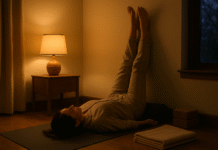




When your mind won’t switch off, visualization gives it something soothing to do. These exercises use guided imagery to steer attention away from worry and toward calm, lowering pre-sleep mental “noise” so your body can follow into rest. In practice, you imagine simple, sensory-rich scenes—like floating clouds or a lit candle—and let your breath sync with the image. In one line: visualization exercises are structured mental pictures that quiet racing thoughts so you can fall asleep more easily. To start tonight, pick one exercise, dim the lights, and follow a short script for 3–10 minutes.
Before we begin, a brief note: this article is educational—not medical advice. If you’ve had long-term insomnia, frequent nightmares, trauma, or a sleep disorder, talk with a qualified clinician. Many people combine visualization with cognitive behavioral therapy for insomnia (CBT-I) or relaxation methods as part of a broader plan, as supported by sleep-medicine guidelines (as of August 2025).
Quick start steps (for any exercise):
- Sit or lie down on your side or back; loosen your jaw and shoulders.
- Close your eyes and take 3 slow breaths through the nose, longer exhale than inhale.
- Picture the scene; name what you “see,” “hear,” “feel,” “smell.”
- If thoughts intrude, notice them, then gently return to your scene.
- Continue 3–10 minutes, then let the image fade and stay with the breath.
1. The Safe-Place Scene
The safe-place scene works by giving your mind a steady, pleasant focal point that competes with worry and sets a relaxed tone for sleep. You choose a location—real or imagined—where you feel secure, such as a quiet beach at dusk, a sun-lit forest clearing, or your grandmother’s kitchen. Start by stating, “I am safe here,” then layer in sights, sounds, temperatures, and textures until the picture feels immersive. This exercise is especially helpful if bedtime triggers restlessness or if your thoughts jump between unfinished tasks. Because the content is self-chosen and soothing, it reduces cognitive arousal and gently cues the parasympathetic (rest-and-digest) response. Do it nightly for a week to make the scene easy to “load,” like a favorite playlist.
1.1 Why it matters
When the brain has a simple, consistent target, it spends less energy scanning for threats or replaying the day. A safe-place image also helps regulate breathing and heart rate as you match your breath to the imagined environment (e.g., waves, wind in trees).
1.2 How to do it (3–5 minutes)
- Pick one place you truly like. Keep the same place for several nights.
- State a grounding phrase: “Right now I am safe, warm, and supported.”
- Add sensory layers: colors, temperature, sounds, scents, textures.
- Sync breath with a repeating feature (e.g., one wave per inhale, exhale).
- If thoughts intrude, imagine placing them in a “drift bottle” that floats away.
Mini-checklist: Comfortable posture; one sentence of reassurance; at least three senses; a rhythmic element to pace your breath.
Close by reminding yourself that you can return to this place anytime—consistency makes it more vivid and effective.
2. The Cloud Conveyor Belt
The cloud conveyor belt teaches your mind to let go of intrusive thoughts without wrestling with them. You picture a slow-moving sky where each thought lands on a soft cloud that glides across your vision and exits the frame. The first one or two sentences set the rule: “Thoughts are clouds; my job is to notice and release.” This reframes mental chatter as passing events rather than problems to solve. It’s ideal for nights when lists, worries, or planning loops keep restarting, because it de-centers you from the content and anchors you to a gentle visual rhythm.
2.1 Steps to practice
- Imagine a horizon; set the speed (e.g., one cloud per full breath cycle).
- Label thoughts lightly: “planning,” “worry,” “memory,” then place each on a cloud.
- Watch the cloud move left to right; avoid zooming in on details.
- If a cloud stalls, picture a breeze resuming its motion.
- After 10–15 clouds pass, soften the image and rest in quiet.
2.2 Common mistakes
- Chasing content: Solving the thought defeats the exercise. Label and release.
- Too fast: If clouds zip by, your breath will speed up. Slow the belt.
- Judging the mind: The goal isn’t zero thoughts; it’s ease with their passing.
Mini case: Amara, 32, used the conveyor belt after late-night work sprints. In a week, she went from 40+ minutes of tossing to under 15, simply by running the belt for five minutes and not picking any thought back up. This section ends with a reminder: letting go isn’t avoidance—it’s timing. You can revisit tasks tomorrow.
3. Body Scan With Color Wash
This hybrid uses visualization to deepen a body scan: a gentle “sheet of light” or “color wash” travels from head to toe as you breathe. The image gives the mind something clear to follow while the scan releases muscle tension—a two-for-one for mental and physical calm. Start with a neutral color (soft gold, pale blue), then imagine it pouring slowly over the scalp, behind the eyes, down the neck, across the shoulders, and through the limbs, pooling warmly in the hands and feet. Each pass lengthens the exhale, which many people find naturally sedating near bedtime.
3.1 Numbers & guardrails
- Duration: 5–8 minutes (one slow pass is ~2–3 minutes; repeat 2–3 times).
- Pace: About one body region per exhale.
- If you have migraines or visual sensitivity, choose softer hues and move slower.
3.2 How to do it
- On inhale, gather the color at the top of the head; on exhale, let it wash down.
- Name brief sensations without judgment: “warm,” “heavy,” “soft,” “loose.”
- If you meet tension, imagine the color “soaking” the muscle for two breaths.
- End by letting the color fade to a dark, comfortable “lights-out” tone.
Mini-checklist: Dim room, phone out of reach; slower exhale than inhale; two full passes; end with quiet. The synthesis: pairing imagery with scanning keeps your attention engaged long enough for the body to catch up and relax.
4. The Whiteboard Wipe
The whiteboard wipe turns overthinking into an easy erasing task. Picture a clean whiteboard in front of you; each lingering thought appears as a short phrase written in dry-erase marker. You pick up an eraser and wipe the board clean in sync with your breath. This converts cognitive load into a simple motor image, which is surprisingly effective at cutting rumination. It’s especially useful for perfectionists who feel compelled to “finish” every thought, because the rules are visual and finite: notice, write, wipe, clear.
4.1 How to do it (stepwise)
- Inhale: a phrase appears (“budget review,” “text back,” “what if…”).
- Exhale: erase the phrase from left to right; watch the particles vanish.
- After three wipes, spray and clean the board until it shines.
- If a phrase returns, reduce it to a single word, then wipe again.
- Finish with a blank board; turn it face-down and slide it away.
4.2 Tools/Examples
- Timer: 3–5 minutes is enough; set a silent countdown so you don’t clock-watch.
- Variation: Use a chalkboard, window, or tablet—any surface you can “clear.”
- Example: “Email to Ravi” → wipe. “Meeting agenda” → wipe. “Flight booking” → wipe.
Close with one intentional replacement image: a plain dark screen or a closed curtain. This tells your brain that “work mode” has ended for the day.
5. Candle Flame Focus (Real or Imagined)
The candle flame focus narrows attention to a single, steady point—either an actual candle for a minute or two before lights out, or an imagined flame once you’re in bed. The soft flicker and warm color naturally slow breathing, and the tiny sway provides just enough motion to keep your mind engaged without wandering. If you prefer not to use a real candle, visualize one at eye level: a small, steady flame with a glow radius the size of your palm. Match your inhale and exhale to the flame’s gentle rise and fall.
5.1 Safety & setup
- If using a real candle, practice away from bed, on a stable surface, and blow it out before lying down.
- Switch to an imagined flame once you’re horizontal.
- Keep lighting low; avoid staring until eyes water—comfort first.
5.2 How to do it (imagery version)
- Picture a candle 1–2 meters away; the flame is bright but not harsh.
- Inhale: the flame leans slightly; exhale: it steadies and shrinks.
- If thoughts arise, place them into the wax pool where they melt away.
- After 20–30 breaths, let the flame dim to embers, then to darkness.
Mini-checklist: Warm color, gentle sway, clear “lights-out” ending. Bottom line: a tiny, friendly focal point gives your attention a home so it doesn’t go looking for problems.
6. The 3-2-1 Memory Walk
The memory walk uses a real, well-known route to anchor you—your front path, a favorite trail, or a corridor at work—then overlays a 3-2-1 sensory game to quiet the mind. Because the locations are familiar, your brain needs little effort to render them; the added counting structure prevents detours into planning. It’s perfect for people who “solve” tomorrow’s tasks at night or replay awkward moments, because the rule set is simple and the destination (your bed) is clear.
6.1 How to do it
- Choose a short route with 6–10 landmarks (door, mailbox, tree, stair, desk).
- At Landmark 1, name 3 things you can “see.”
- Landmark 2: 2 soft sounds you can “hear.”
- Landmark 3: 1 pleasant texture you can “feel.”
- Repeat the 3-2-1 cycle until you “arrive” at a calm resting spot.
6.2 Numbers & pacing
- Total time: 5–7 minutes; don’t rush.
- If you get stuck, jump ahead one landmark—momentum over perfection.
- End by lying down in your imagined room and dimming the “lights.”
Mini-checklist: Familiar route, 3-2-1 sensory loop, gentle pace, clear arrival. The synthesis: structure + familiarity lowers effort, leaving less fuel for rumination.
7. Night-Sky Breathing
Night-sky breathing turns each inhale and exhale into a star that brightens and fades across a dark, velvety sky. The darkness cues sleep, while the tiny points of light keep you engaged. This is a great pick if the room is already dark and you want a visualization that blends seamlessly into drifting off. Begin by picturing a blank night sky behind your closed eyes; on each inhale, a single star appears; on each exhale, it twinkles once and softens.
7.1 How to do it
- Inhale: one star appears anywhere in the sky.
- Exhale: it twinkles and dims a little.
- Every fifth breath, draw a thin constellation line connecting two stars.
- After 20–40 breaths, let the whole sky soften to a gentle dark blue.
- Optional: imagine a crescent moon rising and setting with your last breath.
7.2 Common pitfalls & fixes
- Too busy: If you add galaxies and planets, the scene becomes stimulating. Keep it simple.
- Counting pressure: If counting stresses you, switch to “handfuls” of stars (roughly five).
- Restless body: Place one hand on the belly to feel each breath while you watch the sky.
Mini-checklist: Few elements, slow twinkles, fade to darkness. The essence: darkness plus small, steady visuals bring you right to the edge of sleep.
8. Imagery Rehearsal for Recurrent Nightmares (Gentle Version)
If nightmares or recurring distressing images disturb your nights, a gentle form of imagery rehearsal can help. The core idea is to rewrite the troubling scene into a safer, more neutral version while you’re awake, then rehearse that new script for a few minutes daily—especially before bed. Over time, your brain learns an alternative pathway, reducing nightmare frequency and intensity. For home practice, keep changes modest and soothing; for trauma-related nightmares or severe distress, work with a clinician experienced in imagery rehearsal therapy (IRT).
8.1 How to do it (daytime + bedtime)
- Daytime (5–10 minutes): Write the nightmare’s outline, then change one or two key elements to make it safe (e.g., add a helper, move to daylight, change the ending).
- Read the new script aloud slowly; close your eyes and visualize it twice.
- Bedtime (3 minutes): Re-imagine only the changed version, not the original.
- If the old image appears, cut the scene like a film editor and restart the new ending.
- Practice daily for 1–2 weeks and reassess.
8.2 Guardrails & when to seek help
- If images are linked to trauma, do this under professional guidance.
- Keep edits comforting, not confrontational; soothing tends to work better than “fighting.”
- Pair with standard sleep hygiene and calming routines for best results.
Wrap with a gentle truth: you can’t force dreams, but you can teach your brain safer templates that often spill over into the night.
FAQs
1) What exactly are “visualization exercises” for sleep?
They are short, intentional mental images—like watching clouds or tracing a familiar path—that occupy your attention with calm, predictable content. By giving your mind a low-effort, pleasant task, you reduce the mental arousal that delays sleep. Most take 3–10 minutes, use simple sensory cues (sight, sound, touch), and end by fading to darkness so you can slide directly into sleep.
2) How long should I practice before I notice results?
Many people feel immediate relief the first night because visualization redirects attention. Consistency deepens the effect; practicing the same scene for 5–10 minutes nightly over 1–2 weeks makes it easier to “load” and more calming. If you see no change after two weeks, consider pairing visualization with a broader sleep plan or consulting a clinician.
3) Is visualization part of CBT-I or separate?
Visualization and guided imagery are often used alongside CBT-I as relaxation components. CBT-I targets unhelpful sleep habits and thoughts, while visualization addresses pre-sleep arousal. Together, they complement each other—one restructures routines and beliefs; the other calms the moment-to-moment mind at bedtime.
4) What if I can’t “see” images clearly?
You don’t need vivid pictures. Use sense words instead: imagine the sound of waves, the feel of warm sunlight, or the smell of pine. Some people think in concepts rather than visuals; the key is a gentle, repetitive focus (like tracing a route or “erasing” a board), not high-definition imagery.
5) Can these exercises help with racing thoughts and anxiety?
Yes—by reframing thoughts as passersby (clouds) or tasks (erase, release), you reduce engagement and lower arousal. Many find that pairing a longer exhale with any image amplifies the calming effect. If anxiety is severe or persistent, talk with a healthcare professional; visualization is supportive, not a cure-all.
6) Are there times I should avoid visualization?
If imagery triggers distressing content, switch to neutral scenes (night sky, candle) or to non-imagery techniques like counting breaths. For trauma-related nightmares, consult a clinician for imagery rehearsal therapy. If you experience dizziness, headaches, or panic, stop the exercise and ground with simple breath or touch (hand on belly, feel the mattress).
7) What’s the best time to practice—before or in bed?
Do a brief session during your wind-down (10–30 minutes before bed) and a shorter one once you’re lying down. Practicing earlier “primes” the scene so it loads quickly later; a final 3-minute run helps bridge wake to sleep without stirring you back up.
8) How do I combine visualization with breathing?
Match images to breath cycles. For example, with the cloud belt, one cloud per inhale-exhale; with the color wash, one body region per exhale. If you like numbers, try 4-second inhales and slightly longer 6- to 8-second exhales, but comfort beats precision—never strain or hold your breath uncomfortably.
9) Will audio recordings or apps help?
Guided tracks can be useful, especially for beginners. Choose a calm voice, simple script, and offline mode so notifications don’t interrupt. Over time, try weaning off audio so you can self-guide in silence, which avoids dependency and makes travel or power outages a non-issue.
10) What if I wake at 3 a.m.? Do these still work?
Yes—use the shortest, least stimulating versions (cloud belt, candle flame, night sky). Keep eyes closed, avoid grabbing your phone, and visualize for 3–5 minutes. If you’re still awake after ~20 minutes, get up briefly and do a quiet, dim-light activity, then return and try again.
11) Can visualization replace sleep medication?
That’s a medical decision. Some people use visualization to reduce reliance on medication or to complement it. Never change prescriptions without guidance. Behavioral strategies like CBT-I (with or without imagery) often deliver durable benefits and are worth discussing with your clinician.
12) Are there evidence-based versions for nightmares?
Yes, imagery rehearsal therapy has research support for reducing nightmare frequency and distress in various groups. The home version here is gentle; trauma-linked nightmares deserve professional support so the work feels safe and paced.
Conclusion
When bedtime turns into a mental sprint, visualization gives you a softer lane. Each exercise in this guide does the same essential thing in a different way: it captures attention with calming structure so your threat-scanner can power down. Whether you prefer the rich comfort of a safe-place scene, the tidy satisfaction of a whiteboard wipe, or the minimalist ease of night-sky breathing, the method that works is the one you’ll actually use. Practice one exercise nightly for a week, then keep your favorite two in rotation so you have options on tough days. Pair these with simple sleep supports—consistent bed/wake times, lower evening light, gentle movement—and you’ll build momentum. The most important ingredient is kindness toward your mind when it wanders. Notice, release, return. That’s the practice.
Tonight’s next step: pick one exercise, set a 5-minute timer, and try it lights-out—then let the image fade and follow your breath.
References
- Behavioral and psychological treatments for chronic insomnia disorder in adults: an American Academy of Sleep Medicine clinical practice guideline — Journal of Clinical Sleep Medicine (AASM), 2021. https://jcsm.aasm.org/doi/10.5664/jcsm.8986
- Sleep disorders and problems (insomnia): Learn more — InformedHealth/Institute for Quality and Efficiency in Health Care (IQWiG/NCBI), July 31, 2024. https://www.ncbi.nlm.nih.gov/books/NBK279320/
- Sleep Disorders and Complementary Health Approaches — National Center for Complementary and Integrative Health (NCCIH), reviewed 2022 (accessed August 2025). https://www.nccih.nih.gov/health/sleep-disorders-and-complementary-health-approaches
- Randomized Controlled Trial of Imagery Rehearsal for Posttraumatic Nightmares in Combat Veterans — Harb GC et al., Journal of Clinical Sleep Medicine, May 15, 2019. https://pubmed.ncbi.nlm.nih.gov/31053215/
- Imagery Rehearsal Therapy for Chronic Nightmares in Sexual Assault Survivors — Krakow B. et al., JAMA, 2001. https://jamanetwork.com/journals/jama/fullarticle/194063
- The effect of mindfulness meditation on sleep quality — Rusch HL. et al., Behavioral Sleep Medicine (PMCID: PMC6557693), 2018. https://pmc.ncbi.nlm.nih.gov/articles/PMC6557693/
- Pre-sleep cognitive activity in adults: A systematic review — Lemyre A. et al., Sleep Medicine Reviews, 2020. https://www.sciencedirect.com/science/article/abs/pii/S1087079219302217
- Use of Relaxation Techniques and Complementary and Alternative Medicine by Adults With Insomnia Symptoms — Bertisch SM. et al., Journal of Clinical Sleep Medicine, 2012. https://jcsm.aasm.org/doi/pdf/10.5664/jcsm.2264