








A gentle evening sequence can quiet your mind, loosen a stiff back and hips, and cue your nervous system for rest. The short answer: the best evening yoga poses for better sleep are slow, restorative shapes done in dim light with unhurried nasal breathing 10–30 minutes before bed. Research-supported guidance suggests gentle movement, stretching, and breathwork are appropriate in the evening, while vigorous exercise late at night may be counterproductive for some sleepers.
Quick start (5–10 minutes): Dim the lights → silence notifications → do: Cat–Cow (1 min) → Child’s Pose (1–2 min) → Seated Forward Fold (1–2 min) → Reclined Bound Angle (2–3 min) → Legs-Up-the-Wall (3–5 min) → Savasana with a short body scan (2–5 min).
Friendly disclaimer: This routine is educational, not medical advice. If you’re pregnant, have glaucoma, uncontrolled blood pressure, recent injuries, or other conditions, modify poses and consult a clinician or experienced teacher. Avoid hot yoga at night and skip extreme inversions.
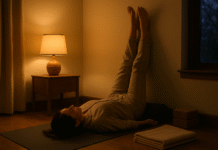
1. Legs-Up-the-Wall (Viparita Karani)
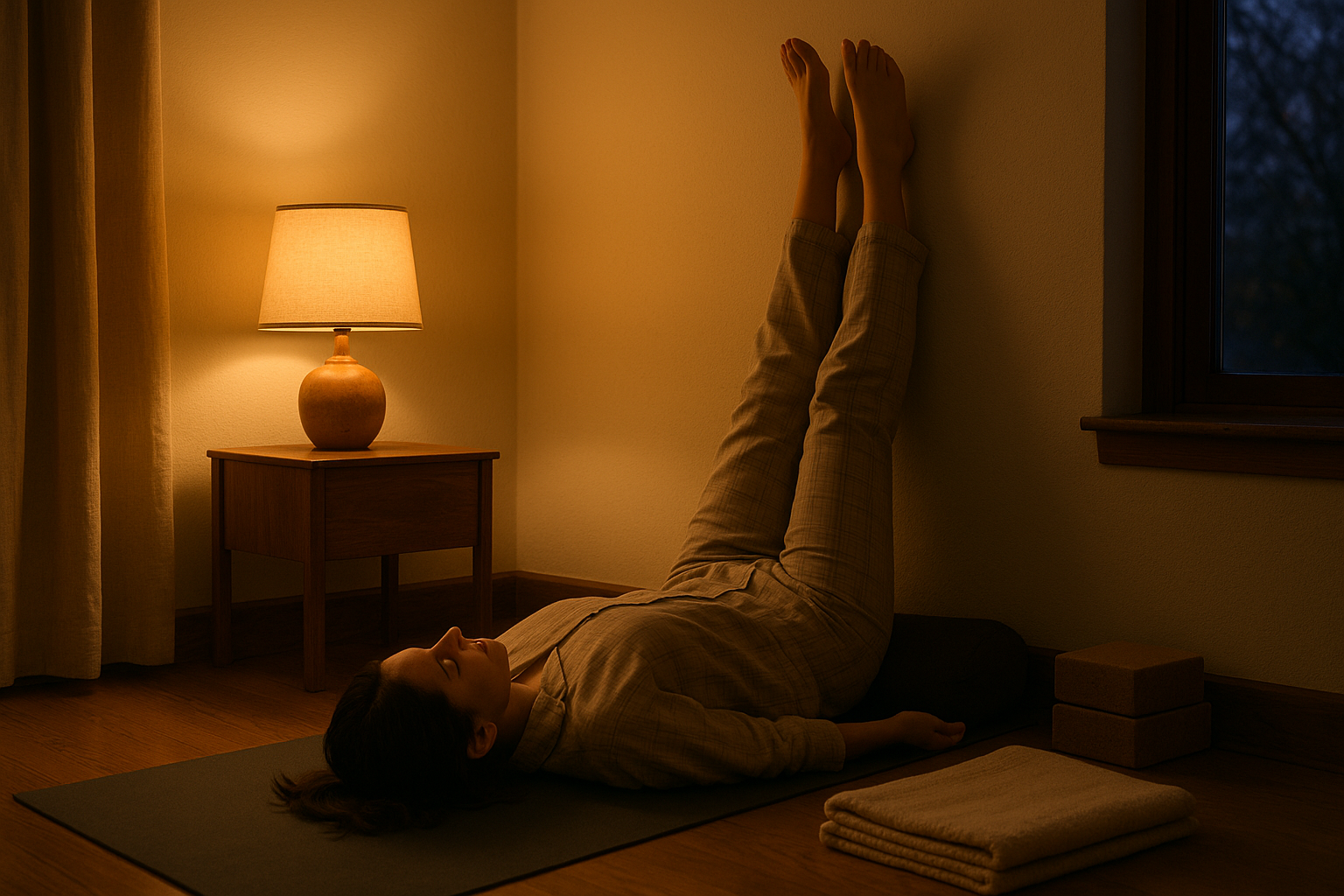
This pose is one of the most reliable wind-down shapes: it reduces effort in the legs, gently shifts blood and lymph, and invites slower breathing—an ideal combination before sleep. It’s especially soothing after long periods of standing or sitting. Keep the setup simple: your hips near a wall, legs vertical, arms relaxed by your sides. Most people feel calmer within a minute as the back body releases and the breath naturally lengthens. If you’re sensitive to hamstring tension, slide farther from the wall until the knees can soften. If you experience eye pressure or have glaucoma, choose the “legs on a chair” alternative instead of going vertical.
1.1 How to do it
- Sit sideways with one hip touching the wall; swing your legs up as you recline.
- Rest your sacrum on the mat; optionally place a folded blanket under your pelvis.
- Let the feet relax; turn palms up to open the chest.
- Breathe in and out through your nose, silently counting a 4–6 second inhale and a 6–8 second exhale.
- To exit, bend your knees, roll to one side, and sit up slowly.
1.2 Numbers & guardrails
- Time: 2–10 minutes; beginners can start with 90 seconds.
- Breath cue: aim for a gentle 1:1.5 inhale-exhale ratio (e.g., 4 in, 6 out).
- Props: blanket under pelvis, small eye pillow, optional thin lumbar towel.
- Caution: if head-down postures aggravate your eyes or blood pressure, elevate your torso or swap for “legs on a chair.”
One-line takeaway: A supported inversion-lite that downshifts your system without effort—perfect near lights-out.
2. Reclined Bound Angle (Supta Baddha Konasana)
Reclined Bound Angle gently opens the hips and groin while encouraging broad, easy belly breathing—great for releasing daytime bracing. It’s deeply restorative when supported: the low back can settle, the chest widens, and the jaw softens. Many people notice a “yawn reflex” after a minute, a sign of parasympathetic activation. If your knees hover high or your hips feel pinchy, you simply haven’t propped enough; more support makes this pose restful, not forceful. This shape appears in many expert bedtime lists because it relaxes without raising heart rate or temperature—exactly what you want before sleep.
2.1 How to do it
- Lie on your back; bring the soles of your feet together.
- Let knees fall outward; place blocks/cushions under each thigh so the inner legs feel supported.
- Arms rest about 45° from your sides, palms up.
- If your low back arches uncomfortably, slip a folded blanket under the sacrum.
2.2 Mini-checklist
- Time: 3–5 minutes.
- Breath cue: 4-count inhale, 6-count exhale; imagine breathing into the sides of the ribs.
- Comfort: add a light blanket over the abdomen for a “weighted” calming effect.
- Skip/modify: if groin or knee pain persists even with support, keep feet hip-width and knock knees in.
One-line takeaway: Supported hips + slow nasal exhale = effortless down-regulation for pre-bed calm.
3. Child’s Pose (Balasana, wide-knee variation)
A classic comfort pose, Child’s Pose lengthens the back, softens the shoulders, and naturally guides diaphragmatic breathing against the thighs—a tactile cue that slows the mind. The wide-knee version makes space for the belly and invites a longer, smoother exhale. Rest your forehead on the mat or a block; that pressure point can be sedating for many people. If your hips don’t reach your heels, pad the gap with a folded blanket. In the evening, think “restorative” not “stretchy”: set enough props so your breath stays quiet and unstrained for the whole hold.
3.1 How to do it
- From all fours, bring big toes together; take knees wide.
- Sink hips toward heels; fold forward, forehead supported.
- Reach arms forward for a back stretch or rest them by your sides for shoulder relief.
- Let the torso settle with gravity; soften the jaw and tongue.
3.2 Common mistakes
- Overreaching the arms so shoulders creep toward ears—relax elbows.
- Forcing hips to heels—use cushions; comfort > depth.
- Holding the breath—keep a steady, whisper-quiet nose exhale.
Numbers & guardrails: Hold 1–3 minutes, breathing 4–6 in / 6–8 out. If knees feel cranky, keep knees narrower and place a rolled towel behind them. Finish with one slow breath in, longer breath out, then rise.
4. Supine Spinal Twist (Jathara Parivartanasana)
A gentle twist on your back wrings out accumulated tension in the lower back and thoracic spine while cueing an unhurried breath rhythm. Because your shoulders stay grounded, the pose feels safe late in the day and doesn’t spike arousal the way strong standing twists can. The key at night is softness: support the knees so the abdomen can relax and the exhale lengthens naturally. Twisting after a heavy meal can feel uncomfortable; either wait at least an hour or keep the bend subtle with props.
4.1 How to do it
- Lie on your back; hug both knees toward the chest.
- Drop knees to the right; place a block/bolster under them so they rest.
- Reach arms into a “T”; turn your head opposite the knees if the neck likes it.
- Breathe: inflate the back ribs on inhales; let the knees get heavier on exhales.
- Repeat on the left.
4.2 Mini-checklist
- Time: ~1–2 minutes per side.
- Breath cue: 4-count in / 6-count out; add a comfortable pause after exhale if it feels soothing.
- Comfort: a thin pillow under the head, a blanket between knees if hips or SI joint are sensitive.
One-line takeaway: Supported, floor-based twists unlock back tightness and elongate the exhale—both sleep-friendly effects.
5. Cat–Cow Flow (Marjaryasana–Bitilasana)
Slow spinal waves synced with breath are a proven way to reduce muscle guarding and quiet the stress response. In the evening, keep the range small and the cadence unhurried; you’re not mobilizing for a workout—you’re signaling safety to the nervous system. Evidence summaries on sleep and exercise note that gentle movement such as yoga, light stretching, and breathing practices can be suitable even close to bedtime, whereas vigorous training in the final hour may impair sleep efficiency for some people. That makes Cat–Cow a perfect bridge between your day and stillness.
5.1 How to do it
- Start on all fours, hands under shoulders, knees under hips.
- Inhale: tip the tail back, broaden the chest (cow).
- Exhale: round gently, draw navel toward spine (cat).
- Keep the neck neutral; imagine the movement initiating at the pelvis.
5.2 Numbers & guardrails
- Time: 60–120 seconds, about 6–12 slow cycles.
- Breath cue: 4–5 seconds each direction; prioritize a slightly longer exhale.
- Comfort: pad knees; if wrists complain, go to fists, forearms, or seated “pelvic clocks.”
- Context: Keep intensity low in the last hour pre-bed; pair with breathwork rather than strength holds.
One-line takeaway: Gentle breath-led spinal waves reduce arousal and prepare you for floor-based restoratives.
6. Seated Forward Fold (Paschimottanasana, supported)
Forward folds are inherently calming when supported—they ease the backline and invite inward focus. The trap is going too deep at night: chasing a hamstring stretch can trigger gripping and shallow breathing. Instead, sit on a folded blanket, bend the knees generously, and support your head and forearms on a stack of pillows or blocks. This transforms the pose into a restorative “curl” that lengthens the back without strain, inviting the long exhale and a feeling of shelter.
6.1 How to do it
- Sit with legs extended; elevate hips on a blanket.
- Bend knees so belly and ribs can meet thighs.
- Hinge forward from the hips; rest forearms and forehead on stacked props.
- Keep neck neutral; let eyes close or half-close.
6.2 Mini-checklist
- Time: 2–4 minutes.
- Breath cue: smooth 4–5 second inhale, 6–8 second exhale; no breath holds.
- Comfort: strap around feet if back muscles grip; keep spine long, not collapsed.
- Skip/modify: acute sciatica—use more knee bend or swap for Child’s Pose.
One-line takeaway: A propped, knee-bent fold quiets the system more effectively than a forceful hamstring stretch.
7. Standing Forward Bend (Uttanasana / “Ragdoll”)
A relaxed forward bend while standing (“ragdoll”) decompresses the upper back and neck and can feel instantly soothing—especially if you’ve been at a desk. The goal at night is not depth but release: soft knees, heavy arms, wide belly breaths. Authoritative sleep resources list standing forward bends among bedtime-appropriate shapes because they’re gentle, gravity-assisted, and pair naturally with slow exhalations. If dizziness arises, come halfway up (hands to shins or a wall) and breathe there.
7.1 How to do it
- Stand hips-width; hinge forward, letting knees soften.
- Hold opposite elbows or let hands rest on blocks.
- Let the crown of the head hang; sway slightly to release shoulders and jaw.
7.2 Common mistakes
- Locking the knees (increases hamstring pull and back tension).
- Forcing hands to floor (depth ≠ relaxation).
- Popping up fast (brief head rush)—rise slowly via a halfway lift.
Numbers & guardrails: Hold 45–90 seconds; breathe 4–6 in / 6–8 out. If low blood pressure or vertigo is an issue, use Ardha Uttanasana at a wall (90-degree “L” position).
8. Supported Bridge (Setu Bandha Sarvangasana, restorative)
Supported Bridge gently opens the front body—hips, hip flexors, and chest—after a day of sitting, without the activation of an active backbend. With a block under the sacrum (low back relaxed), this becomes a passive pose that smooths breathing and can alleviate a “slumped” posture sensation. Keep it mellow: if you’re energized by backbends at night, keep the block on its lowest height and shorten the hold. People with neck discomfort should ensure weight rests on the back of the pelvis, not the lumbar spine or cervical region.
8.1 How to do it
- Lie down, knees bent, feet hip-width.
- Lift hips just enough to slide a yoga block (lowest height) under the sacrum (not the low back).
- Let hips be heavy on the block; arms relaxed, palms up.
- Option: place a folded blanket under shoulders if you tend to round the upper back.
8.2 Mini-checklist
- Time: 1–3 minutes.
- Breath cue: gentle belly-to-rib inhale; whisper-quiet, longer exhale.
- Comfort: if the low back pinches, lower the block or remove it and switch to Knees-to-Chest.
- Contra-notes: If inversions or head-down pressure are restricted for you (e.g., glaucoma), keep the pelvis low and avoid elevating the legs.
One-line takeaway: A low, supported bridge opens the front body just enough to ease breathing without “wiring you up.”
9. Knees-to-Chest (Apanasana) or Happy Baby (Ananda Balasana)
These floor poses soothe the lumbar spine and hips while cueing relaxed, diaphragmatic breathing—great if your back feels tight at the end of the day. Knees-to-Chest is the simplest option; Happy Baby (holding the outsides of the feet or shins) adds gentle hip opening. Keep movements small and rocking; imagine massaging the back on the floor rather than trying to achieve a shape. A brief hold here pairs well with a transition into a twist or straight into Savasana.
9.1 How to do it
- Lying on your back, draw knees toward chest; wrap hands around shins.
- Breathe into the back ribs; rock side-to-side.
- For Happy Baby, widen knees toward armpits; hold shins or feet; keep tail heavy.
9.2 Numbers & guardrails
- Time: 1–3 minutes.
- Breath cue: 4 in / 6 out with a tiny post-exhale pause.
- Comfort: a thin pillow under the head; strap around the thighs if hip mobility limits comfort.
- Alternate: “Legs on a chair” (calves supported) if the hips resist deep flexion—an option widely recommended in bedtime routines.
One-line takeaway: Gentle hip-and-low-back decompression that pairs naturally with a longer exhale.
10. Savasana + Short Yoga Nidra (Body Scan)
Savasana is the final switch from doing to being. Lying flat with neutral alignment, you’ll let the breath return to its natural rhythm and move attention slowly through the body—a mini Yoga Nidra. Short, guided Yoga Nidra practices have been shown to reduce stress and support sleep in diverse groups; it’s effectively a structured relaxation that can be done right on your bed. Keep the room dark, cover yourself with a light blanket, and let the scan be simple: sense, soften, and move on.
10.1 How to do it
- Lie down; place a pillow under knees if your low back tugs.
- Eyes closed; hands rest by your sides, palms up.
- Body scan (3–5 minutes): crown → forehead → jaw → throat → shoulders → arms → hands → chest → belly → pelvis → thighs → calves → feet. At each point: silently label “soften,” then exhale.
10.2 Mini-checklist
- Time: 3–10 minutes.
- Breath cue: no counting necessary—simply notice the exhale lengthening on its own.
- Comfort: light eye pillow; blanket over the abdomen for a calming weight.
- Tip: If you tend to doze, set a gentle chime for 10 minutes so you can turn off the lights and slip into sleep intentionally.
One-line takeaway: The ultimate “off switch”: structured relaxation to close your practice and ease you into sleep.
FAQs
1) When is the best time to do an evening yoga routine?
Aim for the last 30–60 minutes before bed, with dim lighting and minimal screens. Gentle stretching, breathing, and restorative poses are appropriate near bedtime; very intense exercise in the final hour may reduce sleep efficiency for some people. If you’re sensitive to late activity, finish your vigorous workouts at least 3 hours before bed and keep bedtime sessions gentle.
2) How long should I hold each pose?
For a wind-down sequence, 45 seconds to 5 minutes per pose works well. Start shorter and build up as comfort grows. Prioritize a longer exhale rather than long holds that cause fidgeting. The suggested times in each section above are a practical starting point for most healthy adults.
3) What breathing pattern is best for sleep?
A slightly longer exhale signals the parasympathetic (“rest and digest”) response. A simple cue is 4-in / 6-out through the nose. If you get light-headed, reduce the counts and keep it whisper-quiet, not forceful. Gentle breathing and Yoga Nidra are both evening-friendly options.
4) Can I do these poses in bed?
Yes for many: Reclined Bound Angle (with pillows), Knees-to-Chest, Supine Twist (well-propped), and Savasana/Yoga Nidra are bed-friendly. For standing or wall-supported shapes like Forward Fold and Legs-Up-the-Wall, use a mat or rug for stability and alignment. Harvard Health also recommends a “legs on a chair” alternative if a wall setup isn’t comfortable.
5) I’m stiff and not very flexible—will this still help?
Absolutely. The routine emphasizes props and comfort, not range of motion. Meta-analysis and expert overviews suggest yoga benefits sleep quality even when poses are gentle and accessible; intensity is not required. Consistency (most nights) matters more than depth.
6) What if I have insomnia?
Yoga isn’t a cure-all, but studies indicate small-to-moderate improvements in sleep quality across many groups, especially with regular practice and adequate total class time. Combine this routine with basics like a consistent schedule, a cool/dark room, and limited late caffeine. See a sleep professional if insomnia persists.
7) Is it safe to do yoga right before bed?
Gentle yoga, stretching, and breathing are generally safe pre-bed for most healthy adults, and may even be beneficial when timed close to bedtime. Those with medical conditions (e.g., glaucoma, uncontrolled hypertension, late pregnancy concerns) should modify or avoid certain positions and consult a clinician. Skip hot yoga or aggressive backbends at night.
8) What props do I really need?
Minimum: two firm pillows (or folded blankets) and two books/blocks. Nice-to-have: eye pillow, strap, and a thin knee pad. The goal is to remove effort, so don’t hesitate to add more cushioning where your body asks for it.
9) How often should I do this routine?
Nightly is fine—especially if you keep it short (5–15 minutes). Even a few minutes of Legs-Up-the-Wall or a 5-minute Yoga Nidra can help you “downshift” when time is tight. Consistency strengthens the habit cue that bed = sleep.
10) Can I pair this with other exercise?
Yes. Daytime moderate activity generally supports sleep, and on busy days when you can’t work out earlier, keep late sessions gentle (like this routine). Save vigorous intervals and heavy strength work for earlier in the day if evening intensity keeps you alert.
11) Which single pose should I do if I only have 3 minutes?
Pick Legs-Up-the-Wall or Reclined Bound Angle—both convert easily to bed and pair well with long exhalations. Finish with one minute of eyes-closed Savasana or a mini body scan.
12) What if I get sleepy on the mat?
Great—mission accomplished. Set a soft 10-minute chime before Savasana so you can switch off lights and transition into bed intentionally, or do the final pose in bed and let yourself drift off.
Conclusion
Evening yoga works because it changes how you feel right now—less tense, more grounded, more exhale-heavy—rather than chasing flexibility or fitness. The ten poses above were chosen for their low effort, easy prop-support, and reliable calming effects: they coax your breath slower, soften the back and hips, and tell your nervous system it’s safe to rest. Start with 5–10 minutes most nights—Cat–Cow, Child’s Pose, a supported fold, a hip-opener, and a short Legs-Up-the-Wall or Yoga Nidra—and make the room a cue for sleep: dim light, cool temperature, phones away. Over time, you’ll learn which two or three shapes feel like a personal off switch. Pair them with consistent bed and wake times, and your evening practice becomes a habit loop that shortens the gap between “lights out” and sleep.
Ready to try it tonight? Roll out a mat, dim the lights, and give your breath the last word.
References
- How Yoga Can Improve Your Sleep Quality, Sleep Foundation, updated July 29, 2025. Sleep Foundation
- How Can Exercise Affect Sleep?, Sleep Foundation, updated July 29, 2025. Sleep Foundation
- Yoga Nidra for Sleep, Sleep Foundation, updated February 27, 2024. Sleep Foundation
- Yoga: Effectiveness and Safety, National Center for Complementary and Integrative Health (NCCIH), (accessed August 2025). NCCIH
- Yoga for Health (PDF e-book), NCCIH, January 2024. NCCIH
- Sleep Disorders and Complementary Health Approaches, NCCIH, (accessed August 2025). NCCIH
- Yoga for better sleep, Harvard Health Publishing, June 15, 2020. Harvard Health
- Bedtime Yoga for Better Sleep: A 10-Pose Routine to Try, Cleveland Clinic Health Essentials, December 6, 2021. Cleveland Clinic
- The effect of yoga on sleep quality and insomnia in women with sleep problems: a systematic review and meta-analysis, BMC Psychiatry, May 1, 2020. BioMed Central
- Effects of various exercise interventions in insomnia patients, BMJ Evidence-Based Medicine (early online), July 9, 2025. ebm.bmj.com