

























By Noah Sato
Most advice about joint pain circles around motion: stretch it, mobilize it, keep it moving. So it can feel counterintuitive to hear that one of the more consistently useful tools for cranky, irritable joints is the opposite of motion — holding a position without moving at all.
Isometric exercise, muscle contraction against resistance with no change in joint angle, has a growing body of research behind it for tendon pain, early-stage osteoarthritis, and rehab situations where full-range strength training is too aggravating but doing nothing makes things worse. It isn’t a cure, and it isn’t right for every joint problem. But for a specific and common set of complaints, it’s one of the more evidence-backed, low-risk starting points available.
This guide walks through what isometrics actually are, why they seem to calm pain in ways other exercise doesn’t always manage, who tends to benefit, how to build a session, and where the approach runs into its limits. Nothing here replaces an individualized assessment by a doctor or physical therapist — that caveat matters more than usual with joint pain, and it’s repeated throughout for good reason.
What “Isometric” Actually Means
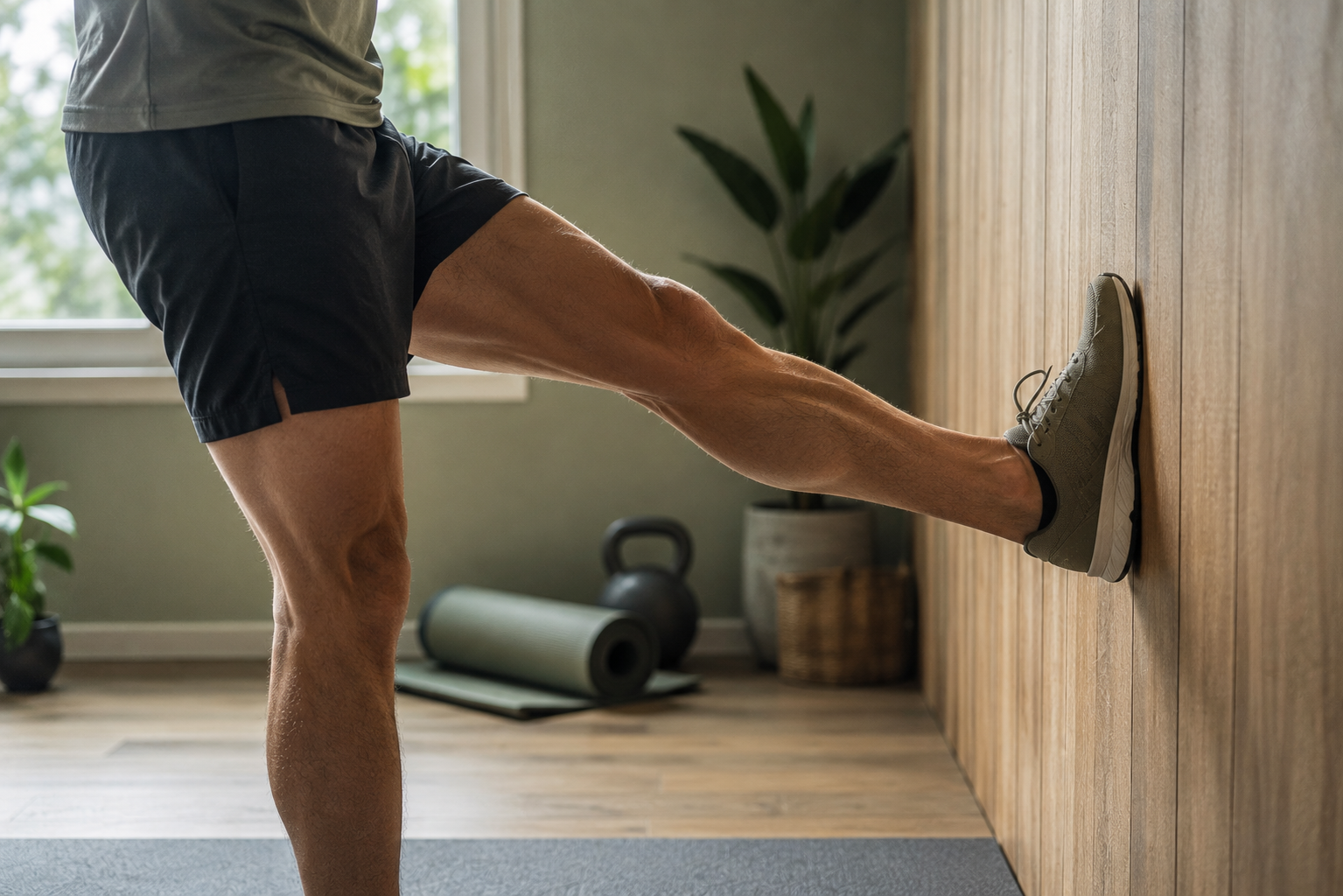
An isometric contraction is one where the muscle generates tension but the joint doesn’t move and the muscle doesn’t meaningfully change length. Pressing your palm against a wall as hard as you can is isometric: your shoulder and elbow muscles are working, but nothing bends or straightens. A wall sit is isometric for the quads. Holding a plank is isometric for the core and shoulders.
Compare that to the two other broad categories of muscle action:
- Concentric contractions shorten the muscle under load — the “lifting” phase of a bicep curl.
- Eccentric contractions lengthen the muscle under load while it resists — the controlled “lowering” phase of that same curl.
Isometrics sit outside that lifting-and-lowering cycle entirely. There’s no joint excursion, which is exactly why they’re useful when movement itself is what provokes pain: you can load a muscle and the tendon or joint it crosses without asking that joint to travel through a range that currently hurts.
Overcoming vs. Yielding Isometrics
Not all isometric holds are the same. Coaches and physical therapists generally split them into two types, and the distinction matters for how you use them:
Overcoming isometrics — you push or pull against an immovable object (a wall, a fixed bar, a resistance band anchored so it can’t stretch further) at or near maximum effort. Nothing yields because the resistance literally cannot move.
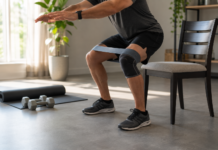
Yielding isometrics — you hold a joint angle against a load that could move it, using muscular effort to prevent that movement, such as holding a squat at 90 degrees or keeping a weighted arm still at shoulder height. The muscle resists being lengthened rather than pushing against something fixed.
Yielding holds are usually what’s prescribed for tendon and joint pain, since they let you control the exact joint angle and the exact load, in a way that’s repeatable and easy to dose from session to session.
Why Holding Still Can Reduce Pain
The clearest evidence for isometrics and pain comes from tendinopathy research, not arthritis specifically, but the mechanisms plausibly overlap.
In a frequently cited 2015 study by physiotherapist and researcher Ebonie Rio and colleagues, volleyball players with patellar tendon pain performed heavy isometric leg-extension holds (five sets of 45 seconds at roughly 70% of maximum effort). Pain dropped sharply right after the exercise and the reduction lasted at least 45 minutes, alongside measurable changes in the muscle’s neural drive, suggesting the effect wasn’t purely psychological (Rio et al., British Journal of Sports Medicine, 2015). The proposed mechanism involves a kind of protective “cortical inhibition” the brain applies to a painful area, which heavy isometric loading appears to temporarily override, alongside a general pain-gating effect similar to what happens with other forms of exercise-induced analgesia.
That said, later research has been more mixed. A 2018 study on Achilles tendinopathy found no immediate pain relief from isometrics, and a separate trial on plantar fasciitis found no meaningful change in pain across several exercise types, isometrics included. A 2016 study by Coombes and colleagues found that isometric holds performed above a person’s pain threshold could actually increase soreness afterward, while holds kept below that threshold offered no clear advantage over doing nothing.
A 2020 systematic review and meta-analysis of randomized trials on isometric exercise for tendinopathy management concluded that isometrics can produce short-term pain relief for some tendons and some individuals, but that the evidence doesn’t support isometrics as a stand-alone long-term fix, and results vary considerably by tendon location and by person.
The honest summary: isometrics reliably help some people with tendon pain feel noticeably better in the short term, they don’t do much for others, and nobody has fully mapped who responds and who doesn’t. That’s worth knowing before treating isometric holds as a guaranteed fix rather than a tool worth trying.
Isometrics for Joint Pain Specifically (Not Just Tendons)
Joint pain and tendon pain overlap constantly, since so much of what irritates a joint runs through the tendons crossing it, but osteoarthritis research gives a slightly different picture.
Multiple trials on isometric quadriceps exercise for knee osteoarthritis have found reductions in pain and improvements in function when isometric strengthening is done consistently over several weeks, generally as part of a broader strengthening routine rather than a single miracle set. The logic here is less about instant analgesia and more about the slower payoff of stronger muscles: a knee with a stronger quadriceps and hamstring absorbs more of the daily mechanical load itself, taking some of that load off the joint surfaces and cartilage.
The Arthritis Foundation recommends isometric exercise specifically as an option when a joint is actively inflamed or too irritated for regular resistance training, describing it as a way to keep building strength “without motion in the joint.” Wall sits for the quadriceps and gentle isometric holds for the hands are common examples they cite for knee and hand arthritis, respectively.
The CDC’s physical activity guidance for adults with arthritis frames muscle-strengthening work (isometric exercise included) as part of the standard recommendation: two sessions a week targeting the major muscle groups, alongside 150 minutes of moderate aerobic activity, with the explicit note that some activity is better than none and that people should check with a health care provider about what’s appropriate for their specific joints.
“Isometric exercise works well as an entry point for people whose joints or tendons can’t yet tolerate a full range of motion. It is a bridge, not a final destination. The goal over time is to rebuild strength through the full movement the joint is meant to do.”
— summarizing physical therapy consensus on isometric progression in tendinopathy and joint rehab
Isometrics vs. Other Approaches: A Practical Comparison
| Approach | Best For | Joint Motion Required | Typical Drawback |
|---|---|---|---|
| Isometric holds | Acute tendon pain, inflamed joints, early rehab | None | Strength gains are angle-specific; doesn’t build full-range capacity |
| Eccentric loading | Chronic tendinopathy (e.g., Achilles, patellar) | Full range, slow lowering phase | Often provokes pain during the exercise itself |
| Isotonic/dynamic strength training | Longer-term strength and function once pain is manageable | Full range | Can aggravate joints or tendons still in an irritable phase |
| Rest / immobilization | Acute injury in the first 24-72 hours | None | Prolonged rest weakens surrounding muscle and can worsen stiffness |
None of these are mutually exclusive. A common and sensible progression in rehab is rest for a short acute window, then isometrics to reintroduce load without provoking symptoms, then a gradual shift toward eccentric or isotonic work as tolerance improves, then a return to full dynamic training. Isometrics are usually a phase, not a permanent home base, unless a joint condition specifically limits range of motion long-term.
Who Tends to Benefit Most
Based on the research and clinical guidance above, isometric work is most often recommended for:
- People with tendinopathy (patellar, Achilles, rotator cuff, elbow) whose pain flares with movement through a range but who can tolerate a static hold at a comfortable angle.
- People with knee or hip osteoarthritis looking to build supporting muscle strength without adding joint compression through a full range of motion.
- Anyone in early-stage rehab after an injury or flare, once acute swelling has settled, who needs to keep a muscle active without moving the joint it crosses.
- Older adults or people newer to strength training who want a lower-skill, lower-equipment way to start loading muscle safely.
Isometrics tend to be a poorer fit, or need more caution, for:
- Acute injuries in the first 24 to 72 hours, where some initial rest is usually more appropriate.
- Uncontrolled high blood pressure or certain cardiovascular conditions, since sustained heavy holds can raise blood pressure temporarily, especially if breath-holding is involved (see the safety section below).
- Joints where the pain is coming from a structural issue, like a labral tear, meniscus tear, or significant instability, that isometric strengthening alone won’t resolve.
- Anyone with sharp, localized, or rapidly worsening pain, numbness, swelling, or a joint that feels unstable or gives way, all of which warrant medical evaluation before any exercise program.
How to Build an Isometric Session
The protocols used in tendinopathy research offer a reasonable starting template, though the right load and duration for a given joint and condition should ideally be confirmed with a physical therapist.
A Sample Isometric Protocol (Research-Informed Starting Point)
- Choose a joint angle that feels stable, not painful. For a knee, that’s often a mid-range bend rather than fully straight or fully bent. Sharp pain at any point means back off the angle or the load.
- Warm up briefly. A few minutes of light movement (walking, gentle cycling) to get blood flow into the area before holding still.
- Hold at a challenging but sustainable effort. Research protocols often use around 70% of maximum effort for 30-45 seconds. For a home routine without lab equipment, “hard enough that the last 10 seconds feel genuinely difficult” is a workable proxy.
- Repeat for 4-5 sets, resting 1-2 minutes between holds.
- Breathe throughout. Don’t hold your breath during the contraction (more on why below).
- Track pain before, during, and after. Some soreness during a hard hold can be normal, but pain that lingers or worsens over the following 24 hours is a signal to reduce load, angle, or duration next time.
Frequency matters less than consistency. Most tendon-focused isometric protocols in the research were used daily or near-daily for a period of weeks, often alongside sport or activity, not as a replacement for it. Osteoarthritis-focused protocols tend to look more like standard strength training: two to three sessions per week, sustained over months, since the goal there is durable muscle strength rather than an immediate analgesic effect.
Adjusting for Common Joints
| Joint / Area | Example Isometric Hold | Notes |
|---|---|---|
| Knee (patellar tendon, mild OA) | Wall sit or seated leg extension hold at a mid-range knee bend | Avoid a fully locked knee; choose an angle you can control cleanly |
| Shoulder (rotator cuff) | Isometric external/internal rotation against a band or wall at 0 degrees abduction | Keep the arm close to the body initially; avoid overhead angles that provoke pain |
| Achilles / calf | Heel raise held at mid-range on a step | Double-leg first, progressing to single-leg as tolerated |
| Elbow (tennis/golfer’s elbow) | Wrist extension or flexion hold against light resistance | Keep grip and forearm relaxed between holds; light loads often work best here |
| Hip | Side-lying hip abduction hold or standing hip hinge isometric | Useful for hip OA and gluteal tendinopathy alike |
Safety Considerations That Actually Matter
Isometric exercise has a good safety profile overall, which is part of why it’s used so often in early rehab. Still, a few points deserve attention.
Blood pressure and breathing
Sustained muscular contractions temporarily raise blood pressure, and that rise is more pronounced if you hold your breath during the effort (the Valsalva maneuver). Mayo Clinic Health System notes this as a common misconception worth correcting: proper isometric technique involves steady breathing throughout the hold, not breath-holding. People with uncontrolled hypertension or certain heart conditions should talk to a doctor before starting a program of heavy isometric holds, and should not treat breath-holding as part of the technique.
Separately, and perhaps counterintuitively, several studies on isometric training (notably wall sits and handgrip holds performed with proper breathing) have found it can lower resting blood pressure over time when done regularly, which is one reason it appears in some cardiovascular exercise guidance as well as rehab guidance. The short-term spike during a hold and the longer-term training effect are two different things.
Distinguishing “productive” discomfort from a warning sign
Stop and seek professional evaluation if you notice:
- Sharp, stabbing, or electric pain, rather than a dull ache or muscle burn
- Pain that gets steadily worse across sets rather than staying steady or easing
- Swelling, warmth, or redness around the joint that develops or worsens
- A joint that feels unstable, locks, or gives way
- Numbness, tingling, or pain radiating away from the joint
- Pain that lingers well beyond 24 hours after exercising, rather than settling
A general rule used in a lot of rehab settings is that pain during exercise up to roughly 3-4 out of 10 on a simple pain scale is often considered acceptable if it settles quickly and doesn’t worsen the next day, but this is a general guideline, not a rule that applies to every joint or every diagnosis, and it should be confirmed with a clinician for your specific situation rather than assumed.
What the Research Doesn’t Settle
It’s worth being direct about the limits of the evidence rather than overselling isometrics as a fix. The instant pain relief effect reported in the original patellar tendon studies hasn’t reproduced consistently across other tendons or conditions. Sample sizes in a lot of the foundational studies are small. Mechanisms proposed (cortical inhibition, pain gating, general exercise-induced analgesia) are plausible and partly supported, but not fully mapped for every joint. And isometric strength gains are known to be fairly angle-specific: holding a contraction at one joint angle builds strength mostly at and near that angle, not across the whole range, which is part of why most rehab protocols use isometrics as a bridge toward full-range strengthening rather than a permanent substitute for it.
None of that erases the value isometrics clearly have for a lot of people. It just means the honest pitch is “worth trying, well-supported for specific situations, and best combined with guidance from someone who can assess your actual joint,” rather than a universal fix.
Frequently Asked Questions
Can isometric exercises make joint pain worse?
Yes, in some cases, particularly if the load or angle chosen provokes sharp pain rather than a manageable effort, or if the underlying cause of pain is something isometric loading won’t address, like a structural tear. Research on tendon pain has found that holds performed above a person’s pain threshold can increase soreness afterward. Choosing a comfortable angle, a sustainable effort level, and monitoring pain over the following day are the main ways to avoid this.
How long should an isometric hold be for joint pain?
Research protocols for tendon pain commonly use holds of 30 to 45 seconds, repeated for 4-5 sets, though individual tolerance varies widely. Shorter holds at a comfortable intensity are a reasonable way to start, building duration and effort gradually rather than jumping straight to a maximal 45-second hold.
Are isometric exercises safe for people with arthritis?
Generally yes, and the Arthritis Foundation specifically recommends isometric exercise as an option for joints that are too inflamed or irritated for regular resistance training, since it builds strength without requiring the joint to move through its full range. That said, form matters more than intensity when starting out, and anyone with significant active inflammation should check with a healthcare provider about timing and load.
How is an isometric exercise different from stretching?
Stretching lengthens a muscle passively or actively without necessarily creating strong muscular tension, and it usually involves the joint moving into a new position and holding there. Isometric exercise creates active muscular tension at a fixed joint angle, without lengthening or shortening the muscle meaningfully. They can look superficially similar (both involve holding still) but the intent and physiological effect are different.
Should isometrics replace regular strength training?
Usually not as a permanent strategy. Isometric strength gains tend to be fairly specific to the joint angle trained, so a program built entirely on static holds won’t build strength across a joint’s full range of motion. Most rehab and training approaches use isometrics as a starting point or a tool for flare-ups, progressing toward full-range strength training as pain and function allow.
How quickly can I expect results?
Some people notice a reduction in tendon pain within minutes of a single isometric session, an effect documented in early patellar tendon research, though this doesn’t happen for everyone and hasn’t held up consistently across all tendons studied. For joint conditions like osteoarthritis, the more reliable timeline is weeks of consistent strengthening work before noticing meaningful changes in pain and function, not a single session.
The Bottom Line
Isometric exercise earns its place in joint and tendon rehab because it does something genuinely useful: it lets a muscle keep working, and a joint keep receiving some mechanical stimulus, without asking that joint to move through the exact range that currently hurts. The evidence for immediate pain relief is real but inconsistent across conditions, and the evidence for longer-term benefit in osteoarthritis leans more on steady strength-building than instant relief.
Used thoughtfully, at a comfortable angle, with attention to how the joint responds over the following day, isometrics are a reasonable and well-supported place to start when movement itself is the problem. They work best as one phase of a broader plan, not a permanent substitute for addressing the underlying cause of the pain.
This article is general information, not a substitute for individualized diagnosis or treatment. If joint pain is sharp, worsening, associated with swelling or instability, or simply isn’t improving, it warrants a proper evaluation from a doctor or physical therapist before you build a home exercise routine around it.
References
- Rio, E., et al. (2015). “Isometric exercise induces analgesia and reduces inhibition in patellar tendinopathy.” British Journal of Sports Medicine, 49(19). https://pubmed.ncbi.nlm.nih.gov/25979840/
- “Effectiveness of isometric exercise in the management of tendinopathy: a systematic review and meta-analysis of randomised trials.” British Journal of Sports Medicine / PMC. https://pmc.ncbi.nlm.nih.gov/articles/PMC7406028/
- Physiotutors. “Isometrics in Tendinopathy – A Wonder Weapon to Decrease Pain?” https://www.physiotutors.com/isometrics-in-tendinopathy-a-wonder-weapon-to-decrease-pain/
- International Association for the Study of Pain (IASP). “Oldies but Goodies – Isometrics reduce tendon pain.” https://www.iasp-pain.org/publications/relief-news/article/isometrics-reduce-tendon-pain/
- Arthritis Foundation. “Exercise and Strength Training With Arthritis.” https://www.arthritis.org/health-wellness/healthy-living/physical-activity/getting-started/exercise-and-strength-training-with-arthritis
- Centers for Disease Control and Prevention. “Chronic Conditions & Disabilities Activity, Physical Activity Basics.” https://www.cdc.gov/physical-activity-basics/guidelines/chronic-health-conditions-and-disabilities.html
- Mayo Clinic Health System. “Isometric exercise and blood pressure.” https://www.mayoclinichealthsystem.org/hometown-health/speaking-of-health/isometric-exercise-and-blood-pressure
- Sengul, Y.S., et al. (2022). “Isometric Quadriceps Exercises for Patients with Knee Osteoarthritis: A Randomized Controlled Trial Comparing Knee Joint Position Flexion versus Extension.” Rehabilitation Research and Practice. https://onlinelibrary.wiley.com/doi/10.1155/2022/2690871
- Z-Health Education. “Overcoming vs. Yielding Isometrics: What They Are and Why It Matters.” https://zhealtheducation.com/blog/overcoming-vs-yielding-isometrics-what-they-are-and-why-it-matters/