
























By Emily Harrison
Bad knees have a way of talking a person out of the weight room entirely. One bad set of lunges, one flare-up after a hike, and suddenly the safest-feeling option is to stop lifting altogether. That instinct is understandable, but it usually backfires. Weak, undertrained legs are shakier under load, and knees that don’t get any strengthening work tend to feel worse over time, not better.
The goal of this guide is not to talk anyone into pushing through real pain. It’s to lay out a practical, step-by-step way to keep building strength around a cranky, arthritic, previously injured, or post-surgical knee without provoking it. Some of this will look different from a standard leg-day program: less depth, more isometric holds, closer attention to how the joint feels the next morning. None of it requires giving up on strength training.
One caveat before anything else: this article is general information, not a diagnosis or a personalized exercise prescription. It can’t account for your specific knee, imaging results, surgical history, or pain pattern. If you have a structural issue, a recent injury, or pain that hasn’t been evaluated, see a doctor or a physical therapist before starting or changing a strength program. That guidance applies throughout this piece, not just here.
Why “Bad Knees” Isn’t a Reason to Stop Strength Training
The knee is a hinge joint stabilized almost entirely by the muscles crossing it, especially the quadriceps, hamstrings, and hip muscles. When those muscles are strong and coordinated, they absorb a large share of the load that would otherwise land directly on cartilage and ligaments. When they’re weak, the joint takes on more of that work by itself.
This is part of why physical therapy guidelines for knee osteoarthritis consistently recommend strengthening rather than rest. According to a clinical summary on Physiopedia, quadriceps strengthening reduces pain and disability in knee osteoarthritis, and many rehabilitation programs also emphasize hip abductor strengthening, since weakness at the hip changes how the knee tracks during standing, walking, and squatting movements. Land-based exercise, including resistance training, is described as appropriate for most people, with aquatic exercise and stationary cycling offered as lower-impact alternatives when needed.
The American Academy of Orthopaedic Surgeons’ patient education program, the Knee Conditioning Program, is built the same way: warm up, stretch, then work through targeted strengthening exercises for the quadriceps, hamstrings, hip muscles, and calves, typically in the range of three sets of ten repetitions, progressing over four to six weeks or longer under a provider’s guidance. The starting resistance is bodyweight, moving up gradually to light ankle weights or resistance bands.
None of this means every exercise is fair game or that more is automatically better. It means the target isn’t “avoid using the knee.” The target is “load the knee in ways it can tolerate, and build from there.”
Red Flags: When to Stop and Get Evaluated First
Before getting into exercise selection, it’s worth being explicit about the situations where strength training should wait for a professional opinion rather than a home program.
See a doctor or physical therapist before continuing to train if you notice any of the following:
- Sharp, stabbing, or electric pain during a movement, rather than a dull ache
- Visible swelling that develops within a few hours of activity, or a knee that feels warm and puffy
- Locking, catching, or a sense that the knee is going to give way
- Instability, or the feeling that the joint can’t be trusted to bear weight
- Pain that keeps getting worse across a week of training rather than settling down
- Redness, warmth, and fever together, which can indicate infection and needs urgent care
The NHS is direct about this: persistent knee pain, significant swelling, locking, instability, or signs of infection are reasons to get seen rather than manage things alone. None of the strategies below are a substitute for that evaluation. They’re what to do once a professional has confirmed it’s reasonable to keep training, or while waiting for that appointment if the pain is mild and stable.
The Pain Rule Most People Get Wrong
A lot of people either avoid every exercise that produces any sensation at all, or push straight through sharp pain because they assume discomfort is just part of getting stronger. Neither approach holds up well over time. Clinicians who work with painful joints tend to use a simpler filter: mild, dull discomfort that stays around a 2 or 3 out of 10, doesn’t climb during the set, and settles back to baseline within a day is generally considered acceptable. Anything sharper, or anything that lingers and gets worse the next morning, is a signal to back off, not push forward.
A simple way to check yourself mid-set:
- Rate it. Before, during, and after the set, put a number on the discomfort, 0 to 10.
- Watch the trend. Mild and steady is fine. Climbing sharply during the set is not.
- Check the next morning. Soreness that fades by the following day is normal training feedback. Pain that’s worse than the day before means the last session was too much for that knee, right now.
- Adjust one variable. Reduce range of motion, drop the load, or swap the exercise, rather than stopping strength training altogether.
The AAOS conditioning program states this plainly: “you should not feel pain during an exercise.” That’s a reasonable baseline. A knee-friendly strength program isn’t one that never produces any sensation. It’s one where sharp or worsening pain is treated as useful information, not something to grit through.
Step 1: Get a Read on Your Specific Knee
Before building a program, it helps to know what type of “bad knee” is being worked with, because the answer changes the details. Arthritic knees generally respond well to consistent, moderate strengthening and tend to stiffen up more from inactivity than from movement. A knee recovering from ligament surgery has protocol-specific timelines that a surgeon or physical therapist sets, and those timelines should override any generic advice, including this article. Patellofemoral pain (the ache behind or around the kneecap that flares with stairs and deep squats) usually responds to controlling range of motion and strengthening the hips and outer quad, more than it responds to rest.
If there’s an existing diagnosis, a recent scan, or a physical therapist involved, their specific restrictions take priority over any of the general steps that follow. If there’s no diagnosis yet and the pain is new, get it looked at before building a training plan around it. Guessing at the cause of knee pain and self-treating it is where most setbacks come from.
Step 2: Warm Up in a Way That Actually Prepares the Joint
A cold knee joint moving into a loaded squat or lunge is a common way to provoke pain that wasn’t necessary. Five to ten minutes of easy movement, walking, a stationary bike at low resistance, or marching in place, raises tissue temperature and gets synovial fluid moving through the joint before any loaded work starts. Follow that with a few sets of bodyweight movement patterns at a shallow range, like sitting most of the way down onto a chair and standing back up, before adding resistance.
Static stretching held for long periods right before lifting isn’t particularly useful for injury prevention and can leave some joints feeling less stable for the first few minutes after. Save longer static stretches, particularly for the hamstrings and calves, for after training or on separate days, since tight hamstrings are commonly linked with knee osteoarthritis and benefit from regular stretching.
Step 3: Choose Exercises That Load the Knee on Your Terms
Not every strength exercise treats the knee the same way. Deep, fast, or heavily loaded knee flexion tends to be the riskiest combination for a cranky joint. Exercises that let you control depth, tempo, and how much bodyweight passes through the knee tend to be far more tolerable, especially early on.
None of the items in the right-hand column are permanently off-limits. They’re simply the moves most likely to need modification, less range of motion, lighter load, a softer surface, a longer warm-up, before a sore knee tolerates them well. Many people eventually work back up to deeper squats and lunges once strength and control improve.
Step 4: Get the Alignment Right Before Adding Weight
Two form details matter more for knee comfort than almost anything else: where the knee travels relative to the foot, and how much the trunk collapses forward under load.
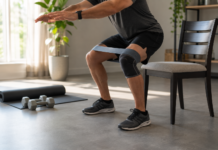
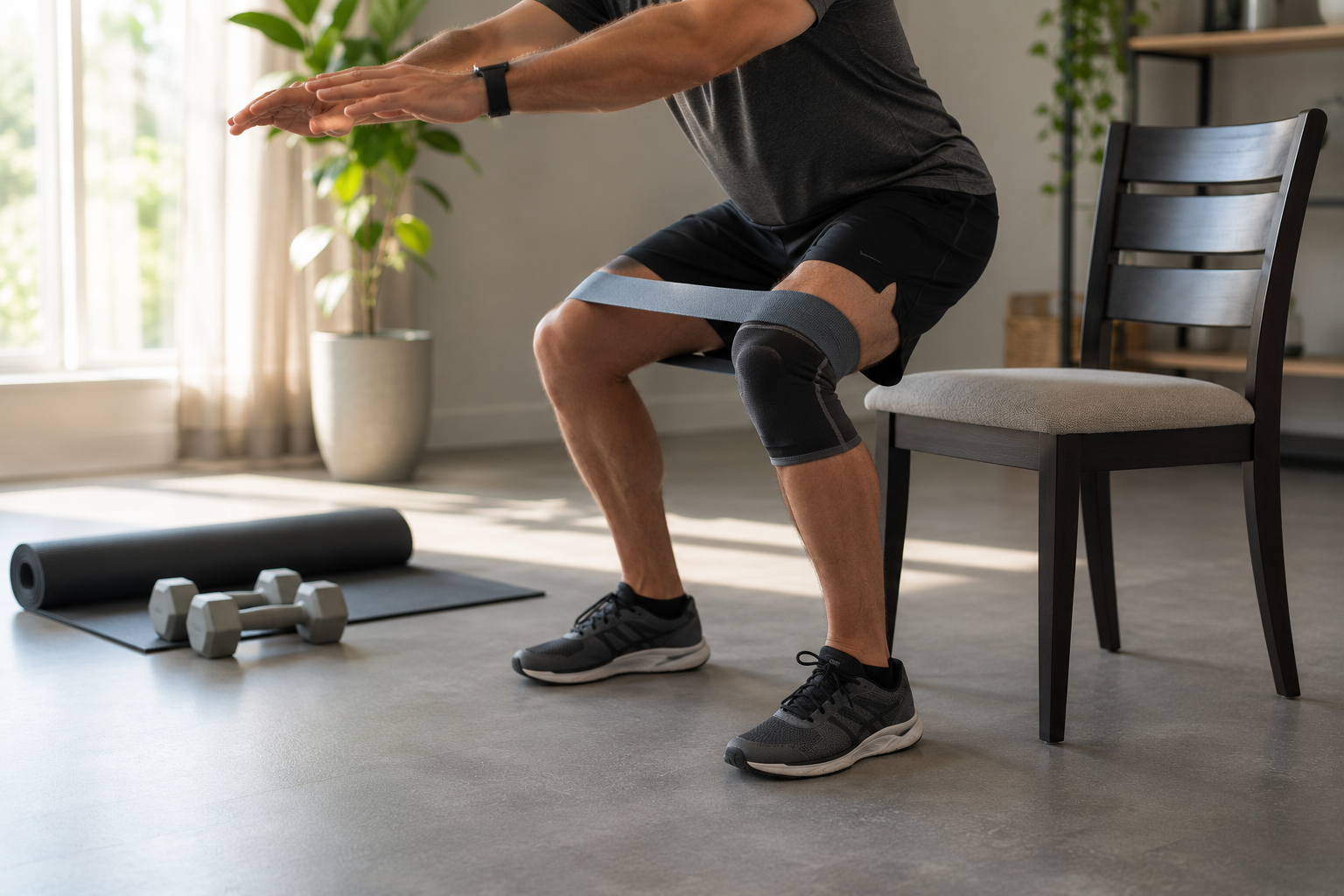
During a squat, step-up, or lunge, the kneecap should track roughly over the second or third toe rather than caving inward. Inward collapse (sometimes called valgus) shifts stress onto the inner knee structures and is strongly associated with hip weakness, which is one reason hip abductor and glute work shows up so often in knee rehab programs. A mirror, a phone propped up to film a set, or a few reps with a resistance band looped just above the knees (enough to feel light tension pulling them inward, which trains you to push outward against it) can make this visible fast.
The second detail is depth versus torso lean. Sitting the hips back and keeping the shin closer to vertical for a shallow squat shifts more work onto the hips and less onto the knee compared with driving the knees far forward over the toes on a deep squat. Neither pattern is inherently wrong, but for an irritable knee, the more hip-dominant, shallower version is usually the gentler starting point.
Step 5: Start With Isometrics and Partial Ranges, Then Build Range Gradually
For a knee that reacts to dynamic movement, isometric holds are one of the most useful entry points. A wall sit held at a shallow angle, a quad set (tightening the thigh muscle with the leg straight), or a static hold at the bottom of a partial squat all load the muscle significantly with very little joint movement, which tends to be well tolerated even on days when full range feels irritable.
A loading progression that works for most irritable knees:
Only change one variable at a time, range, load, or tempo, rather than several at once. That way, if a knee reacts poorly to a session, it’s obvious which change caused it.
Step 6: Build a Weekly Structure Around Recovery
Consistency matters more than intensity for a joint that needs steady input rather than sporadic hard efforts. A useful default is two to three strength sessions per week, spaced with at least one rest or light-activity day between sessions that target the same muscle groups. This lines up with community-based arthritis exercise programs like the CDC-recognized Fit & Strong! and EnhanceFitness models, which typically run two to three times weekly and combine stretching, strengthening, and low-impact aerobic work rather than daily maximal effort.
This is a starting template, not a fixed prescription. A physical therapist can adjust sets, reps, and exercise selection for a specific knee, and that individualized version should take priority over any generic table.
Step 7: Monitor, Recover, and Adjust as You Go
Keeping a short log, even a few lines in a notes app, of what was trained, how the knee felt during the session, and how it felt the next morning, makes it far easier to spot patterns. Some people find that deep squats are fine but lunges flare things up. Others tolerate everything except stairs the day after leg day. That kind of pattern only becomes visible with a few weeks of consistent notes.
Recovery basics still apply: enough sleep, adequate protein intake to support muscle repair, and at least one full rest day between sessions hitting the same muscle groups hard. Ice or over-the-counter anti-inflammatory options can help manage a temporary flare-up, but repeated flare-ups after the same exercise are a sign to modify that exercise rather than to keep icing around it indefinitely.
If pain trends downward and function improves over several weeks, the plan is working, and it’s reasonable to keep progressing range and load slowly. If pain plateaus or worsens despite consistent, moderate training, that’s the point to loop in a physical therapist rather than pushing the same plan harder.
Common Mistakes That Slow Down Progress
A few patterns show up again and again in people trying to train around bad knees.
Doing too much, too soon. Jumping straight into deep squats, lunges, and step-downs in the same week, rather than building through the progression above, is one of the most common ways to trigger a flare-up early on.
Avoiding the knee entirely. Some people swing the opposite direction and cut out lower-body training altogether, relying only on upper-body work. That protects the knee in the short term but allows the surrounding muscles to weaken further, which tends to make the knee feel less stable over months, not more.
Ignoring the hips. Programs that focus only on the quads and skip hip abductor and glute work miss a large part of what keeps the knee tracking well under load.
Chasing soreness instead of tracking function. Muscle soreness the day after training is normal. Joint pain, swelling, or reduced range of motion the day after is a different signal and should change the plan, not just get pushed through.
Skipping the warm-up on short timelines. Rushing straight into loaded squats without raising tissue temperature first is an easy way to provoke a joint that was otherwise ready for the session.
Frequently Asked Questions
Can you actually build strength if you have bad knees?
Yes, in most cases. Strengthening the quadriceps, hamstrings, and hip muscles is a core part of standard treatment recommendations for knee osteoarthritis and general knee pain, not something people with knee problems are advised to avoid. The exercises, range of motion, and loading pace usually need to be adapted to the specific knee, but strength training itself remains appropriate for most people once a professional has ruled out anything requiring a different approach.
What exercises should you avoid with bad knees?
There’s no universal “never do this” list, since it depends on the specific issue, but deep, fast, heavily loaded knee flexion, think unassisted deep squats, long jumping lunges, or high box jumps, tends to be the least tolerated combination for an irritable joint. Most people do better starting with shallower ranges, controlled tempo, and lighter load, then building back toward these more demanding movements gradually.
Is it normal to feel some discomfort when strength training with knee pain?
Mild, dull discomfort that stays low, doesn’t escalate mid-set, and settles back to baseline within a day is generally considered acceptable during rehab-style training. Sharp pain, pain that climbs during a set, or pain that’s worse the next morning than it was the day before is not something to train through, and it’s a cue to modify the exercise or check in with a professional.
How long before knee-friendly strength training starts helping?
Many people notice some improvement in comfort and confidence within a few weeks of consistent training, though meaningful strength gains typically build over a couple of months. Consistency matters more than any single session, and the benefits of a strengthening program tend to fade if training stops for an extended period, which is why maintaining some ongoing routine works better than short bursts followed by long breaks.
Should you use a knee brace or sleeve during strength training?
A compression sleeve or brace can offer proprioceptive feedback and a feeling of support for some people, and there’s nothing wrong with using one if it makes training more comfortable. That said, a brace isn’t a substitute for building strength around the joint, and it shouldn’t be used to push through pain that would otherwise be a stop signal.
When should you stop and see a doctor or physical therapist instead of continuing on your own?
See a professional if you notice sharp or worsening pain, visible swelling, locking or catching, a sense of instability, or pain that keeps building across a week of training rather than settling down. Redness and warmth combined with fever needs urgent medical attention, since that combination can indicate infection rather than a training-related issue.
References
- Centers for Disease Control and Prevention. Physical Activity for Arthritis. cdc.gov/arthritis/interventions/physical-activity.html
- American Academy of Orthopaedic Surgeons, OrthoInfo. Knee Conditioning Program. orthoinfo.aaos.org/en/recovery/knee-conditioning-program
- NHS. Knee Pain. nhs.uk/conditions/knee-pain
- Physiopedia. Knee Osteoarthritis. physio-pedia.com/Knee_Osteoarthritis
This article is for general educational purposes and does not replace individualized assessment, diagnosis, or treatment from a qualified doctor or physical therapist. If you have knee pain that is new, worsening, or accompanied by swelling, locking, instability, or fever, seek professional evaluation before continuing to train through it.