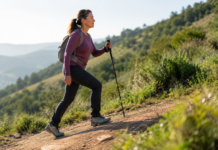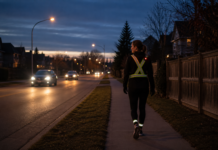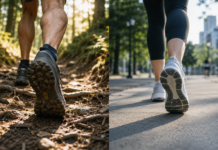

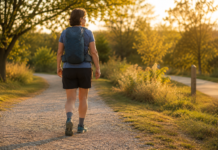


























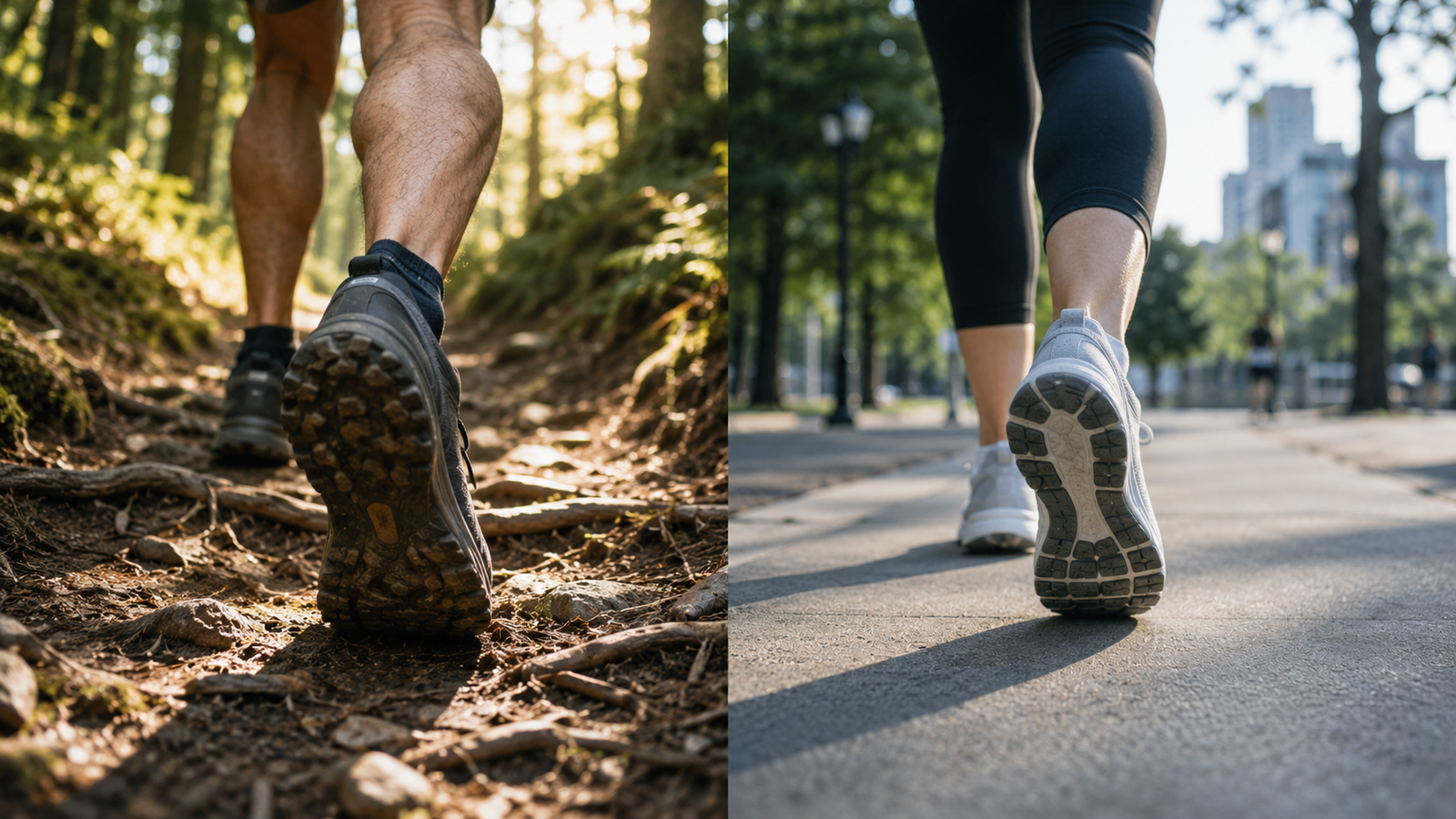
Every walker eventually asks a version of the same question: does the surface underfoot actually matter? Someone who has spent years pounding a flat neighborhood sidewalk might switch to a wooded trail and immediately notice sorer ankles the next morning. Someone else who’s always walked on dirt paths might try a paved riverside route and feel oddly stiff in the knees by mile two. Neither reaction is imagined. Surface changes how the body absorbs force, how hard the stabilizing muscles have to work, and even how the walk feels mentally afterward.
This comparison looks at what biomechanics and exercise science research actually show about trail walking versus pavement walking: how impact forces differ, why uneven ground demands more from the proprioceptive system, what the injury tradeoffs look like in each direction, and why a walk through trees may do something for mood that a walk past storefronts doesn’t. The goal isn’t to declare one surface the winner. It’s to give walkers enough information to choose deliberately based on their own joints, goals, and season of training.
How Impact Forces Actually Differ Between Surfaces
The intuitive assumption is that pavement is harder, so it must transmit dramatically higher forces into the legs than dirt or grass. The research is more nuanced than that. When Ferris, Liang, and Farley studied how runners adjusted to sudden changes in surface stiffness in a widely cited 1999 study published in the Journal of Biomechanics, they found that the body doesn’t simply accept whatever force a hard surface delivers. Instead, runners adjust leg stiffness on the very first step of contact with a new surface, softening their leg on hard ground and stiffening it on soft ground, so that the combined stiffness of leg plus surface stays relatively constant. In effect, the neuromuscular system is doing real-time shock management, which is why the difference in impact force between pavement and a firm dirt trail is often smaller than people assume, at least for a body that’s adapting normally.
That doesn’t mean surface hardness is irrelevant. Tessutti and colleagues, in a study published in the Journal of Science and Medicine in Sport, measured in-shoe plantar pressure during running on natural grass compared with asphalt and found meaningfully different loading patterns between the two surfaces, with asphalt producing higher peak pressures in specific areas of the foot. The takeaway is that surface hardness changes where and how force is distributed through the foot and lower leg, not just how much force exists in total. A softer, more compliant trail surface tends to spread loading more evenly and reduce peak pressure spikes, even if the body’s own stiffness adjustments narrow the gap.
There’s also a cumulative-loading angle worth separating from peak-force comparisons. Research on tibial stress injuries, including work by Milner, Ferber, Pollard, Hamill, and Davis published in Medicine & Science in Sports & Exercise, has tied stress fracture risk less to any single surface and more to repetitive, high-magnitude loading without adequate recovery. A hard, flat surface that lets someone walk faster and longer with identical footfall mechanics, mile after mile, can produce more repetitive strain over time than a varied trail surface simply because the trail naturally interrupts rhythm and forces small mechanical variations with every step.
| Factor | Trail Walking | Pavement Walking |
|---|---|---|
| Surface compliance | Variable, often softer (dirt, leaf litter, packed earth) | Rigid and uniform (asphalt, concrete) |
| Footfall pattern | Constantly adjusting to terrain irregularities | Repetitive, near-identical footfall each step |
| Proprioceptive demand | High — ankle, knee, and hip stabilizers work continuously | Low — minimal balance correction required |
| Typical walking speed | Slower, especially on rocky or root-covered terrain | Faster and easier to sustain a steady pace |
| Cumulative repetitive strain risk | Lower per session due to varied loading | Higher over time with identical repeated mechanics |
| Acute injury risk (trips, ankle rolls) | Higher, particularly in low light or unfamiliar terrain | Lower, though curbs and cracks still pose hazards |
| Accessibility for mobility devices | Limited, depends on trail grading and surface | Generally high — sidewalks, ramps, consistent grade |
| Mental health and mood benefit | Associated with greater reductions in rumination and stress | Present but generally smaller in comparative studies |
Footwear plays a role in how much of this loading difference actually reaches the leg. A shoe built for road walking typically prioritizes a firm, stable platform and cushioning tuned for repetitive, predictable footstrikes. A trail shoe usually adds a more aggressive outsole for traction on loose or wet terrain, a slightly stiffer torsional structure to resist rolling on uneven ground, and in many cases a rock plate to blunt point-loading from stones and roots. Wearing a road-oriented shoe on rough trail terrain, or a heavily lugged trail shoe on long stretches of pavement, tends to exaggerate whichever surface’s downsides are already present, since the shoe isn’t matched to the loading pattern it’s being asked to manage. This is a minor detail next to the underlying surface mechanics, but it partly explains why two people walking the same trail in different footwear can report very different levels of foot fatigue.
Stability and Proprioceptive Demand: Why Uneven Ground Works the Body Differently
Proprioception is the body’s sense of where its joints and limbs are in space without needing to look. It’s what lets someone catch a stumble before it becomes a fall. Walking on pavement asks very little of this system because the surface is flat, predictable, and unchanging step after step. Walking on a trail is a different story.
Menz, Lord, and Fitzpatrick published a frequently referenced study in Gait & Posture examining head and pelvis acceleration patterns when people walked on level ground compared with irregular surfaces. They found that irregular terrain produced significantly greater accelerations at the head and pelvis, along with reduced walking velocity and shorter, more cautious steps, indicating that the body adopts a more conservative, stability-focused gait strategy when the ground can’t be trusted to behave the same way twice. That’s the proprioceptive system doing extra work in real time: sensing small changes in ground height and angle and adjusting muscle activation at the ankle, knee, and hip before instability turns into a stumble.
A separate line of research from Voloshina, Kuo, Daley, and Ferris, published in the Journal of Experimental Biology, examined the biomechanics and energetics of walking on a surface with controlled unevenness. They found that people increased vertical center-of-mass excursion and altered joint work distribution to manage the terrain, even though the metabolic cost increase was more modest than the mechanical adjustments might suggest. In plain terms, the body doesn’t just work harder on uneven ground, it works differently, recruiting stabilizing muscles around the ankle and hip that a flat sidewalk barely calls on at all.
This is precisely why trail walking is often recommended as a low-impact way to build ankle strength, single-leg stability, and fall-prevention reflexes, particularly for older adults or anyone recovering from a lower-limb injury under supervision. It’s also why someone who has only ever walked on pavement can feel disproportionately fatigued in the stabilizer muscles, rather than the primary movers, after a first trail outing. The muscles doing the extra work aren’t the ones being conditioned by a flat, repetitive surface.
Terrain Selection Callout: Matching Ground to Goal
- Rehabbing an ankle or recovering from a fall: Start on pavement or a groomed, flat gravel path. Save technical trail terrain for later in recovery, and only with clearance from a physical therapist.
- Training balance and fall prevention: Choose moderate, well-maintained trails with some root and rock variation, walked at a conservative pace with full attention on footing.
- Managing a joint condition like knee osteoarthritis: A packed dirt or grass trail can reduce peak loading compared with concrete, but avoid steep, loose, or heavily rutted terrain that raises fall risk.
- Building walking speed or training for a timed event: Pavement’s consistency makes pacing and interval work far more measurable and repeatable.
- Walking primarily for stress relief and mental reset: Prioritize the most natural, tree-covered, or green-space route available, even if it’s a groomed park path rather than a rugged trail.
- Low light, unfamiliar area, or limited mobility: Pavement’s predictability and accessibility infrastructure make it the safer default.
Injury Risk Tradeoffs: Two Different Kinds of Risk
It helps to separate injury risk into two distinct categories, because trail and pavement walking each concentrate risk in a different one.
Acute injury risk is about a single bad moment: a rolled ankle on a hidden root, a slip on wet leaves, a stumble over a rock in low light. This risk is meaningfully higher on trails, especially technical ones, and especially for anyone with a history of ankle instability. It’s also highly manageable. Slower pace, trekking poles on descents, appropriate footwear with real tread, and walking familiar routes before attempting new ones all reduce acute risk substantially without eliminating trail walking’s other benefits.
Cumulative or overuse injury risk is about repetitive strain accumulating over weeks and months from identical mechanics repeated thousands of times. This risk tends to run higher on pavement, precisely because the surface doesn’t force any variation. The same joint angles, the same footstrike pattern, the same loading path through the same tissues, session after session. This is the mechanism researchers point to when discussing why some long-term road walkers and runners develop stress-related injuries in the shins, hips, or feet that trail-based athletes report less frequently, independent of total mileage.
Neither surface is categorically safer. A person prone to ankle sprains and walking alone at dusk is taking on real risk on a rooty trail. A person who walks the identical flat pavement loop daily at the same pace for years is taking on a different, slower-building risk of repetitive strain. The safest approach for most walkers who are cleared for general activity is some rotation between the two, letting pavement provide consistency and pace work while trail sections provide mechanical variety and stabilizer conditioning.
The Mental Health Case for Trails
Surface doesn’t only affect joints and muscles. It affects the nervous system’s relationship to the walk itself, and this is where the research on natural environments becomes relevant, separate from the biomechanics discussion entirely.
Bratman, Hamilton, Hahn, Daily, and Gross published a notable study in Proceedings of the National Academy of Sciences comparing a walk through a natural, green environment against a walk along a busy urban street. Participants who walked in the natural setting showed reduced self-reported rumination, the kind of repetitive negative thinking associated with depression risk, along with reduced neural activity in the subgenual prefrontal cortex, a brain region linked to that same rumination pattern. The urban walkers did not show the same reductions.
Barton and Pretty conducted a multi-study analysis published in Environmental Science & Technology looking at what they termed the dose-response relationship of green exercise, examining how different amounts and settings of outdoor natural activity affected self-esteem and mood. Even brief exposure produced measurable improvements, and effects were consistently stronger for activity that took place near water or in green settings compared with more built environments. A related review by Thompson Coon and colleagues, also in Environmental Science & Technology, compared outdoor natural exercise against the same activity performed indoors and found greater feelings of revitalization, positive engagement, and decreased tension, anger, and depression associated with the outdoor natural setting.
None of this means pavement walking has no mental benefit. Walking of any kind reliably improves mood compared with sedentary behavior. But when the specific comparison is trail or green-space walking against urban pavement walking, the research consistently favors the natural setting for measures tied to stress reduction and rumination, independent of exercise intensity or duration. For someone choosing a walking route specifically to manage stress or low mood, the surrounding environment appears to matter as much as the exercise itself.
Practical Guidance: Choosing Based on What You’re Actually Training For
The honest answer to “which is better” depends entirely on what a given walk is supposed to accomplish that day.
Training for a specific pace or distance goal. Pavement’s flat, measurable, repeatable surface makes it far easier to track splits, hold a target heart rate, or build up mileage predictably. A trail’s constantly shifting terrain makes pace comparisons across sessions almost meaningless.
Building ankle and hip stability, especially after age 50. Moderate trail terrain, walked cautiously, gives stabilizing muscles a training stimulus that flat pavement simply can’t replicate. This is one reason physical therapists sometimes incorporate varied-surface walking into fall-prevention programs for older adults, always progressing gradually and under guidance.
Recovering from an injury. Pavement or a smooth, groomed path is usually the safer starting point because it removes an entire category of variables (uneven footing, unpredictable loading) while healing tissue regains capacity. Trail walking can often be reintroduced later as strength and confidence return.
Managing joint pain, particularly knees or hips. A softer natural surface can reduce peak impact pressures compared with concrete, which is why some walkers with joint sensitivity report more comfort on packed dirt or grass. This has to be weighed against the trail’s uneven footing, which can itself aggravate an unstable joint. A well-maintained, flat trail or park path often offers a reasonable middle ground.
Managing stress, anxiety, or low mood. The nature-exposure research points fairly clearly toward green space, trees, and natural surroundings over an urban pavement route, even if the pavement route is objectively easier underfoot.
Building general fitness with no specific constraint. Alternating between the two gives the best of both: pavement for consistency and pace, trails for mechanical variety, stabilizer strength, and the psychological reset that comes with time in a natural setting.
Walking with a dog, a stroller, or mobility support. Pavement’s consistent grade and width generally make it the more practical choice for anyone managing equipment or an unpredictable leash pull, since a sudden misstep on root-covered ground is far harder to recover from while also controlling a stroller or a strong dog. Wide, well-maintained gravel trails can work as a middle ground where terrain and accessibility both matter.
Walking in a group with mixed fitness or mobility levels. A paved or well-groomed path lets a group hold a shared, comfortable pace without the slower members having to constantly watch their footing, which is often the deciding factor for a route choice that needs to work for everyone rather than for one person’s training goal.
Conclusion
Trail walking and pavement walking aren’t competing for the same job. Pavement offers predictability, pace control, and accessibility. Trails offer mechanical variety, proprioceptive training, and a measurable mental health edge tied to natural surroundings rather than exercise alone. The biomechanics research suggests the body is more adaptable to surface hardness than assumed, thanks to real-time leg stiffness adjustments, but that adaptability doesn’t erase the real differences in loading pattern, stability demand, and injury type between the two. The most useful question isn’t which surface is universally superior. It’s which surface matches the goal, the joints, and the mood a person is bringing to that particular walk.
Frequently Asked Questions
Is trail walking harder on the body than pavement walking?
It’s demanding in a different way rather than simply harder. Trails ask more of the proprioceptive and stabilizing systems around the ankle, knee, and hip because the ground constantly changes, while pavement’s repetitive flat surface concentrates strain through identical movement patterns over time. Neither is uniformly harder; they load the body differently.
Does walking on pavement cause more joint pain than trail walking?
Research on plantar pressure suggests harder surfaces like asphalt can produce higher peak pressures in specific areas of the foot compared with softer natural surfaces. For people with joint sensitivity, a packed dirt or grass surface may feel more comfortable, though uneven footing on rougher trails can introduce its own strain on an unstable joint.
Is trail walking better for balance and fall prevention?
Studies on irregular-terrain walking show the body adopts more cautious, stability-focused gait patterns with greater engagement of stabilizing muscles when the surface is uneven. This is one reason moderate trail walking is sometimes incorporated into balance and fall-prevention training, typically introduced gradually and under professional guidance for older adults.
Why does walking in nature feel more relaxing than walking on a sidewalk?
Comparative research has found that walking in natural, green settings reduces rumination and lowers activity in brain regions associated with repetitive negative thinking, effects not seen to the same degree during comparable walks along urban streets. The surrounding environment appears to influence mood benefits independent of the exercise itself.
Should beginners start with trail walking or pavement walking?
Most beginners, especially those returning from inactivity or injury, do well starting on pavement or a flat, groomed path where footing is predictable. Trail walking can be introduced gradually afterward as balance, ankle strength, and confidence build.
Can I get the mental health benefits of trail walking on a paved park path?
To a meaningful degree, yes. The research points to green surroundings and natural settings, not strictly unpaved ground, as the key variable behind reduced stress and rumination. A tree-lined paved path through a park can offer much of that benefit while keeping the predictable footing of pavement.
References
- Ferris DP, Liang K, Farley CT. “Runners adjust leg stiffness for their first step on a new running surface.” Journal of Biomechanics, 1999.
- Tessutti V, Trombini-Souza F, Ribeiro AP, Nunes AL, Sacco ICN. “In-shoe plantar pressure distribution during running on natural grass and asphalt in recreational runners.” Journal of Science and Medicine in Sport, 2010.
- Milner CE, Ferber R, Pollard CD, Hamill J, Davis IS. “Biomechanical factors associated with tibial stress fracture in female runners.” Medicine & Science in Sports & Exercise, 2006.
- Menz HB, Lord SR, Fitzpatrick RC. “Acceleration patterns of the head and pelvis when walking on level and irregular surfaces.” Gait & Posture, 2003.
- Voloshina AS, Kuo AD, Daley MA, Ferris DP. “Biomechanics and energetics of walking on uneven terrain.” Journal of Experimental Biology, 2013.
- Bratman GN, Hamilton JP, Hahn KS, Daily GC, Gross JJ. “Nature experience reduces rumination and subgenual prefrontal cortex activation.” Proceedings of the National Academy of Sciences, 2015.
- Barton J, Pretty J. “What is the best dose of nature and green exercise for improving mental health? A multi-study analysis.” Environmental Science & Technology, 2010.
- Thompson Coon J, Boddy K, Stein K, Whear R, Barton J, Depledge MH. “Does participating in physical activity in outdoor natural environments have a greater effect on physical and mental wellbeing than physical activity indoors?” Environmental Science & Technology, 2011.