















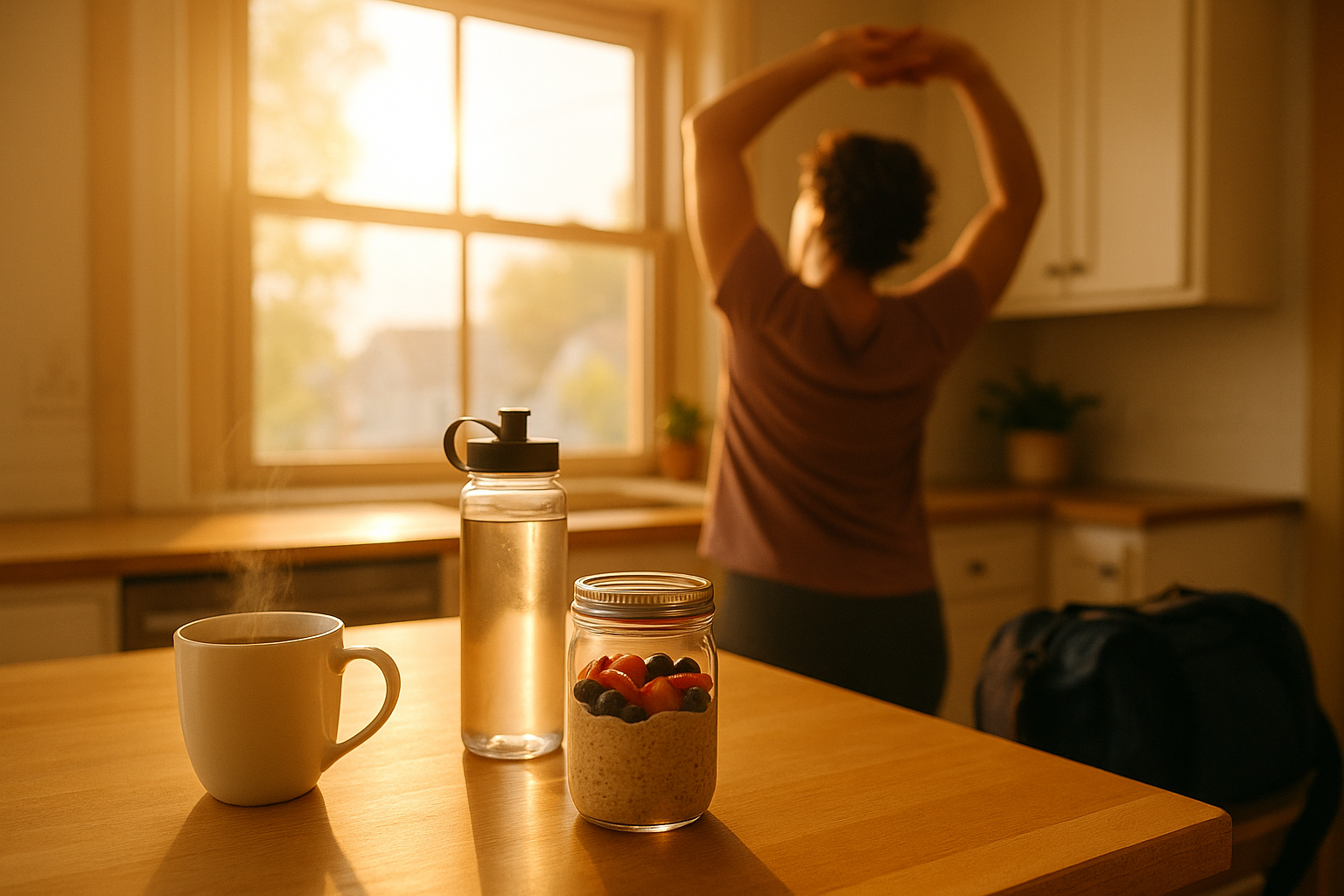
A healthy morning doesn’t have to be complicated. “Effective morning routines” are simply a repeatable set of early-day habits—like light, movement, hydration, and a protein-forward meal—that prime your brain and body for consistent energy and focus. In practice, that means aligning your wake time with your circadian rhythm, getting a dose of sunlight, moving briefly, and setting your plan for the day. Done well, these habits reduce decision fatigue, stabilize appetite, and create momentum that carries through work, study, and family life. For context and safety: this is general information, not medical advice—check with a health professional if you have a condition or specific concerns.
Fast-start steps: Wake at a consistent time → drink water → get outdoor light within 30 minutes → move 5–15 minutes → eat a protein-rich breakfast → pick 1–3 Most Important Tasks (MITs).
1. Wake at a Consistent Time (Even on Weekends)
Consistency is the anchor of effective mornings because your biological clock loves regularity. Waking within the same 60–90-minute window each day synchronizes your sleep–wake cycle, steadies morning energy, and makes falling asleep easier at night. The first light you see after waking helps shut down melatonin and raise core body temperature—natural signals to become alert—so keeping your wake time stable improves how quickly you “switch on.” If you experience weekday–weekend swings, try trimming the difference gradually; even a one-hour shift can make Monday feel like jet lag. Pair your alarm with a compelling cue—like opening the curtains immediately—and a pleasant ritual (stretch, water, music) so the routine sticks. If you’re managing shift work or caregiving, aim for the most consistent block you can sustain and lean on light and mealtime timing to help.
1.1 Why it matters
Morning light reduces melatonin and reinforces the circadian phase that promotes daytime alertness and nighttime sleep; when circadian timing and sleep patterns align, people tend to feel more refreshed.
1.2 Mini-checklist
- Keep wake time within a 60–90-minute window daily.
- Put the alarm across the room; stand and open curtains immediately.
- Batch late-night decisions earlier in the evening to protect bedtime.
- If weekends drift, cap the difference at ~1 hour and nap early if needed.
A stable wake time makes every other morning habit easier to execute and more effective.
2. Hydrate Smartly (But Don’t Overdo It)
After sleep, you’re slightly dehydrated, which can cloud thinking and make you feel sluggish. Start with a glass of water (200–400 ml) to rehydrate and kick-start your routine. There’s no single “right” morning amount; total daily fluid needs vary by body size, activity, diet, climate, and health status. As a broad benchmark, the U.S. National Academies suggest ~3.7 L/day for men and ~2.7 L/day for women—from all beverages and foods—but use thirst, urine color (pale straw), and your environment to guide you. If you drink coffee or tea, remember caffeine contributes to daily fluids, though timing matters for sleep (see Section 5). In hot climates or during Ramadan/fajr training blocks, plan electrolytes and fluids across non-fasting hours so your morning still runs smoothly.
2.1 Numbers & guardrails
Adequate Intake: ~3.7 L/day (men) and ~2.7 L/day (women), including fluids from foods; personalize based on climate and activity. Mayo Clinic
2.2 Practical tips
- Set a filled bottle on your nightstand as a cue.
- Add a squeeze of lemon or a pinch of salt if you’ve sweated heavily.
- Keep caffeine separate from your first water if you’re sensitive.
Hydration is a simple win: it perks up cognition and pairs naturally with the next steps.
3. Get Natural Light Within 30 Minutes of Waking
If you can do only one thing, step outside for 5–10 minutes of daylight. Outdoor light is orders of magnitude brighter than indoor bulbs, even on cloudy days, and it’s the most powerful lever for “setting” your circadian clock. Morning light tells the brain it’s daytime—melatonin tapers, cortisol rises appropriately, and you feel more alert now and sleepier at the right time tonight. Aim to face the horizon (no sunglasses if safe), and increase time to 20–30 minutes in darker winters. In extreme heat or high-latitude winters, use earlier/later windows or consider a certified light box as a supplement.
3.1 Numbers & guardrails
Your circadian system is especially sensitive to light roughly an hour after your usual wake time; getting outdoor light early helps anchor your rhythm for the rest of the day.
3.2 Region note (hot climates)
In hot or humid regions, go out before peak heat (often before 8 a.m.) or on shaded balconies; reflective surfaces still boost lux. Morning light helps halt melatonin and raise body temperature to promote wakefulness.
Light is the master cue; stack it with movement (next section) to compound benefits.
4. Move for 5–20 Minutes (Any Bout Counts)
A short morning movement block activates muscles, elevates mood, and “primes” your brain for focus—even if you train seriously later. The key is consistency and intensity appropriate for you: brisk walking, mobility flow, stairs, band work, or a short interval session. As a bonus, modern guidelines recognize that bouts of any duration contribute to your weekly activity total; even a 5–10-minute climb or walk “counts.” Over a week, aim for 150–300 minutes of moderate-intensity aerobic activity (or 75–150 minutes vigorous) plus 2+ days of muscle-strengthening for broader health.
4.1 Numbers & guardrails
Short, moderate-to-vigorous bouts now “count” toward totals; adults should accumulate 150–300 min/week moderate (or 75–150 min vigorous) + 2 days strength.
4.2 Quick menu (pick one)
- 10-minute brisk walk outside after water and light.
- Mobility ladder: neck–shoulders–hips–ankles (2 minutes each).
- Micro-circuits: 3 rounds of 8 squats, 8 push-ups (incline), 20-second plank.
- Stairs: 6–10 flights at conversational pace.
Finish able to hold a conversation. If you feel dizzy or unwell, stop and reassess.
5. Time Caffeine and Choose a Protein-Forward Breakfast
Breakfast is optional for some, but many people feel steadier energy with an early, protein-rich meal (e.g., eggs, Greek yogurt, tofu scramble, dal + yogurt, or a smoothie with milk/yogurt and nut butter). Target ~20–30 g of protein, fiber-rich carbs, and healthy fats to curb mid-morning cravings and support attention. If you use caffeine, know your dose and cutoff: up to ~400 mg/day is generally considered safe for most healthy adults, but caffeine later in the day can disrupt sleep. As a rule of thumb, cut caffeine at least 6–8 hours before bedtime; shift your first cup slightly later (60–90 minutes after waking) if you get early energy dips.
5.1 Numbers & guardrails
Protein at breakfast can help moderate appetite and post-meal glucose; up to ~400 mg/day caffeine is generally safe for most healthy adults, and caffeine within 6 hours of bedtime can impair sleep.
5.2 Tools & ideas
- Build plates with MyPlate (vegetables, fruits, grains, protein, dairy).
- Batch overnight oats, egg muffins, or yogurt pots on Sundays.
- If commuting, pack a shatter-proof container and spoon by the door. Food and Nutrition Service
A steady first meal—paired with smart caffeine timing—keeps energy and focus predictable.
6. Plan the Day With MITs and Time Blocking
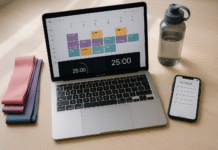
Five minutes of planning in the morning trades chaos for clarity. Pick 1–3 Most Important Tasks (MITs) that directly advance your goals, then time-block the first 60–90 minutes for deep work. This reduces context switching and stress while improving follow-through. Keep the plan visible (paper card, calendar, or an app), and protect your first block from meetings and messaging when possible. If your job is reactive, set shorter blocks (20–30 minutes) and a “buffer” slot for surprises.
6.1 Why it matters
Research and guidance from psychology orgs consistently link poor time management with higher perceived stress; structured planning helps people cope better and feel more in control. American Psychological AssociationPMC
6.2 Mini-checklist
- Choose 1–3 MITs that, if done, make the day a win.
- Block your calendar for the first focused work session.
- Tackle low-effort admin later; batch messages at set times.
A simple written plan transforms a “busy” morning into meaningful progress.
7. Add 3–10 Minutes of Mindfulness or Breathwork
Short mindfulness sessions calm the stress response, improve emotional regulation, and sharpen attention—benefits that compound when practiced regularly. A 3–10-minute exercise in the morning (box breathing, body scan, or guided meditation) is long enough to shift state without derailing your schedule. If you don’t like silent meditation, try mindful walking after your light exposure, focusing on breath and surroundings. Pairing mindfulness with a consistent cue—after light, before coffee—helps it become automatic over time.
7.1 What the evidence says
Mindfulness-based approaches can reduce symptoms of anxiety and depression compared with usual care (though results vary by approach and quality of study); integrate practices you can sustain.
7.2 Try one
- Box breathing: inhale–hold–exhale–hold (4–4–4–4) × 10 cycles.
- Body scan: 2–5 minutes, head to toes.
- Guided app: choose a 5-minute “morning reset.”
A calmer nervous system early in the day makes every following task easier.
8. Do 10 Minutes of Meal Prep or Snack Setup
Future-you will thank morning-you for ten minutes of prep. Wash fruit, portion nuts or hummus, box leftovers with whole-grain add-ons, and set a water bottle by your bag. Planning a few meals prevents “decision fatigue” and makes the healthy choice the easy one—especially on hectic days. If budget is tight, use tools that surface local produce savings and simple recipes. For families, involve kids in rinsing veggies or packing lunch to build skills and save time later.
8.1 Why it works
Planning and prepping meals improves food choices and helps you avoid less-healthy fast options; short tracking (“My Food Diary”) and MyPlate tools can support consistency.
8.2 Tools & tips
- Batch once, use thrice: cook a grain/protein/veg base on weekends.
- Portion snacks into grab-and-go containers.
- Shop Simple with MyPlate for local deals and budget recipes. MyPlate
Ten deliberate minutes reduce stress at noon and keep energy stable through the afternoon.
9. Practice Digital Hygiene (Delay Doomscrolling)
The first minutes after waking are when you set your attentional tone. Diving into notifications or news can spike stress and fracture focus before you’ve chosen your priorities. Instead, make your phone part of the routine on your terms: silence non-urgent notifications, use a minimalist home screen, and set a 15–30-minute “message check” after your light, water, and movement. If you must check for emergencies, add a rule: inbox scan only—no replies until your first work block. Many people find they get more done by not starting their day inside someone else’s to-do list.
9.1 Mini-checklist
- Use Do Not Disturb until you’ve finished your core routine.
- Keep only two apps on the first screen: calendar and notes.
- Batch messages at set times; pin VIP contacts.
Guard your attention early; you’ll feel calmer and accomplish more.
10. Use Habit Stacking and “If-Then” Plans
Lasting routines rely on cues. Habit stacking ties a new behavior to an existing one (“After I open the blinds, I drink 300 ml water”). Implementation intentions are specific if-then plans (“If I see sunlight, I’ll walk to the corner and back”), which research shows meaningfully boost goal follow-through because they automate action in response to cues. Combine the two across your morning sequence: wake → open blinds → water → outside light → movement → protein → plan. Track each action with a simple checkbox to reinforce progress.
10.1 What the evidence says
Forming if-then plans increases the likelihood of acting on goals across domains; habit strength builds over time, with a widely cited study showing a median ~66 days to reach automaticity (range 18–254).
10.2 Build your chain
- Convert each step into an if-then statement.
- Add a visible cue (filled bottle, shoes by door).
- Use a one-line tracker; streaks motivate consistency.
Design the morning so the next right action is almost automatic.
11. Set Up Your Environment the Night Before
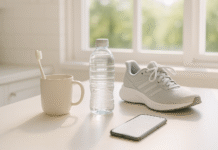
The easiest morning is the one you staged in advance. Place your water bottle by the bed, lay out clothes, pack your bag, and prep your breakfast base. Clear your desk, charge devices away from the bedroom, and leave only the essentials visible for your first work block. If you share a home, agree on noise-friendly hours and “quiet wake-ups” (lamp timers, headphones). These small, physical cues reduce friction and decision fatigue, so you glide through the first 30–60 minutes without negotiating with yourself.
11.1 Mini-checklist
- Stage the first 60 minutes before bed: clothes, bottle, keys, list.
- Put shoes where you’ll trip over them (in a good way).
- Set a lamp timer to coincide with your alarm.
Environment doesn’t rely on willpower; it quietly nudges you into action.
12. Measure, Review, and Iterate Weekly
Great routines evolve. Track just a few metrics that matter—sleep/wake time, sunlight minutes, movement minutes, and breakfast quality—and review them once a week. Ask: What felt easy? What created friction? Tweak one thing at a time (earlier light; simpler breakfast; shorter, more consistent movement). Expect several weeks for a routine to “click”—habit formation is variable, but consistency plus clear cues wins. If your life stage changes (new baby, travel, Ramadan, intense work sprint), scale back to a minimum viable morning and rebuild from there.
12.1 Numbers & perspective
Habit automaticity often requires weeks, not days; 66 days is a helpful median—your number may be shorter or longer, and that’s normal. Scientific American
12.2 Weekly review prompts
- Which step delivered the biggest benefit this week?
- Which single friction point can I remove next week?
- What’s my minimum viable morning on bad nights or travel days?
Measure lightly, learn quickly, and your routine will keep paying dividends.
FAQs
1) What’s the simplest effective morning routine if I only have 15 minutes?
Use a three-part stack: water (1–2 minutes), outdoor light + walk (8–10 minutes), and a protein-rich grab-and-go (2–4 minutes). This sequence hydrates, anchors your circadian rhythm, boosts mood and alertness, and stabilizes appetite until lunch. On busier days, skip the sit-down breakfast and take yogurt, eggs, or a protein smoothie for the commute. Morning light’s circadian effect is especially valuable when time is tight.
2) I don’t eat breakfast—is that OK for productivity and health?
Plenty of people thrive without breakfast. If you skip it, ensure your first meal—whenever it lands—is protein-rich and includes fiber to avoid energy crashes. If you struggle with mid-morning cravings or focus dips, trial a 2-week protein-forward breakfast and compare. Evidence suggests protein at the first meal can help with appetite control and glycemic response for many people, but preferences and responses vary.
3) How much morning movement do I really need?
Even short bouts count and help—aim for 5–20 minutes most days. Over the week, the big target is 150–300 minutes moderate (or 75–150 minutes vigorous) plus strength work twice—your morning block can contribute to that total. If you’re new to exercise or returning after injury, start with brisk walking and gentle mobility.
4) When should I have my first coffee?
If you’re sensitive to early dips, try delaying coffee 60–90 minutes after waking so your natural cortisol peak can rise unhindered; then enjoy. Keep total daily caffeine within ~400 mg (unless pregnant or advised otherwise), and set a cutoff 6–8 hours before bedtime to protect sleep.
5) Does blue light in the morning help or hurt?
Daytime blue-enriched light supports alertness and circadian signaling; bright morning light is beneficial. The caution applies to evening exposure, which can suppress melatonin and delay sleep. Use screens freely in the morning if you like, but avoid late-evening screen glare without filters. Sleep Foundation
6) How much water should I drink right after waking?
There’s no universal number. Begin with a glass (200–400 ml) and let thirst and urine color guide you; the National Academies’ daily Adequate Intakes are ~3.7 L (men) and ~2.7 L (women), including food moisture. Adjust for climate, body size, and activity.
7) What if my mornings vary (kids, shift work, travel)?
Create a minimum viable morning: a 5-minute combo of water, 5 minutes of light (balcony/window if needed), and a 5-minute movement snack. Do it whenever your “morning” occurs, then scale up when life allows. Light timing relative to your wake time still helps anchor your body clock. Sleep Foundation
8) Are mindfulness apps worth it for short sessions?
If an app helps you practice consistently, yes. Even brief (3–10 minute) guided sessions can reduce stress symptoms for many people compared with usual care, though effects vary. Try different formats until you find one you’ll actually do.
9) Is breakfast more important for athletes or heavy labor days?
Often yes: a protein-rich breakfast with complex carbs helps replenish glycogen and supports training or manual work later. If training very early, a small pre-session snack (banana + yogurt) may be enough, with a full meal after. Use your sport/coach’s guidance and how you personally feel. (See Section 5 and general nutrition resources.)
10) How long until a new routine feels automatic?
Expect weeks, not days. A landmark study found a median of ~66 days to reach habit automaticity, with wide variation (18–254 days). Track small wins and keep cues obvious to speed it up.
11) What’s a smart order for the steps?
A practical chain is: wake → open blinds → water → outdoor light walk → 5–15-minute movement → protein breakfast → pick 1–3 MITs. That order aligns with circadian signals, appetite control, and attention. Tweak based on context (e.g., school runs or early shifts).
12) How do I keep weekends from wrecking my Mondays?
Cap sleep-in to ~1 hour, keep morning light and movement, and hold mealtimes relatively stable. Large shifts can feel like jet lag; small, predictable variations are easier to recover from.
Conclusion
Mornings are not about perfection; they’re about building a repeatable system that starts your day on your terms. Anchor the rhythm (consistent wake, outdoor light), power the body (hydration, a short movement block, protein-forward meal), and point your attention (1–3 MITs, brief mindfulness, digital hygiene). Then remove friction with smart environment design and habit-stacked cues. Keep your routine small enough to do on your worst day, not just your best, and iterate weekly by measuring what matters—light, movement, breakfast quality, and focus time. Within a few weeks you’ll feel smoother starts, more stable energy, and easier nights.
Start tomorrow: Set your wake window, fill a bottle, put shoes by the door, and write down three words—light, move, protein—to cue your new morning.
CTA: Pick one habit from this guide and lock it in for the next 7 days—your future mornings will thank you.
References
- Adult Activity: An Overview. Centers for Disease Control and Prevention (CDC). Dec 20, 2023. https://www.cdc.gov/physical-activity-basics/guidelines/adults.html
- The Physical Activity Guidelines for Americans (2nd ed.). U.S. HHS / JAMA overview by Piercy KL et al. 2018. https://pmc.ncbi.nlm.nih.gov/articles/PMC9582631/
- The Influence of Removing the Ten-Minute Bout Requirement from the 2018 Guidelines. CDC Preventing Chronic Disease. 2020. https://www.cdc.gov/pcd/issues/2020/19_0321.htm
- World Health Organization 2020 Guidelines on Physical Activity. Bull FC et al., Br J Sports Med. 2020. https://pubmed.ncbi.nlm.nih.gov/33239350/
- What Is Circadian Rhythm? Sleep Foundation. Jul 23, 2025. https://www.sleepfoundation.org/circadian-rhythm
- Good Light, Bad Light, and Better Sleep. National Sleep Foundation. Mar 21, 2025. https://www.thensf.org/good-light-bad-light-and-better-sleep/
- Extra protein at breakfast helps control hunger. Harvard Health Publishing. Dec 1, 2018. https://www.health.harvard.edu/staying-healthy/extra-protein-at-breakfast-helps-control-hunger
- Breakfast & MyPlate resources. MyPlate.gov (USDA). Accessed 2025. https://www.myplate.gov/taxonomy/term/119
- Spilling the Beans: How Much Caffeine is Too Much? U.S. Food & Drug Administration. Aug 28, 2024. https://www.fda.gov/consumers/consumer-updates/spilling-beans-how-much-caffeine-too-much
- Caffeine Effects on Sleep Taken 0, 3, or 6 Hours Before Bedtime. Drake C et al., J Clin Sleep Med. 2013. https://pmc.ncbi.nlm.nih.gov/articles/PMC3805807/
- Meditation and Mindfulness: Effectiveness and Safety. National Center for Complementary and Integrative Health (NCCIH). Jun 3, 2022. https://www.nccih.nih.gov/health/meditation-and-mindfulness-effectiveness-and-safety
- Water: Adequate Intakes. National Academies (NASEM) / Dietary Reference Intakes. Accessed 2025. https://www.nationalacademies.org/news/2004/02/report-sets-dietary-intake-levels-for-water-salt-and-potassium-to-maintain-health-and-reduce-chronic-disease-risk
- How to Have Healthier Meals and Snacks; Tips for Healthy Eating for a Healthy Weight. CDC. 2023–2024. https://www.cdc.gov/healthy-weight-growth/healthy-eating/meals-snacks.html and https://www.cdc.gov/healthy-weight-growth/healthy-eating/index.html
- Meal Prep Guide. Harvard T.H. Chan School of Public Health—The Nutrition Source. Accessed 2025. https://nutritionsource.hsph.harvard.edu/meal-prep/
- Modelling Habit Formation in the Real World. Lally P. et al., Eur J Soc Psychol. 2010. https://onlinelibrary.wiley.com/doi/full/10.1002/ejsp.674
- Implementation Intentions: Strong Effects of Simple Plans. Gollwitzer PM., review/brief (Cancer Control PDF). 2006. https://cancercontrol.cancer.gov/sites/default/files/2020-06/goal_intent_attain.pdf