
















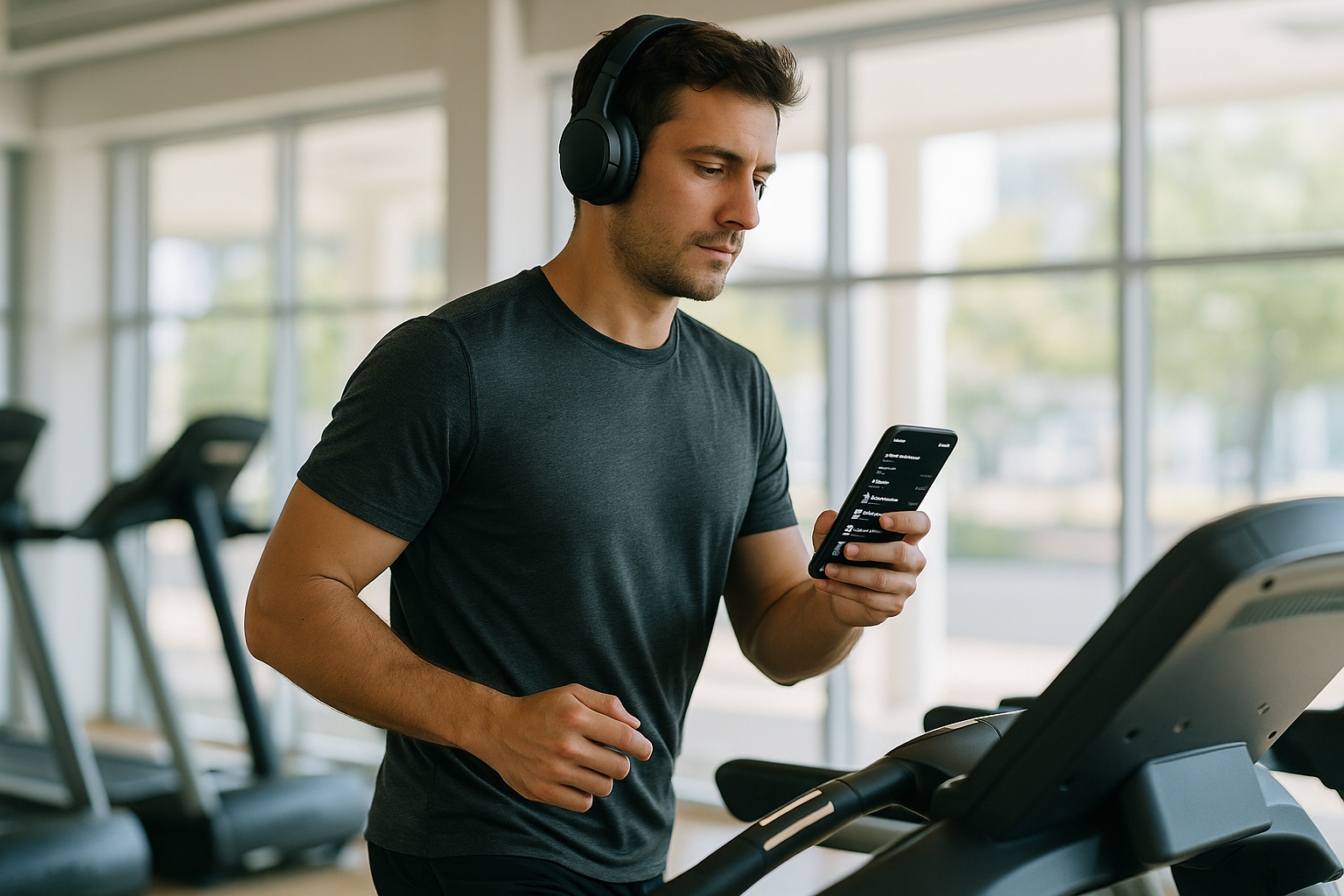
Music and podcasts can turn “I should work out” into “I can’t wait to move.” Used intentionally, audio can reduce perceived effort, lift mood, and even improve performance, especially when tempo and format match your goal. In short: use music for intensity and cadence, and use podcasts to build consistency and make long efforts fly by. A large meta-analysis across 139 studies found music modestly boosts performance and enjoyment while lowering perceived exertion; fast tempos help most.
1. Match Tempo (BPM) to Your Workout’s Effort
Start by choosing tempos that fit the work you’re about to do; the right beats per minute (BPM) nudge your pace and make effort feel smoother. For moderate to high-impact classes, a range around ~120–155 BPM often feels “naturally” motivating, whereas yoga or mobility flows benefit from lower tempos. Think of BPM as a metronome for your session: higher for intervals and cardio surges, lower for warm-ups and cooldowns. Rather than guessing, anchor your picks to evidence-based ranges and then fine-tune to taste. This “fit first, preference second” approach keeps you honest on hard days and relaxed on easy days.
How to do it
- Use a BPM counter app to scan songs you already love.
- For high-impact cardio, start near 135–155 BPM; for step/low-impact work, 118–140 BPM; for yoga/pilates, keep it <110–120 BPM.
- Build warm-up and cooldown crates at ≤110–120 BPM to dial arousal down when needed.
- Save a small “overdrive” set (e.g., 1–2 tracks at your top BPM) for your main set.
- If a song feels too fast, try “half-stepping” (move on every other beat).
Tools/Examples
- BPM analyzer apps, smart playlists that sort by tempo, and wearable cadence readouts are your friends.
- Start with one 30-song master list sorted by BPM bands; promote/remove tracks each week.
Wrap by reminding yourself that tempo is a steering wheel: set it before the road gets windy.
2. Sync Beats to Your Movement (Cadence Lock)
Locking your steps or pedal strokes to the beat—“synchronous music”—can make hard efforts feel smoother and help you sustain pace longer. The simple trick is to match song tempo with your natural cadence or a target cadence for intervals. Research shows fast-tempo music has greater ergogenic effects than slow-to-medium, and 130 BPM has extended high-intensity cycling time to exhaustion by about 10% in lab settings. Cadence-locking won’t magically make VO₂max work easy, but it can delay the “this is too hard” moment and improve rhythm under fatigue.
How to do it
- Find your cadence from your watch/bike computer; pick songs within ±5 BPM of that number.
- For running, if music feels “too fast,” try moving on every second beat (half-time).
- For cycling, align chorus “peaks” with interval surges.
Numbers & guardrails
- Use fast-tempo tracks for work bouts and mid-tempo for recovery; keep transitions obvious.
- If your gait feels forced, back off—comfort beats “perfect” sync every time.
Finish by noting that synchronization is a feel skill; the more you practice, the less you think about it.
3. Program Your Playlist by Phase: Warm-Up → Work → Cooldown
A great workout sounds like a story: gentle opening, rising action, decisive climax, and a calm ending. Start with two to three low-tempo tracks (≤110–120 BPM) to raise temperature and wake up mobility. Then stack your “meat and potatoes” in the middle—four to eight up-tempo tracks that hit your target cadence and style. Land the plane with two cooldown cuts that let heart rate fall and breathing even out. This simple structure keeps you present and reduces the urge to skip around mid-session. It also gives your nervous system the arousal curve it expects: steady ramp, sharp focus, then decompression.
Mini-checklist
- Warm-up (2–3 songs): ≤110–120 BPM, soothing intros, minimal lyrical intensity.
- Main set (20–30 min): 120–155 BPM matched to cadence or interval targets.
- Cooldown (2 tracks): ≤110 BPM, longer outros, downshift energy.
Why it matters
Programming beats reduces decision fatigue. You’ll spend focus on reps, not track-hunting, and the consistent arc trains your body to “recognize” it’s time to perform—and then recover.
4. Use Preferred (Not Just Popular) Tracks for Peak Efforts
What moves the charts isn’t always what moves you. Studies suggest that preferred music—what you like—can lift motivation, improve mood, and in some protocols improve power or repetitions to failure compared with nonpreferred tracks or silence. The mechanism is part psychological (affect and arousal) and part psychophysical (lower perceived exertion), with effects strongest around warm-up and high-intent efforts. That means your “PR crate” should be highly personal, not just algorithmic. In practice, a handful of beloved songs tied to strong positive memories can be your best legal performance enhancer.
How to do it
- Create two crates: Preferred for go-time; Nonpreferred for variety/novelty days.
- Tag tracks that consistently make you “lean in” (goosebumps, head nods).
- Re-test every 4–6 weeks; retire songs that feel stale.
Common mistakes
- Overusing one anthem until it loses punch.
- Letting trends dictate your picks.
- Confusing volume with motivation—protect your hearing (see Tip 9).
Bottom line: when the set matters, hit play on songs that matter to you.
5. Make Long, Easy Sessions Fly with Podcasts (“Temptation Bundling”)
Podcasts shine on low-intensity steady-state days and recovery walks: they keep your mind engaged without forcing cadence. Behavior-change research calls this temptation bundling—pairing a “want” (an addictive show) with a “should” (exercise)—which has increased weekly workouts by roughly 10–14% in field experiments when people saved beloved audio for the gym. If you reserve your favorite series for walks, you’ll start to crave the walk when a new episode drops. Bonus: a recent randomized trial found no meaningful difference in knowledge acquisition or 30-day retention for residents who learned via podcast while exercising versus seated. ScienceDirect
How to do it
- Pick “evergreen” shows for weekly LISS (30–60 min).
- Only allow yourself to listen while moving.
- Keep the pace easy enough to breathe and listen comfortably.
Mini case
- If new episodes release Tuesdays, schedule your recovery run then. Your habit gets a free “pull.”
Use podcasts to feed your brain while your body accumulates easy, enjoyable volume. PMC
6. Build Interval-Ready Playlists with Clear Audio Cues
Intervals feel shorter when your playlist tells you what to do. Pre-mark surges with a distinctive intro, drop, or lyric, and use spoken countdowns or timer chimes for precision. Group your “on” songs around the same BPM so each rep auto-locks to cadence; choose mellow instrumentals for “off” periods to promote active recovery. This reduces cognitive load, keeps reps consistent, and makes pacing mistakes less likely. Many athletes find that hearing the same cue at the same rep creates a “Pavlovian pop” of effort that carries them through the tough middle.
Tools/Examples
- Timer apps with custom sound cues; interval-specific mixes; short tracks (~2:00–2:30) for 2-minute reps.
- For 30/30s, stack a 30-second sample loop for “on” and a softer 30-second loop for “off,” repeated 10–12 times.
Checklist
- Distinct cue for rep start.
- BPM within ±5 for all “on” tracks.
- Softer dynamics during recovery.
Design once; reuse forever. Your intervals will feel scripted—in a good way.
7. Rotate and Refresh to Avoid “Hedonic Adaptation”
Even the best playlist dulls with overuse. Our brains adapt to repeated stimuli, so a song that once lit you up may fade into background noise. Build a rotation system: keep a core of 10–15 keepers and swap 3–5 tracks weekly. Maintain separate crates for seasons, vibes, and workout types (speed, tempo, strength). Add new music during easy weeks and “lock” the set before test days to avoid surprises. This intentional rotation preserves novelty’s dopamine kick without destabilizing your routine.
How to do it
- Calendar a 10-minute “DJ session” every Sunday to rotate in 3–5 tracks.
- Use smart playlists that auto-exclude songs played >5 times in 14 days.
- Keep a “probation” crate for candidates; promote only the ones that consistently move you.
Synthesis
With small, regular tweaks, you keep motivation fresh while preserving the familiar backbone that cues performance.
8. Use Lyrics and Themes Deliberately (and Sparingly)
Lyrics can energize—or distract. For complex lifts and technical drills, simpler, predictable structures preserve focus; for grinders and finishers, anthemic choruses can help you “lean into” discomfort. Consider language, cultural references, and personal associations. Align themes with goals (e.g., resilience during hill repeats; calm focus during mobility). When in doubt, instrumentals or minimal-lyric tracks reduce cognitive load and keep you inside your body.
Mini-checklist
- Skill work: instrumentals, ambient, minimal vocals.
- Power/PR attempts: personally meaningful anthems.
- Mobility/cooldown: low-tempo, low-lyric density.
Tip
Couple lyrical “peaks” with the last 60–90 seconds of a hard block to create a predictable push. Close the loop with quieter tracks as you recover.
9. Train Your Ears, Too: Safe Volume & Awareness
Great audio shouldn’t cost you your hearing—or your safety outdoors. Follow safe-listening guidance: aim to keep device volume ≤60% and weekly exposure near 80 dB for no more than ~40 hours; at 90 dB, safe time drops to ~4 hours per week. Noise-canceling or well-fitted headphones can help you keep volumes down, but always maintain situational awareness (lower volume, one-ear mode, or bone-conduction in traffic). Give your ears breaks and watch for warning signs like ringing or muffled hearing. Safety first means you can enjoy training soundtracks for decades, not months.
How to do it
- Set a hard max volume and enable device “hearing” alerts.
- Use noise-canceling in gyms/planes to avoid cranking volume, and disable it outdoors when you need awareness.
- Schedule occasional “quiet miles” to rest your ears.
Synthesis
Protecting your hearing is part of longevity—treat decibels like load and recover accordingly.
10. Let Fast Tempos Do the Heavy Lifting on Hard Days
When intensity climbs, fast beats shine. Evidence shows fast tempo yields stronger performance effects than slower music, and a controlled trial at 130 BPM extended high-intensity cycling time to exhaustion by ~10%. This doesn’t mean louder or faster is always better, but for intervals and threshold work, upbeat tracks can provide just enough dissociation and arousal to carry you through the toughest reps. Think of these as “performance picks” reserved for work that requires grit.
How to do it
- Create a small HIIT crate of 6–10 tracks at your target cadence.
- Use the same opener every time to condition a rapid shift into “work mode.”
- Keep cooldown tracks ready to downshift arousal afterward.
Numbers & guardrails
- If form slips when the music peaks, you’ve crossed your helpful arousal threshold—dial back.
11. Learn While You Move: Podcasts Without the Performance Penalty
Worried that podcasts might “steal focus”? For easy cardio, that’s a feature, not a bug. And for learning: a multicenter randomized crossover trial found no meaningful difference in immediate or 30-day knowledge retention when residents listened to a 30-minute educational podcast while exercising versus seated. That means you can collect low-intensity volume and lecture hours simultaneously—without sacrificing comprehension. Choose topics that match the vibe of the day: deep-dive episodes for long walks; lighter shows for restorative spins.
How to do it
- Set “listen goals” tied to training blocks (e.g., finish a 10-episode series during a 6-week base phase).
- Favor single-host or well-paced shows; dense roundtables can be harder to follow while moving.
- Use bookmarks/voice notes to capture ideas mid-stride.
Synthesis
When intensity is low, podcasts are a two-for-one: fitness for the body, curiosity for the brain.
12. Put It All Together with a Simple Weekly Audio Plan
Tie these ideas into a repeatable rhythm so you never face a silent treadmill again. Map audio to training intent: music for speed/strength, podcasts for aerobic base, calm instrumentals for recovery and mobility. Build one “auto-pilot” playlist per key session, then rotate 3–5 tracks weekly to keep things fresh. Protect your hearing with smart volume habits and keep an eye on cadence for synchronization on cardio days. The more you pre-decide, the less you’ll negotiate with yourself when it’s time to move.
Example week
- Mon – Upper Strength: Preferred hype tracks for warm-up + top sets; instrumentals for accessories.
- Tue – Easy Run (45’): Favorite podcast; low volume; one-ear awareness outdoors.
- Thu – Intervals: HIIT crate at target BPM with clear cues.
- Sat – Long Ride: Two podcast episodes + mid-ride music set for surges; cooldown playlist.
Synthesis
A tiny bit of planning creates an audio environment that nudges you toward the workout you intended—every time.
FAQs
1) What BPM should I choose for different workouts?
Use evidence-based ranges as a starting point: high-impact cardio often feels right around ~135–155 BPM; step/low-impact around 118–140; yoga/pilates under ~110–120. Then tune by feel and cadence. If a BPM clashes with your stride or pedal rate, halve or double the beat to fit your movement.
2) Does music really improve performance, or is it placebo?
Across 139 studies, music shows small-to-moderate benefits: better affect, lower perceived exertion, and modest performance gains, especially in exercise (vs. competitive sport) contexts. Fast tempo tends to help more than slow. Expect a nudge, not a miracle—and make it count on hard sets.
3) Are podcasts okay during workouts?
Yes—particularly for low-intensity sessions. For learning, a randomized trial in residents found no meaningful difference in immediate or 30-day knowledge retention when listening while exercising versus seated, so you can learn and move simultaneously.
4) Is synchronous music (moving on the beat) actually better?
Often, yes. Synchronizing movement with rhythm can improve efficiency and delay fatigue at certain intensities; one trial at 130 BPM extended high-intensity cycling time to exhaustion by ~10%. Use cadence-matched tracks for intervals and tempo work.
5) How loud is safe for headphones?
Keep device volume at or under ~60% and aim for safe exposure levels: roughly 80 dB up to ~40 hours/week, but only ~4 hours/week at 90 dB. Use noise-canceling or better seals to avoid cranking volume and take listening breaks.
6) Do my music preferences matter, or should I follow “best of” lists?
Preference matters. Reviews and experiments show preferred music can improve motivation and sometimes performance compared with nonpreferred tracks. Build a personal “PR crate” and refresh it regularly to avoid adaptation.
7) Can fast music replace a proper warm-up?
No. Music can prime arousal, but your tissues still need progressive loading and mobility. Use lower-tempo tracks to pace a 5–10 minute ramp, then bring in faster songs for the first working set to focus your attention.
8) What about strength training—does music help or hurt?
For complex lifts, simpler music can help focus; for heavy top sets, preferred hype tracks may boost intent. Some studies report benefits for repetitions or power when preferred music is used during warm-ups, though effects vary by person and exercise. Test it on your accessory work first. MDPI
9) Will noise-canceling make outdoor workouts dangerous?
It can if it blocks critical environmental sounds. Use lower volumes, awareness modes, or bone-conduction outdoors. Indoors, noise-canceling can help you keep volume down and protect hearing—be smart about context.
10) How often should I update my playlists?
Weekly micro-updates (swap 3–5 tracks) keep novelty high without destabilizing routine. Retire songs that no longer motivate you and promote new contenders after two or three workouts.
Conclusion
Used intentionally, music and podcasts are more than background noise—they’re levers for motivation, pacing, and consistency. Start with tempo: choose BPM that suits your session and, where useful, synchronize to cadence. Lean on preferred tracks for high-intent efforts and structure playlists by workout phase so arousal rises and falls when it should. On easy days, bundle exercise with a favorite podcast to make time fly and strengthen habit; evidence suggests you won’t sacrifice learning along the way. Refresh your crates to avoid adaptation, protect your hearing with safe-listening habits, and pre-program interval cues so reps run on rails. Put these 12 tactics into a simple weekly plan and you’ll remove friction, boost enjoyment, and stack more good sessions—week after week.
Press play on today’s plan, and let your audio do some of the work.
References
- Terry PC, Karageorghis CI, Curran ML, Martin OV, Parsons-Smith RL. Effects of music in exercise and sport: A meta-analytic review. Psychological Bulletin (2019/2020). PubMed
- Maddigan ME, Sullivan KM, Halperin I, et al. High tempo music prolongs high-intensity exercise. PeerJ (2019). PMC
- World Health Organization. Deafness and hearing loss: Safe listening (2025). World Health Organization
- American College of Sports Medicine. Music Tempo Guidelines for Exercise (2022). (Infographic) ACSM
- Li C, et al. Synchronized music during aerobic exercise leads to better self-regulation performance. PLOS ONE (2022). PMC
- Ballmann CG, et al. The Influence of Music Preference on Exercise Responses and Performance: A Review. Frontiers in Psychology (2021). PMC
- Karow MC, Rogers RR, Pederson JA, Williams TD, Marshall MR, Ballmann CG. Effects of Preferred and Nonpreferred Warm-Up Music on Exercise Performance. Perceptual and Motor Skills (2020). PubMed
- Gottlieb M, et al. A Randomized Trial Assessing the Effect of Exercise on Residents’ Podcast Knowledge Acquisition and Retention. Academic Medicine (2024). PubMed
- ACSM. Physical Activity Guidelines (summary resources) (accessed 2025). ACSM