



























Confidence rarely arrives in a single breakthrough—it compounds through tiny actions that prove to you, “I can do this.” This guide shows exactly how to turn small, repeatable wins into durable self-belief. You’ll learn practical methods, data-backed tactics, and cues that transform effort into evidence, especially if you’re chasing fitness, skill, or lifestyle changes. Brief note: this article is for education, not medical advice—check with a professional if you have health concerns.
Quick definition: Building confidence through incremental achievements means deliberately designing small, achievable steps that provide frequent proof of progress, which strengthens self-efficacy and motivation.
Fast start: pick one goal, reduce it to a “non-zero” daily action, track it visibly, review weekly, and make adjustments of 1–5% at a time.
1. Set a “One-Rep-Over” Baseline to Guarantee Daily Evidence
Start by defining a baseline so small you can complete it even on a rough day—then aim for just one rep over that baseline whenever you can. This creates reliable evidence that progress is happening without demanding perfection. In practice, “one-rep-over” might be a literal extra rep in the gym, 30 more seconds of walking, or one more paragraph of writing. The psychology is simple: when a step is small enough to feel doable, you show up more often; when you slightly exceed it, you collect a concrete win that compounds into self-belief. Over days and weeks, these micro-confirmations reshape identity (“I’m someone who follows through”) and reduce the all-or-nothing thinking that ruins consistency.
1.1 Why it works
- Tiny wins lower friction and increase action frequency, which improves skill and stamina.
- Micro-progress provides fast feedback, strengthening self-efficacy and persistence.
- Frequent completion triggers a “progress principle” effect—small steps feel meaningful.
1.2 How to do it
- Define your baseline: the smallest version of your habit (e.g., 1 push-up, 3-minute walk, 5 minutes of studying).
- Add one: try to beat the baseline by a single unit when energy allows (1 more rep, +30 seconds).
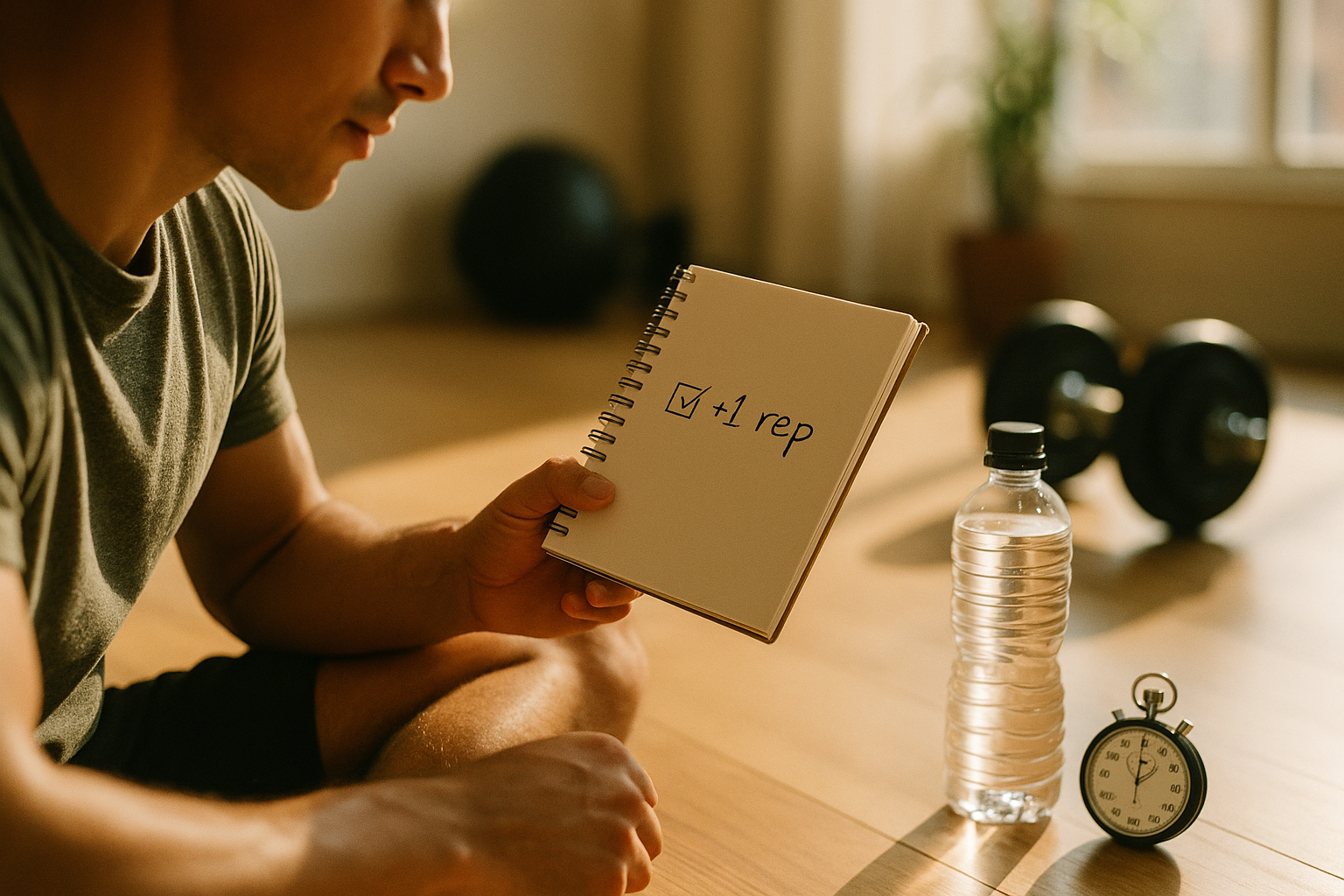
- Track visibly: mark a check plus “+1” to reinforce the extra effort.
Close the day knowing you banked a win—your confidence grows from data, not wishes.
2. Use Implementation Intentions (If–Then Plans) to Eliminate Hesitation
Implementation intentions convert intentions into pre-decided actions: “If it’s 7:30 a.m., then I put on shoes and walk for six minutes.” The power here is removal of choice at the moment of action; you’ve already scripted what happens when a specific cue appears. This dramatically reduces friction and hesitation, turning vague goals into concrete behaviors. For incremental achievements, pairing your baseline habit with a specific context (time, place, cue) ensures you’ll rack up frequent completions, which then drives confidence. If the cue triggers reliably—alarm, calendar alert, coffee brewing—you can expect the action to follow automatically.
2.1 Craft strong if–then statements
- Tie to a cue you never miss: after brushing teeth, during kettle boil, after school drop-off.
- Make the action tiny: six-minute walk, one warm-up set, one page of reading.
- Plan a fallback: “If it’s raining, then I do 10 stair climbs.”
2.2 Mini case
A learner who struggles to practice guitar sets: “If I sit on the couch after dinner, then I play one chord progression for two minutes.” Within two weeks, daily streaks become normal; most days extend to 10 minutes. Confidence rises because the plan removes decision fatigue and guarantees action.
Implementation intentions are the bridge between intention and evidence—your future self thanks you.
3. Track Wins Visibly to Convert Progress into Motivation
You can’t build confidence from progress you can’t see. Visible tracking transforms tiny actions into a tangible streak of successes. Paper calendars, bullet journals, or simple apps (like Apple Health, TickTick, Streaks, or Habitify) make the invisible visible. The key is immediacy—record the win right after completing it. When your eyes meet a growing line of checkmarks or a chart creeping upward, the feedback loop tightens: “I do this. It’s working.” That emotional payoff fuels the next action, which in turn creates more evidence.
3.1 What to track
- Leading indicators: minutes practiced, reps, sets, pages read, sessions completed.
- Scale increments: +1 rep, +30 seconds, +2% distance, +0.5 kg, +5 minutes.
- Recovery variables: sleep hours, RPE (effort rating), soreness notes.
3.2 Numbers & guardrails
- Daily: record any “non-zero” effort.
- Weekly: summarize a 1–2 sentence insight (“Energy dips on Thu—move hard session to Wed”).
- Monthly: highlight 1–3 personal records (PRs), even micro-PRs.
End each week with a written “win log.” Confidence compounds when your proof is on paper.
4. Make Habits Minimum-Viable (2–10 Minutes) and Time-Box Heavier Work
When a habit is tiny, starting is easy—even when motivation is low. Two to ten minutes is a powerful range for minimum-viable habits: short enough to feel trivial, long enough to matter over time. Time-boxing heavier work prevents perfectionism; you set a 25–50 minute block (use a timer) and focus only on starting and staying within the box. This pairing—tiny default plus occasional time-box—generates consistent action and frequent “done” moments, the currency of confidence. Crucially, the small version counts as success; extra intensity is optional.
4.1 Mini-checklist
- Define your “two-minute open”: e.g., put on shoes and walk the block.
- Set a timer for deeper work: 25 minutes; stop when it ends to avoid burnout.
- Score the session: quick RPE (1–10) and a one-line takeaway.
4.2 Common mistakes
- Moving the goalposts: treating the small version as “not real.” It is real—protect it.
- Stacking too many habits at once: start with one; add another after 14 days stable.
- Ignoring recovery: time-box does not mean “squeeze more”—guard sleep and breaks.
Time-bound containers make effort manageable; confidence grows from finishing, not fantasizing.
5. Progress by 1–5% a Week Using RPE to Set Difficulty
Incremental overload works in fitness and skill-building alike. Aim to increase your volume or duration by 1–5% per week, guided by RPE (Rating of Perceived Exertion, 1–10 scale). This lets you calibrate challenge to your current capacity while avoiding jumps that trigger injury or burnout. In the gym, that might be +1 rep per set or +0.5–1.25 kg on compound lifts. For cardio, add 2–5 minutes to a session or extend intervals slightly. For cognitive tasks, nudge complexity or time-on-task modestly. Confidence rises when progress feels earned yet sustainable.
5.1 Numbers & guardrails
- RPE 6–8 for work sets (moderately hard but repeatable).
- Deload every 4–8 weeks by reducing volume 20–40% for recovery.
- Cap weekly increases at 5% for volume or duration (2–3% is fine for beginners).
5.2 Tools & examples
- Lifting: microplates (0.5–1.25 kg), double-progression (more reps before more load).
- Running: add 0.3–0.5 km to one run; keep another run easy for confidence.
- Learning: increase practice 3 minutes per session; raise difficulty slightly (e.g., new chord).
You become the kind of person who improves—because your numbers prove it.
6. Celebrate Small Wins with Specific Reflection (Not Just “Good Job”)
A win is more powerful when you label exactly what you did well. “I kept my elbows tucked on the last two reps,” or “I sat for five minutes even though I didn’t feel like it.” This specific reflection cements learning, amplifies motivation, and converts luck into skill. Brief celebrations—micro-fist pump, a checkmark ritual, or sharing with an accountability buddy—pair accomplishment with emotion, reinforcing the behavior loop. Treat the celebration as part of the habit, not an afterthought.
6.1 The 60-second debrief
- What worked? Name the micro-technique or decision.
- What got in the way? Identify a friction point.
- What’s next? One tiny improvement for tomorrow.
6.2 Common pitfalls
- Vague praise: it doesn’t teach your brain what to repeat.
- Only celebrating “big” wins: small wins come faster—use them.
- Rewarding with undermining treats: choose rewards that don’t sabotage your goals.
The more precisely you mark success, the faster your competence—and confidence—accelerate.
7. Build a Tight Feedback Loop with Leading Metrics and Weekly Reviews
Confidence thrives on fast, accurate feedback. Waiting for the scale, a race time, or a quarterly KPI leaves long gaps where motivation stalls. Use leading metrics you can influence today (minutes practiced, sets completed, RPE, sleep hours) and review them weekly. A 10–15 minute review closes the loop: you look at evidence, adjust next week’s plan, and write one sentence about what you’re proud of. This “see → adjust → confirm” cadence keeps improvements visible and actionable.
7.1 What to review weekly
- Adherence: % of planned sessions completed.
- Intensity & energy: average RPE; notes on mood/fatigue.
- Progress markers: micro-PRs, streak days, skill milestones.
7.2 Adjust with simple rules
- Low adherence (<60%): reduce the plan (fewer days, shorter sessions).
- High fatigue (RPE >8 often): insert an easy day or deload.
- Stalled progress: change one variable (rest, reps, route) for novelty.
A weekly review translates experience into strategy—your plan gets better because you do.
8. Tie Actions to Identity with an Evidence Log
Confidence sticks when actions align with identity: “I’m the kind of person who trains, reads, or shows up.” Create an evidence log—a living document or notes page where you paste concrete proof of follow-through: screenshots of tracked sessions, photos of finished pages, race splits, or simple daily “I showed up” entries. Over time, this becomes a rebuttal to self-doubt. When your mind says, “You’re inconsistent,” the log answers, “Here are 23 receipts from this month.”
8.1 What to capture
- Quantitative: sets/reps, minutes, distances, weights, pages.
- Qualitative: one-liners about effort quality, tactics that helped, mindset shifts.
- Milestones: first unbroken set, first 20-minute jog, first week without skipping.
8.2 How to make it stick
- Keep it low-friction: one note per day; 60–90 seconds to update.
- Review monthly: highlight top three learnings, one thing to test next month.
- Share selectively: with a coach or buddy to deepen accountability.
Identity grows from receipts; let the paper (or pixels) argue on your behalf.
9. Design Your Environment so the Small Step Is the Default
Willpower is fickle; environment design is dependable. Put your shoes by the door, preload the coffee maker, lay out gym clothes, keep a water bottle at your desk, and remove friction for the first minute of action. Conversely, increase friction on behaviors you want to avoid—log out of social apps, put snacks out of sight, move the TV remote. Each tweak increases the odds you’ll perform the tiny step that begets a win, and that win feeds confidence.
9.1 Setup checklist
- Cue the start: visual triggers (sticky note on laptop, shoes at threshold).
- Preload materials: playlist, timer app, program card, notebook.
- Shrink the first minute: eliminate decisions; make “start” obvious.
9.2 Examples across domains
- Fitness: keep a kettlebell in the living area for 1–2 sets during breaks.
- Learning: open the textbook to the next page before bed.
- Nutrition: place fruit within reach and high-protein snacks at eye level.
Design beats discipline. Make the easiest path the one that earns a win.
10. Use Gentle Accountability Without Comparison Traps
Accountability magnifies follow-through when it’s supportive and non-judgmental. Share your tiny baseline and weekly target with a friend, a small group, or a coach. Post a daily checkmark or a short sentence—nothing performative, just proof of completion. Avoid comparison metrics (leaderboards, body visuals) if they fuel discouragement. The goal is compassionate pressure: enough to nudge action, not enough to trigger shame.
10.1 Practical formats
- Two-sentence daily message: “Walked 6 minutes. Felt easier than last week.”
- Weekly summary: 3 wins, 1 challenge, 1 tweak for next week.
- Quiet channel: a private chat or small group with similar goals.
10.2 Guardrails
- Skip judgment words: “good/bad,” “weak/strong.” Use descriptive data instead.
- Time-box feedback: 5–7 minutes; keep it brief and constructive.
- Celebrate process: praise attendance, technique, and consistency first.
You’re borrowing motivation from a future version of you—accountability helps you pay it back.
11. Treat Setbacks as Data: Non-Zero Days and “Reset Rituals”
Progress isn’t linear. The incremental path expects missed days, bad sessions, and plateaus—and converts them into information. Use non-zero days: even if life explodes, do the smallest possible action (one rep, one paragraph, one stretch). Pair this with a reset ritual the next day: review what happened, rewrite the baseline if needed, and commit to one tiny win before noon. This minimizes the emotional hangover and restores momentum quickly.
11.1 Reset ritual (5 minutes)
- Acknowledge: one sentence naming the disruption (travel, illness, overtime).
- Adjust: shrink today’s plan (2–5 minutes only).
- Act: do the smallest step now; record it visibly.
11.2 Common reframes
- Lapse vs. relapse: a missed day is a blip, not a character flaw.
- Data, not drama: treat deviations as experiments revealing constraints.
- Return to baseline: the small version still “counts”—always.
Confidence grows fastest when you recover fast; a reset ritual is your rebound plan.
12. Consolidate Gains with Monthly Retrospectives and Micro-Challenges
Every 4–5 weeks, consolidate: step back, reduce volume for a few days, and run a short retrospective. What micro-skills improved? Which cues worked? Where did friction persist? Then choose a micro-challenge for the next month that’s just beyond your current baseline—an extra set once a week, three more minutes per study session, or adding a balance drill to warm-ups. Consolidation converts scattered wins into a coherent story; a micro-challenge sets the next rung on the ladder.
12.1 Retrospective prompts
- Evidence: three concrete proofs you improved (numbers or skills).
- Process: one habit that felt effortless; one that needs simplification.
- Next month: one micro-challenge with a clear metric.
12.2 Example cadence
- Week 1: re-establish baseline after deload; focus on technique.
- Weeks 2–3: apply 1–3% progression where energy is highest.
- Week 4: attempt one small PR; then deload 20–30% for 3–4 days.
Monthly consolidation stitches a narrative of competence—and the story you repeat becomes the confidence you carry.
FAQs
1) What does “incremental achievements” actually mean?
It’s the practice of splitting a goal into tiny, repeatable steps that you can complete most days. Each completion creates proof that you’re capable, and those proofs accumulate into confidence. Think of adding one rep, writing one paragraph, or walking for six minutes—small, but consistent.
2) How small should the first step be?
Small enough that you can do it even on a low-energy day—usually 2–10 minutes or a single easy unit (1 push-up, one paragraph, one call). This ensures you start often, rack up completions, and collect frequent emotional rewards that keep you engaged.
3) Won’t tiny steps make progress too slow?
Tiny steps feel slow in the moment, but they enable near-daily action. Over weeks, that frequency outpaces sporadic big efforts. You’re trading speed for sustainability—and sustainability wins. Many skills and fitness adaptations compound from consistent, small stressors rather than rare heroic bursts.
4) How do I measure progress without getting obsessed with numbers?
Track leading metrics you can influence today (minutes, sets, reps, pages) and review them weekly. Use numbers as feedback, not judgment. Pair them with one-line qualitative notes—energy, technique, mood—to keep the story human and balanced.
5) What if I miss a day or a whole week?
Treat it as data, not failure. Use a reset ritual: write one sentence about what happened, shrink today’s plan to the minimum, complete a non-zero action, and record it. Momentum returns faster than you think when the bar to re-entry is low.
6) Which apps or tools help most?
Any simple tracker you’ll actually use: paper calendar, bullet journal, or basic apps (Streaks, Habitify, TickTick, Google Keep). Add a timer (your phone works), and consider a notes app for an evidence log with photos or screenshots of wins.
7) How hard should training feel if I’m doing fitness goals?
Aim for RPE 6–8 on work sets: challenging but repeatable, with clean technique. Increase volume or duration by 1–5% weekly and insert a deload every 4–8 weeks. For cardio, add 2–5 minutes to one session or add one easy interval; keep at least one easy day.
8) How do I celebrate without relying on food or shopping?
Use experiential or social rewards: a short walk outside, a playlist you love, a celebratory message to a friend, or 10 minutes with a hobby. The key is to pair the action with a positive emotion. A 60-second “what worked” reflection also cements the win.
9) Can accountability backfire?
Yes—if it turns into comparison or shame. Keep it supportive and data-based: share a daily checkmark, not body images or leaderboards. Choose people who will normalize tiny steps and celebrate consistency, not just outcomes.
10) How long until I feel more confident?
Many people notice a shift within 2–3 weeks of daily tiny wins because the evidence log starts to outweigh old self-talk. You’ll likely feel steadier first, then noticeably more confident as small PRs accumulate and your review notes get specific.
11) What if I’m starting from burnout or low mood?
Lower the bar further. Think 1–3 minutes and choose something that gently raises energy (light stretching, a short walk, a shower, one email). Your goal is to prove to your nervous system that tiny actions are safe, doable, and make you feel a bit better.
12) How do I avoid perfectionism creeping back in?
Write “baseline counts” at the top of your plan. Keep a recurring reminder that the smallest version is success; anything extra is bonus. End sessions with a 60-second debrief focusing on specifics you did well—precision praise strengthens the anti-perfectionism muscle.
Conclusion
Confidence is not a personality trait you either have or don’t—it’s a track record you build. The most reliable way to assemble that record is to create frequent, tiny wins that your brain can’t dismiss. Start with a minimum-viable habit, script it with an if–then cue, track it visibly, and let RPE-guided micro-increases carry you forward. Celebrate specifics, review weekly, and log evidence so your identity keeps pace with your actions. Expect setbacks and absorb them with non-zero days and reset rituals. Then, at regular intervals, consolidate what you’ve learned and choose the next micro-challenge.
Begin where you are, win small today, and let those receipts add up into the quiet, unshakable confidence you’ve been trying to “feel” into existence.
CTA: Pick one baseline and do it now—then write down “+1” beside it.
References
- Bandura, A. Self-efficacy: Toward a Unifying Theory of Behavioral Change. Psychological Review, 1977. https://doi.org/10.1037/0033-295X.84.2.191
- Amabile, T., & Kramer, S. The Power of Small Wins. Harvard Business Review, May 2011. https://hbr.org/2011/05/the-power-of-small-wins
- Harkin, B. et al. Does Monitoring Goal Progress Promote Goal Attainment? A Meta-Analysis. Psychological Bulletin, 2016. https://doi.org/10.1037/bul0000025
- Gollwitzer, P. M. Implementation Intentions: Strong Effects of Simple Plans. American Psychologist, 1999. https://doi.org/10.1037/0003-066X.54.7.493
- Kivetz, R., Urminsky, O., & Zheng, Y. The Goal-Gradient Hypothesis Resurrected: Purchase Acceleration, Illusionary Goal Progress, and Customer Retention. Journal of Marketing Research, 2006. https://doi.org/10.1509/jmkr.43.1.39
- Deci, E. L., & Ryan, R. M. The “What” and “Why” of Goal Pursuits: Human Needs and the Self-Determination of Behavior. Psychological Inquiry, 2000. https://doi.org/10.1207/S15327965PLI1104_01
- Borg, G. Psychophysical Bases of Perceived Exertion. Medicine & Science in Sports & Exercise, 1982. https://doi.org/10.1249/00005768-198205000-00012
- Oettingen, G. Future Thought and Behavior Change. Current Directions in Psychological Science, 2012. https://doi.org/10.1177/0963721412465799
- Fogg, B. J. A Behavior Model for Persuasive Design. Proceedings of Persuasive Technology, 2009. https://doi.org/10.1145/1541948.1541999
- Schultz, W., Dayan, P., & Montague, P. R. A Neural Substrate of Prediction and Reward. Science, 1997. https://doi.org/10.1126/science.275.5306.1593