

























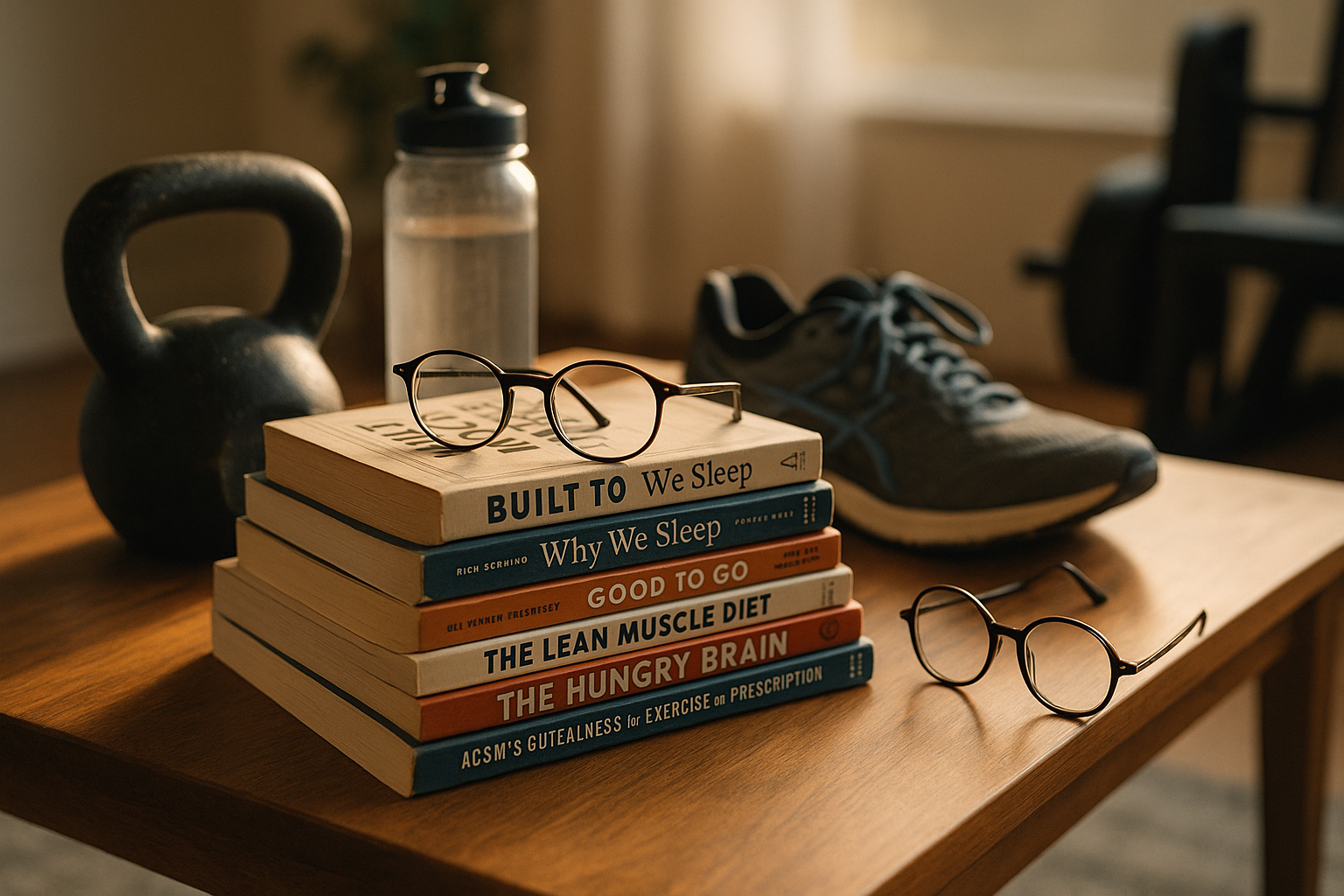
If you’re serious about training smarter—not just harder—your bookshelf can be as powerful as any barbell or meal plan. Below is a curated list of health and fitness books that cover training, nutrition, recovery, sleep, endurance, mobility, and behavior change so you can make better decisions in the gym and the kitchen. In short: the best health and fitness books teach you why a method works, when to use it, and how to adapt it to your life. This reading list does exactly that.
Quick note: the information here is educational and not a substitute for personalized medical advice; check with a qualified clinician if you have a health condition or injury.
How to use this list (fast):
- Pick one strength or endurance title and one nutrition title to start.
- Read with a goal (e.g., “test a 4-week plan,” “fix my squat depth,” “improve sleep by 30 minutes”).
- Take margin notes: 1 actionable idea per chapter.
- Trial a small change for 2–4 weeks; track it.
- Keep what works; drop what doesn’t; move to the next book.
1. ACSM’s Guidelines for Exercise Testing and Prescription (11th ed.)
ACSM’s Guidelines is the profession’s backbone: it explains how to assess risk, test fitness, and prescribe exercise safely for healthy people and those with common clinical conditions. If you’ve ever wondered how much cardio is “enough,” what intensity counts as “moderate,” or how to progress resistance training in older adults or those with hypertension, this reference lays out guardrails and standards. Use it to translate broad public-health targets into practical programming (frequency, intensity, time, type) and to understand when medical clearance is indicated. For coaches, clinicians, and diligent self-coachers, it’s the gold standard for safe, scalable training.
Why it matters
- Sets shared definitions (e.g., METs, RPE, intensity zones) so programs are comparable and safe.
- Bridges general fitness and clinical populations, helping you adapt training to comorbidities.
- Clarifies screening and progression so you reduce avoidable setbacks.
How to apply it this month
- Convert your weekly activity into minutes at moderate/vigorous intensity and log it for four weeks.
- Use an RPE or talk-test scale to calibrate your cardio days; progress time or intensity, not both.
- For strength, pick 6–8 core lifts and progress load or reps weekly within a safe range.
Bottom line: This is the field manual for safe, effective training decisions—use it to set baselines and progress with confidence.
2. Science and Development of Muscle Hypertrophy (2nd ed.) — Brad Schoenfeld
If your goal is to build muscle efficiently, Schoenfeld’s book is the clearest synthesis of mechanisms (tension, metabolic stress, muscle damage) and programming variables that influence hypertrophy. It parses what actually drives growth, how volume and intensity interact over weeks, and why exercise selection and tempo matter. The text is rigorous but practical: you’ll finish with a cleaner view of how to structure phases, measure progress beyond mirror changes, and avoid junk volume.
What you’ll learn first
- The “levers” of hypertrophy—volume, load, proximity to failure—and how to balance them.
- How to select lifts to bias specific regions and reduce overuse.
- Why recovery resources (sleep, nutrition) gate your progress more than novelty.
Mini-checklist to redesign your split
- Choose 4–6 big movements that you can load and track reliably.
- Plan weekly volume per muscle group; progress one variable at a time.
- Keep 1–2 reps in reserve on most sets; push closer to failure strategically.
- Reassess after 4–6 weeks with photos, strength markers, and circumference.
Bottom line: Turn guesswork into a plan that emphasizes the few variables that actually move hypertrophy forward. Amazon
3. Daniels’ Running Formula (4th ed.) — Jack Daniels
Daniels’ VDOT system gives runners a simple way to estimate fitness and convert it into training paces across workouts. The genius isn’t just the tables—it’s the logic linking stress and adaptation so you don’t overcook easy days and underdose quality sessions. Whether you’re eyeing your first 5K or a marathon PR, you’ll get templates that scale from base building to race-specific sharpening, plus guidance for returning from breaks or injury.
How to use VDOT in practice
- Test a recent race or time trial to find your VDOT; derive easy, threshold, and interval paces.
- Anchor the week: 2 quality sessions (e.g., threshold, intervals) + long run; keep easy runs easy.
- Taper intelligently; protect sleep in the final 10–14 days.
Numbers & guardrails
- Quality work is purposeful and limited; over-stacking hard days is a common plateau trap.
- Use heart rate or RPE to sanity-check paces in heat or at altitude.
Bottom line: Train at the right effort every day, progress systematically, and arrive at the start line prepared—not fried. Amazon
4. Built to Move — Kelly & Juliet Starrett
Mobility is not yoga-only nor foam-rolling alone; it’s your body’s capacity to access positions you need for strength, endurance, and daily life. Built to Move distills ten simple tests and habits to reclaim range of motion, reduce stiffness, and make walking, lifting, and sitting less costly. It’s written for busy people: short “minimums” and daily rituals you can layer into existing routines without turning recovery into a second job.
Why it matters
- Movement options reduce load on any single joint or tissue; more options = fewer flare-ups.
- Brief, daily inputs beat sporadic weekend marathons of mobility work.
- Clear tests let you target the biggest restriction first.
Try this weekly cadence
- 10 minutes/day of position work (hips, thoracic spine, ankles).
- One longer reset (20–30 minutes) around your hardest training day.
- Track a nagging movement (e.g., deep squat) with weekly video for objective progress.
Bottom line: Small, repeatable habits can restore the positions your training—and life—depend on.
5. Good to Go — Christie Aschwanden
Recovery isn’t a shopping list of gadgets; it’s a small set of fundamentals done consistently. In Good to Go, science journalist Christie Aschwanden investigates popular recovery claims—from cryotherapy to compression—and shows which ideas have signal and which are more ritual than requirement. The real takeaways are simple: quality sleep, sufficient fueling, smart workload management, and time are the big rocks. Everything else is optional frosting.
Tools/Examples
- Use “expected soreness” as a nudge, not a panic cue; adapt training rather than chasing fixes.
- If a low-risk method makes you feel better (placebo counts), and it doesn’t displace sleep or food, it can be “good enough.”
Common mistakes
- Spending time and money on tech while under-eating and sleeping five hours.
- Treating supplements as first-line instead of protein/carbs and hydration.
Bottom line: Focus on the boring basics that consistently move the needle; let fads orbit around them, not the other way around.
6. Why We Sleep — Matthew Walker
Sleep amplifies nearly every training and nutrition decision you make. Why We Sleep illustrates how sleep affects learning, reaction time, hormones, appetite, and injury risk. Even if some claims spark debate, the central message stands: more and better sleep is a performance enhancer available to everyone. Expect actionable ideas for wind-down routines, light management, and caffeine timing, alongside broader science about REM and deep sleep.
How to implement without perfectionism
- Protect a consistent sleep window most nights; aim for a relaxing pre-bed routine.
- Dim screens and overhead lights 60–90 minutes before bed; cool the room.
- Treat weekend “catch-up” sleep as a safety net, not a long-term strategy.
Mini case
- Many athletes see better session quality by shifting hard training to times when they’re most alert (e.g., late morning) and extending sleep by 30–45 minutes.
Bottom line: Improving sleep quantity and quality is the highest-leverage recovery step most people can take.
7. The Hungry Brain — Stephan J. Guyenet
Why is “just eat less” so hard? The Hungry Brain explains appetite from the top down: how reward, variety, stress, and the modern food environment nudge us to overeat. Instead of moralizing willpower, it shows how smart defaults—fewer ultra-palatable cues at home, protein/produce anchors, mindful portions—make weight management easier. The goal isn’t perfection; it’s stacking the deck so the “easy” choice is also the better one.
How to put the book to work
- Engineer your environment: visible fruit/veggies; pre-portioned snacks; fewer “open bowls.”
- Build meals around protein + fiber; delay dessert decisions by 20 minutes.
- Track “cue exposure” (ads, screens, late-night grazing) for one week; change one trigger.
Numbers & guardrails
- Expect 1–2 weeks per habit before it feels automatic; weight trends matter more than daily scale noise.
Bottom line: Change the environment and your habits follow—your brain often decides before “willpower” gets a vote.
8. The Lean Muscle Diet — Lou Schuler & Alan Aragon
Diets fail when they demand perfection and ignore preference. The Lean Muscle Diet takes the opposite tack: create a calorie and protein “budget” that fits your life, then lift progressively. It’s pragmatic, flexible, and sustainable—especially if you’ve bounced between cutting and bulking without a plan. The authors demystify portioning, meal timing, and menu design so you can hit targets without white-knuckle restriction.
Practical framework
- Establish a daily calorie range and protein target; distribute carbs/fats based on preference and training.
- Use simple meal templates (e.g., protein + veg + starch) and rotate 8–12 go-to meals.
- Reassess every 2–4 weeks: adjust 100–200 kcal/day as needed.
Mini-checklist
- Batch-cook proteins; keep frozen veg and microwavable grains on hand.
- Track with a light touch (3–4 days/week) to maintain awareness without burnout.
Bottom line: Flexible structure beats rigid rules—this book helps you build a plan you’ll actually keep. Google Books
9. Eat, Drink, and Be Healthy (Revised & Updated) — Walter Willett with P.J. Skerrett
From the team behind Harvard’s long-running cohort studies, this book reframes healthy eating beyond fad diets. It emphasizes dietary patterns (vegetables, whole grains, healthy fats) and pragmatic swaps you can sustain for decades. You’ll understand how plate composition, fiber, and fat quality link to long-term health, and why a single “superfood” matters less than consistent patterns.
Tools/Examples
- Use a “Healthy Eating Plate”: half plants, a quarter protein, a quarter whole grains, with healthy oils.
- Replace “add this” advice with “swap that”: e.g., olive oil for butter, beans for part of ground meat.
- Think week-long: plan 10 dinners you actually like and rotate them.
Common pitfalls
- Over-indexing on supplements while neglecting everyday meals.
- Treating short-term scale changes as verdicts on dietary quality.
Bottom line: Build a flexible, plant-forward pattern you can live with; the long game matters most.
10. Atomic Habits — James Clear
Great programs fail without consistent execution. Atomic Habits gives you a playbook for behavior change: make good habits obvious, attractive, easy, and satisfying—and bad ones the opposite. Applied to fitness, it turns lofty goals into tiny, reliable actions (show up, warm up, begin). You’ll learn to design environments that nudge you toward training, cooking, and sleeping well without constant motivation.
How to deploy it this week
- Tie a new habit to an existing anchor: “After I make coffee, I do 5 minutes of mobility.”
- Reduce friction: lay out gym clothes, pre-log your workout, prep ingredients.
- Reward the process: track streaks; let the checkbox be its own dopamine hit.
Mini case
- A 3x/week lifter stuck at two sessions moved to four by scheduling 30-minute “minimum viable workouts,” then letting optional sets expand when energy allowed.
Bottom line: Systems beat motivation—shape your environment and routines so consistency happens on autopilot.
11. Endure — Alex Hutchinson
Performance isn’t just VO₂max and lactate; it’s also belief, focus, and how the brain regulates effort. Endure blends physiology with psychology to explain why pacing, heat, dehydration, and even self-talk shape your ceiling on race day. You’ll come away with tools to train the “software” as well as the “hardware,” from mental reframing to heat acclimation and strategic carbohydrate use.
Why it matters
- Teaches you to interpret discomfort: not all “slow down” signals mean “stop.”
- Reveals how context—temperature, hydration, expectations—recalibrates your limits.
- Encourages experiment-driven training: small trials to see what helps you most.
Try this experiment
- Add a once-weekly session where you practice even pacing, positive self-talk, and nutrition timing; note perceived exertion vs. splits.
Bottom line: Skillful minds go faster; train yours alongside the body.
12. The Barbell Prescription — Jonathon Sullivan & Andy Baker
Strength is critical healthspan medicine—especially after 40. The Barbell Prescription argues that intelligently coached barbell training (squat, press, deadlift, bench) can build resilience, bone density, and independence for decades. It explains safety, progression, and programming with realistic pathways for true novices and late starters. Pair it with your clinician’s guidance if you have medical conditions, and expect steady, confidence-building gains.
Getting started safely
- Learn lifts with a broomstick/PVC, then progress loads you can control through full range.
- Keep reps submaximal early; earn load with consistent technique.
- Prioritize sleep, protein, and walking to support recovery.
Region-specific note
- If equipment is limited, substitute goblet squats, dumbbell presses, and trap-bar deadlifts, then transition to barbells when possible.
Bottom line: Stronger, safer, and more capable at 50, 60, and 70 is a realistic, trainable target—this book shows how.
FAQs
1) Which book should a complete beginner start with?
Start with one training title plus one “foundations” title. For most people that’s Daniels’ Running Formula (if you run) or The Barbell Prescription (if you’re lifting) plus Eat, Drink, and Be Healthy for nutrition basics. This pairing gives you clear workouts and a sustainable eating pattern without micromanaging calories. As you build momentum, add Atomic Habits to make your routine stick.
2) Are these books useful for women and older adults?
Yes. The core principles—progressive overload, adequate protein, smart workloads, and consistent sleep—apply across ages and genders, but progression and exercise selection may differ. ACSM’s Guidelines and The Barbell Prescription have specific guidance for older adults; Built to Move helps anyone restore positions needed for everyday life. Always adapt loads and volumes to your recovery and medical context.
3) Can I rely on recovery gadgets instead of more sleep and food?
No. Gadgets can be fun and sometimes helpful, but they’re not substitutes for sleep, fueling, and sensible programming. Good to Go shows that many recovery products have mixed or marginal evidence, while fundamentals consistently matter most. Use low-risk tools if they help you relax, but don’t let them displace real recovery.
4) What if I’m short on time—will mobility work actually help my lifts and runs?
Ten minutes daily can make training feel smoother and reduce “cost” the next day. Built to Move focuses on simple tests and habits that deliver high return on time investment, especially for hips, ankles, and the thoracic spine. Pair short daily sessions with one slightly longer weekly reset.
5) Are the sleep recommendations in Why We Sleep controversial?
Some researchers debate specific claims, but the overarching guidance—protect enough sleep, mind your light and caffeine, and keep a consistent schedule—is widely supported and low-risk. Treat the book as a compelling argument to prioritize sleep, then implement the practical steps that fit your life.
6) I want to build muscle and lose fat—should I bulk or cut first?
You can progress either way, but The Lean Muscle Diet makes a case for flexible nutrition aligned to your preferences and training phase. Start with a modest caloric adjustment, prioritize protein and whole foods, and lift progressively. Adjust every few weeks based on trend data rather than daily fluctuations.
7) How do I set running paces without overtraining?
Use performance (a recent race or time trial) to determine your VDOT and derive pace zones from Daniels’ Running Formula. Keep most miles easy, sprinkle specific quality sessions, and honor recovery days. This prevents the common trap of running every day “medium hard.”
8) I’m returning from injury—where should I start?
Consult your clinician, then rebuild capacity gradually. ACSM’s Guidelines provides screening and progression guardrails, Built to Move helps reclaim pain-free positions, and Daniels’ Running Formula includes return-to-running plans. Keep loads and volumes conservative at first; consistency beats intensity.
9) Which titles are best if I only care about endurance?
Pair Daniels’ Running Formula for day-to-day workouts with Endure to understand the brain-body factors that cap performance under heat, dehydration, and fatigue. Add Good to Go for recovery strategies during high-mileage blocks.
10) Do I need a textbook like ACSM’s Guidelines if I’m not a coach?
If you want safe, effective training that adapts to your life or health history, yes—it’s worth it. The book’s screening, intensity definitions, and progression advice help you tailor workouts and reduce “avoidable” risks, even as a self-coached athlete.
11) What’s the best “mindset” or behavior book on this list?
Atomic Habits is the most actionable for most readers: it shows how to make good behaviors frictionless and how to design cues and rewards so habits stick. Use it to lock in training, meal prep, and sleep routines incrementally.
12) How should I pace this reading list across a year?
Read one training and one lifestyle title per quarter (four pairs total). Apply each book’s ideas for 8–12 weeks before layering in the next. This keeps your focus tight and gives you time to measure whether the change improved performance, body composition, or energy. (Example: Q1 Schoenfeld + Lean Muscle Diet; Q2 Daniels + Good to Go; Q3 Built to Move + Why We Sleep; Q4 The Barbell Prescription + Atomic Habits.) Barnes & Noble
Conclusion
Great training is a loop: learn, apply, observe, adjust. The twelve titles above give you a complete toolkit for that loop—strength and endurance programming you can trust, nutrition frameworks that fit real lives, recovery practices that prioritize the fundamentals, and behavior strategies that make good choices easier. You don’t need all twelve at once. Pick two, implement one or two ideas for a month, and watch what changes. Keep the parts that improve your life and performance; ditch the parts that don’t. Within a year, you’ll have a personal playbook that’s simpler, stronger, and far more sustainable than any one-size-fits-all plan.
CTA: Choose one book from this list today, schedule your first experiment for the next two weeks, and start turning pages into progress.
References
- ACSM’s Guidelines for Exercise Testing and Prescription (11th ed.), Lippincott Williams & Wilkins (LWW), April 16, 2021. LWW Official Store
- Science and Development of Muscle Hypertrophy (2nd ed.), Human Kinetics, April 20, 2020. Human Kinetics
- Daniels’ Running Formula (4th ed.), Human Kinetics, March 19, 2021. Human Kinetics
- Built to Move, Penguin Random House (Knopf), April 4, 2023. PenguinRandomhouse.com
- Good to Go: What the Athlete in All of Us Can Learn from the Strange Science of Recovery, W. W. Norton & Company, February 5, 2019. W. W. Norton & Company
- Why We Sleep, Scribner (Simon & Schuster), June 19, 2018 (paperback edition). Simon & Schuster
- The Hungry Brain: Outsmarting the Instincts That Make Us Overeat, Flatiron Books (Macmillan), February 7, 2017. Macmillan Publishers
- The Lean Muscle Diet, Rodale Books / PRH Canada, December 23, 2014. Penguin Random House Canada
- Eat, Drink, and Be Healthy (Revised & Updated), Simon & Schuster, September 19, 2017. Simon & Schuster
- Atomic Habits, Avery / Penguin Random House, October 16, 2018. PenguinRandomhouse.com
- Endure: Mind, Body, and the Curiously Elastic Limits of Human Performance, William Morrow / HarperCollins, February 6, 2018. HarperCollins
- The Barbell Prescription: Strength Training for Life After 40, The Aasgaard Company, December 1, 2016. aasgaardco.com