



























By Emily Harrison
Medical disclaimer: This article is educational and does not diagnose or treat any condition. It is not a substitute for individualized care from your obstetrician, midwife, or a pelvic floor physical therapist. Recovery after birth varies enormously by delivery type, complications, and each body’s healing pace. Before starting or progressing through any stage below, get personalized clearance from your OB-GYN or midwife at your postpartum visit, and consider a pelvic floor physical therapy evaluation, especially after a cesarean birth, forceps or vacuum delivery, a significant perineal tear, or any pregnancy or birth complication. If something in this framework does not match what your own provider has told you, follow your provider’s guidance instead.
Somewhere around the six-week mark, a lot of new parents get handed a single line at a checkup: “you’re cleared for normal activity.” That sentence often arrives without much detail about what to actually do first, how hard to push, or how to tell whether a symptom is a normal part of healing or a sign to slow down. A staged, week-by-week return to exercise fills that gap. It gives structure to a process that otherwise feels like guesswork, and it builds in the checkpoints that catch problems before they become bigger ones.
This guide lays out a twelve-week framework for returning to cardio and strength training after childbirth, built around the concept of graded loading: starting with breath and gentle movement, rebuilding core and pelvic floor coordination, and only then progressively adding impact, load, and intensity. It draws on guidance from the American College of Obstetricians and Gynecologists (ACOG), postnatal return-to-running research associated with the Royal College of Obstetricians and Gynaecologists (RCOG) in the UK, and pelvic floor physical therapy screening practices. It is written for people recovering from vaginal or cesarean birth who have no complications requiring more specialized care, and every stage assumes ongoing communication with a qualified provider. It focuses on rebuilding cardio capacity and strength across a full-body program rather than on flexibility work; gentle stretching for pregnancy and early postpartum comfort is a related but separate topic from the loading progression described here.
Why a staged, gradual return matters
Pregnancy and birth change tissue that does not simply snap back to its prior state the moment a baby arrives. Connective tissue laxity from relaxin can persist for months after delivery. Abdominal wall muscles separate to accommodate a growing uterus and need time and specific loading to reconnect. The pelvic floor, whether stretched during a vaginal delivery or affected indirectly by pregnancy weight and hormonal changes before a cesarean, needs to regain both strength and coordination, not just strength alone. Jumping back into pre-pregnancy workout intensity before these systems have caught up is one of the more common paths to postpartum pelvic organ prolapse symptoms, urinary leakage, or a diastasis recti that does not close.
ACOG’s updated committee opinion on physical activity in pregnancy and postpartum notes that the timeline for resuming exercise should be individualized based on the mode of delivery and how a person feels, rather than fixed to a single date on a calendar. The UK’s Chief Medical Officers’ guidance, referenced in postnatal exercise literature tied to RCOG-endorsed return-to-running guidelines, recommends postpartum people without contraindications work toward roughly 150 minutes of moderate-intensity activity per week, but arriving there through a graded build rather than an immediate jump. Staging exists precisely because tissue healing, hormonal shifts, sleep deprivation, and the physical demands of caring for an infant all interact, and none of those variables move on a fixed schedule.
A staged plan also creates natural checkpoints. Instead of a single all-or-nothing clearance conversation, you get several smaller decision points, at two weeks, at six weeks, and again before returning to running or high-impact training, where a provider or pelvic floor therapist can confirm you are ready to progress. That structure catches problems early rather than after months of compounding strain.
Before you begin: diastasis recti and pelvic floor screening
Two screenings belong at the front of any postpartum return-to-exercise plan, not somewhere in the middle of it: a diastasis recti abdominis check and a pelvic floor assessment. Neither requires a diagnosis from you personally, but both should factor into how you progress.
Diastasis recti abdominis
Diastasis recti is a separation of the two sides of the rectus abdominis muscle along the linea alba, the connective tissue running down the midline of the abdomen. Some separation is a normal, expected part of pregnancy for nearly everyone; the question postpartum is whether the gap is narrowing, whether the connective tissue can generate tension across it, and whether the abdominal wall can manage load without doming or bulging outward. A visible ridge or dome down the midline of the belly during a curl-up, a plank, or even standing and bearing down are signals worth mentioning to a provider or pelvic floor physical therapist before progressing into higher-load core work or impact training. This is not a self-diagnosis exercise; it is a screening cue for when to ask a professional for a hands-on assessment.
Pelvic floor function
Pelvic floor screening looks at both strength and coordination, not just one or the other. Pelvic floor physical therapists commonly assess this with manual muscle testing scales (such as the Modified Oxford Scale), endurance testing for both quick and sustained contractions, and functional load tests like single-leg balance, single-leg squats, calf raises, and eventually hopping or jogging in place. Postnatal return-to-running guidelines associated with RCOG researcher Emma Goom and colleagues describe using these same functional tests, along with the Pelvic Floor Distress Inventory (PFDI-20) questionnaire and, where relevant, a Pelvic Organ Prolapse Quantification (POP-Q) assessment, to decide when someone is ready for impact loading. You do not need to run these tests yourself. What you can do is pay attention to how your pelvic floor feels during daily activity, note any heaviness, leaking, or dragging sensation, and bring those observations to a pelvic floor physical therapist visit, ideally before week six and again before any stage involving running, jumping, or heavy lifting.
Both screenings matter more than the calendar. A person at week four with a well-coordinated pelvic floor and a closing, load-tolerant midline may be ready to progress faster through early stages than someone at week ten who is still experiencing leaking with a cough or a visible bulge during a plank. The stages below are a framework for pacing, not a substitute for that individualized read on your own healing.
The twelve-week staged framework
The following table gives a stage-by-stage overview. Each stage assumes the previous one was completed without red flag symptoms (covered further down) and, at the marked checkpoints, with input from a provider or pelvic floor physical therapist.
| Weeks | Focus | What it typically includes | Checkpoint before progressing |
|---|---|---|---|
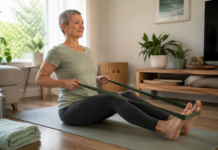
| 1–2 | Gentle movement and breath reconnection | Short walks, diaphragmatic breathing, gentle pelvic floor and transverse abdominis activation lying down, posture awareness while feeding or holding the baby | No increase in bleeding, pain, or heaviness after activity |
| 3–6 | Core and pelvic floor reconnection | Longer walks, supported bridges, seated marches, gentle standing pelvic floor work in varied positions, light mobility work | Postpartum visit clearance (around week 6); pelvic floor screening recommended, particularly after cesarean birth or complications |
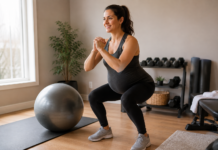
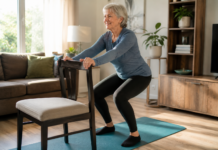
| 6–8 | Reintroducing low-impact cardio and light resistance | Stationary cycling, brisk walking intervals, bodyweight squats and rows, light dumbbell work, continued pelvic floor progression through standing and dynamic positions | Comfortable 30-minute walk, no leaking or heaviness, midline tolerating light load without doming |
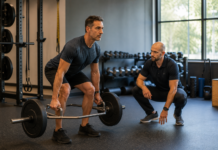
| 8–10 | Progressive strength loading | Moderate resistance training for major muscle groups, single-leg balance and single-leg squat progressions, calf raises, controlled step-ups | Single-leg balance 10+ seconds each side, single-leg squat without pelvic floor symptoms, functional strength tests pass comfortably |
| 10–12 | Introducing impact, with individualized clearance | Short bouts of jogging in place, low hop tests, gradual run-walk intervals only after passing load-tolerance testing and receiving individualized clearance | Formal pelvic floor and running-readiness assessment; many providers advise against structured running before three months postpartum |
Weeks 1 to 2: gentle movement and breath reconnection
The first two weeks are about reconnecting with basic movement patterns, not training. Short, unhurried walks around the block, gentle diaphragmatic breathing paired with soft pelvic floor engagement, and simply moving in and out of bed or a chair with attention to posture all count. This stage is less about building fitness and more about giving tissue time to begin healing while reestablishing the mind-body link between breath, deep core, and pelvic floor. ACOG’s guidance notes that for most people who had an uncomplicated vaginal delivery, light activity like walking can often resume within days if it feels comfortable and bleeding does not increase, while those recovering from a cesarean or a complicated birth need a slower, more individualized start guided by their surgical team.
Weeks 3 to 6: core and pelvic floor reconnection
By week three, many people can add gentle core activation work: supported bridges, seated marches, and standing pelvic floor contractions performed in a few different positions rather than only lying down. The aim is coordination as much as strength, learning to engage the deep core and pelvic floor together during daily tasks like lifting the baby or standing up from a couch. This is also the window in which the six-week postpartum visit typically falls, and it is the first major checkpoint in this framework. That visit is the point to explicitly ask about diastasis recti status, healing of any incision or perineal repair, and whether a referral to pelvic floor physical therapy makes sense before moving into more demanding stages, particularly for anyone who had a cesarean birth, an assisted vaginal delivery, or a significant tear.
Weeks 6 to 12: progressive loading, with checkpoints
Once cleared, activity can progress from low-impact cardio, such as stationary cycling or brisk walking intervals, toward moderate resistance training and, later, single-leg and balance work that more closely mirrors the demands of running and higher-intensity training. This is where a second, more functional checkpoint matters: before adding real impact, whether that’s jogging, jumping, or return-to-sport training, a pelvic floor physical therapist or trained provider can run through the same kinds of load-tolerance tests used in RCOG-linked postnatal return-to-running research, including single-leg balance, single-leg squats, calf raise endurance, and hopping, to confirm the pelvic floor and abdominal wall can handle the load without symptoms. That same research generally advises against beginning structured running before three months postpartum, and often longer for people recovering from cesarean birth, significant tearing, or ongoing pelvic floor symptoms. Twelve weeks is a reasonable point to have built a strength and cardio base; it is not automatically the point to add high-impact training for everyone, and the decision belongs to you and your provider together.
Cesarean birth and complicated deliveries need their own timeline
A cesarean birth is major abdominal surgery, and the framework above needs to shift accordingly. Early weeks should stay focused on gentle walking, breath work, and very light core activation that does not strain the incision, with progression paced by how the incision and deeper abdominal layers are healing rather than a fixed calendar date. Scar tissue continues remodeling for months, and abdominal wall strength returns more slowly than surface healing might suggest. Patient guidance from Oxford University Hospitals NHS Foundation Trust places gentle scar massage around six to eight weeks postpartum, once the wound has fully closed, and reserves swimming for around eight to twelve weeks once healing is confirmed; both are useful reference points, but a clinician should confirm your own incision is ready before either one, since healing speed varies from person to person. The same applies to forceps or vacuum-assisted deliveries and to third- or fourth-degree perineal tears, all of which carry a higher likelihood of pelvic floor nerve or muscle involvement and generally warrant a longer runway before impact training and an earlier pelvic floor physical therapy referral rather than a later one. If you had any of these, treat every “checkpoint” in the table above as a firm stop until your surgeon, OB-GYN, or midwife has specifically looked at your healing and given the go-ahead, and lean toward a pelvic floor assessment sooner rather than later.
Red flags: stop and contact your provider
Pause the current stage and reach out to your OB-GYN, midwife, or a pelvic floor physical therapist if you notice any of the following during or after activity:
- Leaking urine or stool, or a strong, sudden urge you can’t control
- A feeling of heaviness, pressure, or something “falling down” in the vagina
- A visible bulge or doming along the midline of the abdomen during exertion
- Increased or bright red vaginal bleeding, or bleeding that restarts after slowing down
- Sharp, localized, or worsening pain in the pelvis, abdomen, incision, or back
- Separation, discharge, or opening of a cesarean or perineal wound
- Dizziness, chest pain, or unusual shortness of breath during activity
None of these signs mean something is permanently wrong, and several of them are common enough that pelvic floor physical therapists see them regularly. What they do mean is that the current stage is asking more of your body than it can currently handle, and that a professional assessment, rather than pushing through, is the appropriate next step.
Setting realistic expectations along the way
Fitness after childbirth rarely progresses in a straight line, and it helps to plan for that ahead of time rather than treating a setback as failure. A rough night with a newborn can turn what was supposed to be a moderate workout into a short walk, and that adjustment is appropriate, not a step backward in the overall plan. Sleep deprivation changes how effort feels: a pace or a weight that used to feel easy can feel considerably harder in the first months postpartum simply because recovery between sessions is less complete. Feeding schedules, whether breastfeeding, pumping, or bottle feeding, also shape when and how long a workout window realistically is, and building the framework around a baby’s routine tends to work better than forcing a rigid schedule the household can’t sustain.
Mood and movement are connected during this period as well. Gentle, consistent activity is one of several supports that can help with the emotional adjustment of early parenthood, but a staged exercise plan is not a treatment for postpartum depression or anxiety, and persistent low mood, intrusive thoughts, or loss of interest in things that used to bring joy deserve a direct conversation with your provider regardless of how the exercise plan is going. Progress in this framework is best measured by how consistently you’re moving through the stages and how your body responds at each checkpoint, not by how quickly you return to a pre-pregnancy routine or pace.
Putting it together
A twelve-week staged framework is a starting structure, not a rigid contract. Some people move through early stages faster because their pelvic floor and core screen well early; others need extra weeks at a given stage, especially after cesarean birth, assisted delivery, or a complicated recovery, and that is a normal, expected variation rather than a setback. The constants that matter across every version of this timeline are the same: gentle movement and breath work first, deliberate core and pelvic floor reconnection before adding load, functional screening before impact, and a provider or pelvic floor physical therapist involved at each major checkpoint. Respecting that order tends to produce a stronger, more durable return to activity than chasing a faster timeline ever does.
Frequently asked questions
When can I start exercising after giving birth?
For an uncomplicated vaginal delivery, gentle walking and breath work can often begin within the first couple of weeks if it feels comfortable and doesn’t increase bleeding or pain. After a cesarean birth or a complicated delivery, timing should be set individually with your surgical team, since abdominal healing takes longer than surface appearance suggests.
Is it safe to do core exercises before my six-week checkup?
Gentle diaphragmatic breathing and light pelvic floor activation are generally appropriate early on for uncomplicated recoveries, but more demanding core work, like planks, crunches, or loaded carries, is better held until after your postpartum visit and, ideally, a diastasis recti and pelvic floor check confirm your midline can tolerate that load.
How do I know if I have diastasis recti?
A visible ridge, bulge, or doming down the center of your abdomen during a curl-up, a plank, or even standing and bearing down is a cue worth raising with your provider or a pelvic floor physical therapist. Self-checks at home are a starting point for a conversation, not a diagnosis, and a hands-on assessment gives a clearer picture of whether the tissue is generating tension and closing over time.
When is it safe to start running again?
Postnatal return-to-running guidance associated with RCOG-linked research generally advises against structured running before three months postpartum, and recommends passing functional load tests, such as single-leg balance, single-leg squats, and hopping without symptoms, plus individualized clearance, before adding impact. People recovering from cesarean birth or pelvic floor complications often need longer.
Do I need to see a pelvic floor physical therapist if I feel fine?
Not everyone needs ongoing pelvic floor physical therapy, but a baseline screening, especially around the six-week mark or before returning to impact activity, catches issues like reduced pelvic floor coordination or a slow-closing diastasis that may not cause obvious symptoms yet. This is particularly worth prioritizing after cesarean birth, assisted vaginal delivery, or significant perineal tearing.
What if I feel ready to progress faster than this framework suggests?
Feeling ready is meaningful information, but pair it with the objective checkpoints above, a completed postpartum visit, a diastasis and pelvic floor screening, and functional load tests before impact work, rather than skipping them. Tissue healing doesn’t always match how strong or capable you feel day to day, and your provider’s individualized clearance should be the deciding factor at each stage.
References
- American College of Obstetricians and Gynecologists (ACOG). “Exercise After Pregnancy.” acog.org/womens-health/faqs/exercise-after-pregnancy
- American College of Obstetricians and Gynecologists (ACOG). Committee Opinion No. 804: “Physical Activity and Exercise During Pregnancy and the Postpartum Period.” acog.org/clinical/clinical-guidance/committee-opinion
- Goom, T., Donnelly, G., Brockwell, E. “Returning to running postnatal – guidelines for medical, health and fitness professionals managing this population.” Referenced via Physiopedia summary. physio-pedia.com/Current_Guidelines_and_Recommendations_for_Postnatal_Exercise
- Oxford University Hospitals NHS Foundation Trust. “Returning to exercise and sport after childbirth: Information for patients.” ouh.nhs.uk patient information PDF