


























A mindfulness journal is a simple, repeatable way to pay attention to your present-moment experience and learn from it. If you’ve wondered how to start a mindfulness journal without overthinking the format, this guide gives you a clear path you can follow today. You’ll learn what to write, when to write, and how to keep going when life gets busy. Brief note: journaling can support mental well-being but isn’t a substitute for professional care; if you’re struggling, consider reaching out to a qualified clinician. In one line: a mindfulness journal captures what you notice—sensations, thoughts, feelings, and actions—so you can respond wisely rather than react.
Quick start: Set a 5–10 minute window, breathe for 3–5 breaths, write three short lines (What I notice, What I feel, What I’ll do kindly), close with one gratitude. Do it daily for a week, then refine with the steps below.
1. Define Your “Why” So Your Practice Has Direction
Start by clarifying why you’re journaling; a clear intention turns a vague wish into a practice you’ll stick with. In the first 1–2 minutes, write a single sentence about the benefit you’re seeking—less reactivity, better sleep, steadier focus, or kinder self-talk. This intention acts like a compass when motivation dips and helps you choose prompts that serve your goal. It also reduces perfectionism by shifting attention from “pretty pages” to meaningful noticing. A vivid, personal “why” makes small sessions feel purposeful and protects your practice from comparison with other people’s elaborate spreads online. When you know why you’re here, you’ll know what belongs on the page—and what doesn’t.
1.1 Why it matters
- Intention anchors your attention, which is the core of mindfulness.
- It prevents “busywork journaling” that feels productive but doesn’t change behavior.
- It guides prompt selection and review cadence.
- It makes missing a day a detour, not a derailment.
1.2 How to do it
- Write a one-sentence purpose at the top of your notebook: “I’m journaling to respond, not react.”
- Add 2–3 success signals (e.g., “I pause before replying,” “I sleep 20 minutes faster,” “I notice jaw tension sooner”).
- Revisit monthly and update your “why” as your needs evolve.
Synthesis: A clear intention is your North Star—every page should point to it.
2. Choose a Format You’ll Actually Use (Paper, App, or Hybrid)
Pick the medium that lowers friction. Paper notebooks invite presence and reduce distraction. Apps add search, tags, reminders, and privacy features; they’re great if you type faster than you write. A hybrid approach—paper in the morning, app on the go—works for many. Don’t overinvest in tools before you’ve built the habit; minimal setups often beat complex systems. Your choice should reflect where and when you’ll write, how private your entries need to be, and whether you want metrics like streaks or mood charts. The right tool is the one you’ll open reliably when it’s time to journal.
2.1 Tools & examples
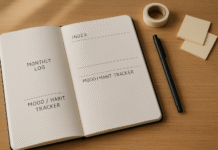
- Paper: A5 dot-grid notebook + reliable pen; optional page flag for the week.
- Apps: Day One, Journey, Notion, Apple Notes, Google Keep—pick what you already use.
- Hybrid: Snapshot a paper page into your app’s private folder for backup/search.
2.2 Decision guardrails
- Privacy: Does the tool support passcodes/Face ID or a lockable drawer?
- Friction: Can you start a new entry in ≤5 seconds?
- Portability: Will you have it when the urge to write appears?
Synthesis: Choose the format that fits your flow—convenience beats aesthetics every time.
3. Set a Tiny, Consistent Time Window (5–10 Minutes)
Consistency beats intensity. Commit to a small, specific window—say, 7 minutes after breakfast or right before bed. Tiny sessions make starting easy and sustaining realistic. Scheduling reduces decision fatigue and mood-based avoidance; you don’t wait to “feel inspired.” A defined container also reduces rambling: when time is short, you write what matters. Protect the window with a simple boundary—phone on airplane mode, door closed, one playlist on repeat. Over time, this cue becomes a ritual that primes attention and signals your brain: “Now we notice.”
3.1 Mini-checklist
- Pick a time you can protect 5 days out of 7.
- Link it to an existing habit: coffee, teeth brushing, commute.
- Use a timer (5–10 minutes) so you’re not clock-watching.
- Keep a fallback slot (e.g., lunchtime) for missed mornings.
3.2 Common mistakes
- Vague plans (“I’ll write sometime today”).
- Overlong sessions that create resistance tomorrow.
- Chasing streaks at the cost of meaningful noticing.
Synthesis: A small, repeatable window makes mindfulness journaling sustainable and honest.
4. Open With a 60–90 Second Centering Ritual
Begin each entry by arriving in your body. Take 3–6 slow breaths, relax your jaw and shoulders, and note one sensation (e.g., warmth in your hands, pressure of the chair). This quick reset lowers arousal and nudges you out of auto-pilot. You don’t need candles or a perfect setup—just a moment of deliberate presence. If you’re busy, a micro-ritual (one breath + one sensation) is enough. The goal isn’t bliss; it’s contact with what’s here now, so your writing describes reality, not rumination.
4.1 How to do it
- Breath ladder: Inhale 4 counts, exhale 6 counts, repeat 4 times.
- Label 1 sensation: “Cool air at nostrils,” “Tightness in forehead.”
- Name your state: “Alert but rushed,” “Foggy but calm.”
4.2 Pitfalls to avoid
- Turning the ritual into performance (“Was that mindful enough?”).
- Using it to suppress emotions; the point is noticing, not numbing.
- Skipping it “just this once” until it disappears entirely.
Synthesis: A brief arrival ritual tunes the instrument before you play—then the writing rings true.
5. Use a Simple 3-Line Entry to Beat Perfectionism
Structure beats perfectionism. Start with a three-line template you can finish in minutes. It reduces blank-page anxiety and produces consistent data you can review later. Keep it plain text so you’re not distracted by layouts. Over time you can add depth, but only after the pattern feels automatic. The aim is not literary excellence; it’s honest observation you can act on. If nothing “interesting” happened, that too is data—notice boredom, resistance, or calm.
5.1 Template
- Line 1 — What I notice: One concrete sensory fact or thought.
- Line 2 — What I feel: Name 1–2 emotions (e.g., “irritated, hopeful”) and body cues.
- Line 3 — What I’ll do kindly: One tiny action (pause before replying, drink water, step outside).
5.2 Example
- Notice: “Buzzing in my temples; Slack messages rising.”
- Feel: “Tense + mildly anxious (5/10).”
- Do kindly: “Two breaths before opening Slack; start with hardest message.”
Synthesis: The three-line entry is a small doorway you can pass through daily—no drama, just clarity.
6. Rotate Science-Backed Prompts That Match Your Goal
Once your three-line base is solid, layer in prompts 2–3 times a week to target skills: attention, emotion labeling, cognitive defusion, compassion, gratitude, and values-based action. Evidence-informed prompts help you practice specific micro-skills rather than freewriting aimlessly. Pick one prompt per session and keep your response to 5–8 sentences so you stay focused. Rotate them so you don’t habituate and stop seeing fresh data.
6.1 Prompt set (choose one)
- RAIN check: Recognize, Allow, Investigate, Nurture—apply to one sticky moment.
- Thought on a leaf: Write a difficult thought, then describe it floating by (defusion).
- Emotion granularity: Swap “bad” for a precise label (irritated vs. angry).
- Kindness note: “If a friend felt this, I’d tell them…” then direct it to yourself.
- Values step: “One 10-minute act that aligns with [value] today is…”
6.2 Guardrails
- Keep prompts targeted—one per entry.
- Tie each prompt to your why from Section 1.
- Review which prompts produce the most helpful actions.
Synthesis: Good prompts are power tools—use sparingly, aim precisely, and put them down.
7. Add a Body Scan or 3-Minute Breathing Space
Pairing writing with brief somatic attention stabilizes the practice. A 2–3 minute body scan or breathing space widens your awareness beyond thoughts to include sensations and posture, which are often early warning signs of stress. You’re training interoception: noticing internal cues so you can intervene sooner. If you only have 60 seconds, scan head-to-toe naming one sensation per region; if you have three minutes, linger where tension is strongest and soften 5–10%. The writing that follows will be more grounded and less reactive.
7.1 How to do it
- 3-minute breathing space: (1) Aware of what’s here; (2) Focus on breath; (3) Expand to the whole body.
- Micro body scan: Forehead, jaw, shoulders, chest, belly, hands, hips—one label each.
- Anchor phrase: “Let me feel this, then choose.”
7.2 Mini-checklist
- Set a soft timer for 2–3 minutes.
- Sit with a supported spine, feet on the floor.
- Keep eyes open or closed—choose what feels safest.
Synthesis: A brief somatic check makes the page a mirror, not an echo chamber.
8. Track Moods and Triggers With Simple Numbers
Lightweight metrics make your journal review actionable. Add a 0–10 rating for stress, energy, or mood, and note one trigger when relevant (e.g., “back-to-back meetings”). Over a week, patterns emerge—maybe energy tanks after 3 p.m., or a certain conversation spikes anxiety. Numbers won’t capture your whole story, but they make trends visible and give your future self a head start. Keep scales simple and consistent so the data stays comparable across days.
8.1 Suggested scales
- Mood: −3 (very low) to +3 (very high).
- Stress: 0 (none) to 10 (max).
- Sleep quality: 1 (poor) to 5 (great).
8.2 Using the data
- Weekly glance: Are there consistent low-mood days or contexts?
- If-then plan: “If stress ≥7, then I take a 3-minute breathing space + step outside.”
- Boundary experiment: Move a meeting, shorten a task block, or insert a buffer.
Synthesis: Small numbers point to big levers—use them to design kinder weeks.
9. Practice Non-Judgment and Self-Compassion on the Page
Mindfulness without kindness can become surveillance. Treat each entry as a conversation with yourself that assumes good intent. Replace “should/always/never” with descriptive language, and respond to suffering with warmth, not scolding. Self-compassion reduces shame and rebound perfectionism, making it more likely you’ll show up tomorrow. When you miss days, note it without drama and begin again. This stance turns the journal into a safe lab for behavior change rather than a courtroom.
9.1 How to do it
- Three tones: Mindful (what’s happening), common humanity (others feel this too), kindness (what’s helpful now).
- Rewrites: Change “I failed” to “I’m disappointed; the plan was unrealistic for today.”
- Support cue: Put a small heart or star next to lines where you showed up despite difficulty.
9.2 Common traps
- Using the journal to self-criticize “to improve.”
- Treating feelings as problems to fix rather than experiences to feel.
- Comparing entries to others’ highlight reels.
Synthesis: Kind attention is the fertile soil—judgment makes practice brittle.
10. Close Each Entry With One Tiny Action or Kindness
Mindfulness journaling earns its keep when it nudges behavior in the next hour, not just insights on the page. End with a one-line commitment you can complete within your current constraints. Think of it as a kindness or micro-experiment that tests your hypotheses about what helps. Keep actions small—30 seconds to 10 minutes—so they survive real-world schedules. Over time, these small steps compound into habits that change how your days feel from the inside.
10.1 Action menu
- Drink a glass of water; stand and stretch for 60 seconds.
- Say “I need a minute—happy to continue after a quick break.”
- Write a two-sentence email you’ve been avoiding.
- Walk outside for five minutes without your phone.
- Put the next difficult task on your calendar for a 15-minute sprint.
10.2 Mini case
Yesterday you noticed afternoon brain fog (mood −1, energy 3/5) after long Zooms. Today’s action: 5 minutes outdoors at 3:30 p.m. + tea. Result: energy 4/5, stress down from 6 to 4. Keep or adjust?
Synthesis: Close with a doable verb—the smallest kind action that moves the day forward.
11. Review Weekly to Spot Patterns and Iterate
A short weekly review turns scattered entries into wisdom. Spend 10–15 minutes scanning the week’s pages for patterns: repeated triggers, helpful actions, times you felt most aligned with your values. Circle or tag what worked; strike what didn’t. Update your prompts and environment accordingly. The point is not to grade yourself but to learn from real data. A weekly rhythm also renews motivation by reminding you that small attention pays cumulative dividends.
11.1 Review prompts
- Highlights: What helped most this week? What moment felt most mindful?
- Sticking points: Where did I get hooked? What warning signs did I miss?
- Next tweak: What single change will make next week 10% easier?
11.2 Light metrics
- Count entries (target 4–6/week).
- Average mood/stress scores.
- Note one boundary you protected and one you’ll try next week.
Synthesis: Review is where insight becomes strategy—look back briefly so you can move forward wisely.
12. Protect Privacy and Design for Longevity
Safety supports honesty. Decide how you’ll keep entries private—locked drawer, app passcode, initials instead of full names. Create a low-effort archiving plan so your notebook or app doesn’t become cluttered: start a fresh notebook when one fills, or export a PDF every quarter. Plan for interruptions (travel, holidays, illness) with a “bare-minimum mode” you can sustain for a week or two. Longevity comes from simplifying friction points: privacy anxiety, disorganized pages, and perfectionist expectations.
12.1 Practical safeguards
- Privacy: App lock; paper stored in a consistent, safe spot.
- Anonymize: Use initials for people/sensitive topics.
- Bare-minimum mode: One-line entries + mood number when life is full.
12.2 Sustainability tips
- Keep a spare pen and a “micro journal” (thin notebook) in your bag.
- Use a sticky bookmark to open directly to today’s page.
- Every 90 days, skim and archive; capture 3 lessons on an index card.
Synthesis: When privacy is protected and friction is low, your practice can keep breathing for years.
FAQs
1) What’s the difference between a mindfulness journal and a regular diary?
A regular diary often recounts events and opinions; a mindfulness journal focuses on present-moment noticing—sensations, thoughts, emotions—and on how you choose to respond. You’ll use concise prompts, mood numbers, and short actions more than long narratives. Both have value, but mindfulness journaling is deliberately structured to train attention, reduce reactivity, and guide kind, next-step behaviors.
2) How long should I journal each day?
Five to ten minutes is enough to build a sustainable habit. Short, consistent sessions train the “show up” muscle and keep entries focused. If you feel pulled to write more, add an optional extra five minutes, but don’t let longer sessions make you skip tomorrow. The goal is daily contact with your experience, not word count.
3) Do I need to meditate before journaling?
No, but a 60–90 second centering ritual—3–6 slow breaths and a quick body check—will improve the quality of your writing. Meditation and journaling complement each other: meditation strengthens attention; journaling turns observations into practical choices and plans. If you already meditate, journal right after to capture insights while they’re fresh.
4) What should I write if I feel “nothing”?
Write exactly that: “Feeling flat; body quiet; slight restlessness in legs.” Neutral or blank states are part of experience, and labeling them builds accuracy. Add one kindness action (stand, stretch, step outside) and a number (mood −1 to +1). Over time, you’ll notice subtle textures you used to miss, and the pattern itself becomes informative.
5) How can I keep my journal private?
Decide on safeguards before you begin. Use an app with passcode/biometric lock, or store your notebook in a consistent, secure place. Avoid naming people or sensitive details in full; use initials or roles. If privacy anxiety spikes, switch to “bare-minimum mode” for a few days (one line + a number) until you feel safe enough to write more.
6) Are prompts necessary, or can I freewrite?
Prompts aren’t mandatory, but they make practice targeted. Freewriting can help you debrief a charged moment; prompts like RAIN, emotion granularity, or values-based action train specific skills. Try one prompt twice a week and evaluate whether it changes your behavior in the next 24 hours—that’s the litmus test for usefulness.
7) Can mindfulness journaling help with stress and anxiety?
Many people find it reduces reactivity and increases a sense of control by clarifying triggers and next actions. It’s a supportive practice, not a replacement for therapy or medical care. If anxiety is high or persistent, consider combining journaling with evidence-based care. Use gentle language and focus on small, doable actions to avoid overwhelm.
8) What if I miss a day (or a week)?
Begin again without drama. Note what disrupted the routine, choose a smallest-possible restart (three-line entry), and schedule a backup slot for the next two days. Consistency matters, but flexibility keeps the practice alive. The page is always there when you return—your job is just to show up kindly.
9) How do I review my entries effectively?
Set a 10–15 minute weekly review. Scan for patterns in mood/energy numbers, note helpful actions, and identify repeated triggers. Choose one change for the week ahead—simplify a meeting, insert a pause, or adjust a boundary. Capture three lessons on a sticky note and keep it visible for seven days.
10) Should I keep digital backups of paper journals?
If privacy allows, yes. Snap photos of key pages and store them in a locked folder or secure app. Backups enable quick search (“sleep” or “anger”) and protect against loss. If you prefer not to digitize, create quarterly summaries on a single page so the highlights are easy to revisit.
11) What’s a good first-week plan?
Days 1–3: three-line entries + 60-second centering; Days 4–5: add a single prompt; Day 6: include mood/stress numbers; Day 7: 10-minute review. Keep every action tiny. At week’s end, adjust your time, tool, and prompts based on what felt doable and helpful.
12) Can I combine gratitude with mindfulness journaling?
Absolutely. Gratitude is a natural complement that nudges attention toward sufficiency and connection. Add one line at the end of each entry: “One thing I appreciate today is…” Keep it specific and small—“the way the light hit my desk,” “a friend’s text.” Gratitude widens perspective without denying difficulty.
Conclusion
Mindfulness journaling is less about ornate pages and more about a steady relationship with your moment-to-moment experience. When you define a meaningful “why,” pick a format you’ll actually open, and commit to a small daily window, the habit becomes resilient. A brief arrival ritual, a simple three-line structure, and occasional science-backed prompts keep the practice focused. Light metrics surface patterns; a kind closing action turns insight into behavior. Weekly reviews stitch single entries into a story about what helps you live the way you intend. Privacy safeguards and a bare-minimum mode protect honesty through busy and tender seasons. You don’t need perfect words—just attention and care, shown regularly. Set a 7-minute timer, breathe once, and write your first three lines today.
References
- Mindfulness: What You Need to Know, National Center for Complementary and Integrative Health (NCCIH), updated 2022, https://www.nccih.nih.gov/health/mindfulness
- Expressive Writing: Words That Heal (overview), The University of Texas at Austin – James W. Pennebaker, accessed 2025, https://liberalarts.utexas.edu/psychology/faculty/pennebak
- Mindfulness meditation: A research-proven way to reduce stress, American Psychological Association, 2019, https://www.apa.org/topics/mindfulness/meditation
- Mindfulness-based stress reduction and health benefits: A meta-analysis, Grossman, P. et al., Journal of Psychosomatic Research, 2004, https://www.sciencedirect.com/science/article/pii/S0022399903005577
- The Science of Gratitude (White Paper), Greater Good Science Center at UC Berkeley, 2018, https://ggsc.berkeley.edu/what_we_do/major_initiatives/expanding_gratitude/science_of_gratitude
- Self-Compassion Research Overview, Kristin Neff, PhD (self-compassion.org), updated 2023, https://self-compassion.org/research/
- Body Scan Meditation (Guided), Mindful.org, 2020, https://www.mindful.org/body-scan-meditation/
- The Three-Minute Breathing Space, Oxford Mindfulness Foundation, accessed 2025, https://www.oxfordmindfulness.org/learn/resources/three-minute-breathing-space/