



















If your hips feel tight from sitting, lifting, or running, good news: targeted mobility work can help. This guide walks you through 10 hip flexor and groin stretches with precise form cues, hold times, and safety guardrails so you can loosen up without guessing. It’s designed for everyday movers, lifters, and runners who want practical, science-aware guidance—no yoga pretzel experience required. Brief disclaimer: this is general education, not medical advice; if you have sharp pain, numbness, or a recent injury, consult a qualified clinician before doing these movements.
Quick definition: Hip flexor and groin stretches are exercises that lengthen the muscles at the front of the hip (iliopsoas, rectus femoris, sartorius) and inner thigh (adductor longus/brevis/magnus, gracilis, pectineus) to improve range of motion and reduce stiffness. A practical starting target is 20–45 seconds per hold, 2–4 repetitions per side, most days of the week.
Fast-start checklist
- Warm up lightly (1–3 minutes of marching in place or easy bodyweight squats).
- Move into stretch until you feel mild–moderate tension (≈3–5/10), not pain.
- Breathe slowly; avoid holding your breath.
- Ease out if you feel pinching in the front of the hip joint or any nerve-like symptoms.
1. Half-Kneeling Hip Flexor (Lunge) Stretch
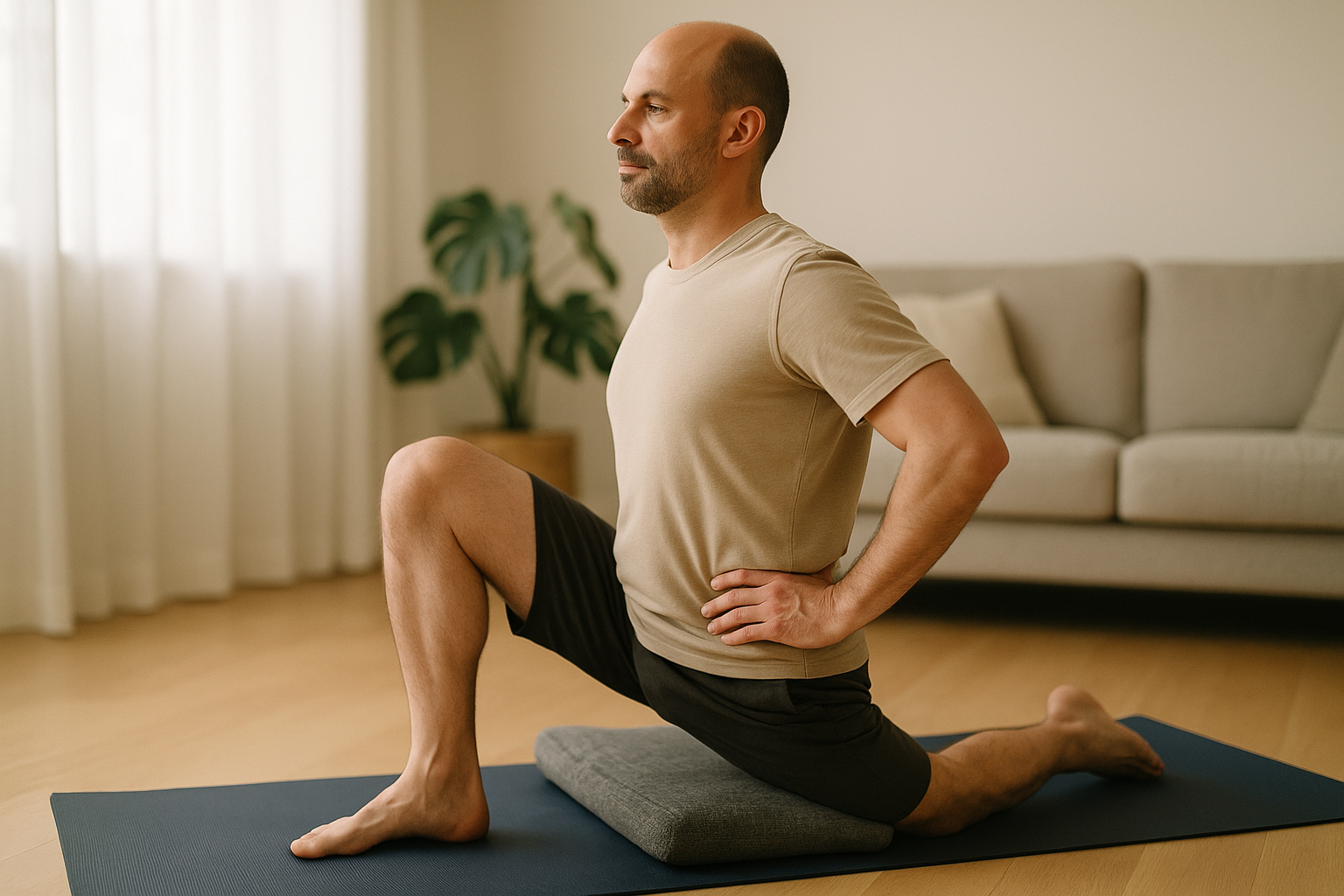
The half-kneeling lunge stretch is a reliable way to target the hip flexors of your back leg while keeping your spine stable. Start by stacking your front knee over your ankle and placing your back knee on a cushion. The key cue is a posterior pelvic tilt—think “zip your zipper up” or “tuck tail”—so you feel the stretch high in the front of the hip rather than dumping into the low back. This variation suits most bodies and offers a large margin of error compared with deeper yoga poses. If you sit a lot or run frequently, this is often the single stretch that gives the biggest return. Begin with small ranges and steady breathing; you should feel tension across the front of the hip and upper thigh, not a sharp pinch inside the joint. Done consistently, it can improve stride mechanics and reduce the “stuck” feeling when standing after prolonged sitting.
How to do it
- Set up half-kneeling: front foot flat, back knee on a folded towel.
- Squeeze the back-leg glute lightly and tuck your pelvis.
- Shift your hips forward 2–5 cm while keeping ribs down and spine tall.
- Keep weight in the mid-foot of the front leg; avoid collapsing the knee inward.
- Hold 20–45 seconds, breathing slowly; repeat 2–4 times each side.
Numbers & guardrails
- Frequency: 4–6 days/week; runners: consider after easy runs or strength sessions.
- Intensity: gentle stretch (3–5/10); no low-back arching.
- Progression: raise the back foot on a small step, or reach the same-side arm overhead.
Common mistakes
- Arching the low back instead of tucking the pelvis.
- Lunging too far so the front knee shoots past toes with heel lifting.
- Feeling pressure on the kneecap (pad the knee generously).
A controlled pelvic tuck and small forward shift beat big ranges; precision here yields better hip opening with less risk.
2. Couch Stretch (Sofa-Edge) for Hip Flexors
The couch stretch powerfully targets the rectus femoris (a quad muscle that also crosses the hip) along with deep hip flexors. It’s ideal if squats or lunges feel “blocked” in the front of the hip, but it’s intense, so set up carefully. By pinning your back shin against the wall or couch and bringing your knee close to the base, you create a long lever that magnifies the stretch—use padding and start conservatively. Keep your pelvis tucked and ribs stacked; you should feel a broad tension across the front of the thigh, not a sharp kneecap ache. Many people benefit from holding a stable object to keep the torso upright and avoid hinging into the low back. If kneeling is uncomfortable, you can perform a gentler version by elevating the back foot on the couch with the knee farther from the wall.
How to do it
- Place a cushion at the base of a wall or couch.
- Back knee on the cushion, shin vertical up the wall; front foot steps forward to lunge.
- Tuck pelvis, squeeze back-leg glute, and slowly bring torso upright.
- Keep the chin slightly tucked and ribs over pelvis; breathe steadily.
- Hold 20–40 seconds, 2–3 rounds per side; exit slowly.
Why it matters
- Targets rectus femoris more than a standard lunge stretch.
- Useful for people who feel front-of-hip tightness at the bottom of squats.
- May improve comfort in prolonged sitting by offsetting hip flexion postures.
Common mistakes
- Letting the low back arch as you reach upright.
- Placing the knee too close to the wall too soon (over-stress on kneecap).
- Holding the breath; the intensity tends to spike if you brace too hard.
Respect the intensity: small setup tweaks and abundant padding turn this from “too much” into “just right.”
3. Standing Quad & Hip Flexor Stretch (Knee-Bent)
This classic upright stretch hits the front of the thigh and hip when you don’t have floor space. It’s especially convenient as a post-run or post-ride cool-down. The goal is to keep your knees close together, gently tuck your pelvis, and pull the heel toward the glute without yanking. A soft, tall posture avoids compressing the low back and lets you feel the tension in the front of the thigh. Hold a wall or chair for balance so you can relax rather than wobbling. If your knee is sensitive, hold the foot by the laces or use a strap to reduce the angle. Done correctly, it preferentially lengthens rectus femoris and can ease the “front-of-hip tug” many feel when climbing stairs after sitting.
How to do it
- Stand tall, feet hip-width; hold a wall for balance.
- Bend one knee, bring heel toward glute, and grasp the ankle or foot.
- Gently tuck pelvis and draw knees together.
- Keep ribs stacked over pelvis; avoid flaring the chest.
- Hold 20–45 seconds; 2–4 rounds each side.
Numbers & guardrails
- Intensity: mild–moderate (3–5/10), no kneecap pain.
- Variations: loop a yoga strap around the ankle; add a slight hip extension by moving the knee just behind the stance leg.
- Runners/cyclists: pair with light calf and hip external rotation mobility for a balanced cool-down.
Mini-checklist
- Knees together
- Pelvis tucked
- Breathing easy
- No low-back arch
Steady balance makes this stretch effective; when you don’t fight to stand, you can focus on precise hip positioning.
4. Lizard Lunge with Adductor Bias
Lizard lunge places your front foot outside your hands to open the inner thigh while also lengthening the back-leg hip flexors. This hybrid makes it a top pick for both groin and front-of-hip tightness. Begin with blocks or books under your hands to lift the floor and keep your spine neutral. The front knee tracks over the middle toes while the back leg extends with a light glute squeeze. Think “long spine, heavy hips,” and breathe into the belly. You should feel a broad stretch across the inner thigh of the front leg and the front of the hip on the back leg, not a pinch in the hip socket. If wrists are uncomfortable, drop to your forearms on a cushion or maintain straight arms on blocks.
How to do it
- From a runner’s lunge, step the front foot to the outside of your hands.
- Turn the front toes slightly outward (≈10–20°) to bias adductors.
- Squeeze the back-leg glute, tuck slightly, and lengthen through the crown of the head.
- Option: drop the back knee for support or stay lifted for more intensity.
- Hold 25–45 seconds, 2–3 rounds each side.
Why it matters
- Simultaneously addresses inner-thigh (adductor) and front-hip (flexor) tension.
- Useful for field sports and trail runners who need split-stance mobility.
- Scales easily with blocks or forearm support.
Common mistakes
- Collapsing the front arch/knee inward; keep knee tracking over middle toes.
- Sinking into the low back or shoulders; stay tall through the spine.
- Pushing range too fast; let the hips melt forward over several breaths.
Aim for equal length through both sides of the pelvis; when you balance the stretch, your hips open more uniformly.
5. Butterfly (Bound Angle) Groin Stretch
Butterfly is a seated classic that targets the adductors while allowing your spine to stay tall. It’s gentle, accessible, and easy to dose on rest days. Sit with the soles of your feet together and knees out to the sides; elevate the hips on a folded blanket to avoid rounding the low back. Instead of forcing your knees down with your hands, tilt your pelvis forward slightly and imagine your femurs externally rotating in the sockets. The sensation should be a mild stretch along the inner thighs; if you feel pinching in the front of the hip, elevate the hips higher and decrease the knee angle. Slow breathing and a slight forward hinge increase the intensity without strain.
How to do it
- Sit tall on a cushion, soles together, knees out.
- Hold the ankles or shins; lengthen through the crown of the head.
- Pelvis tips forward slightly; maintain a long spine.
- Optional gentle hinge forward while keeping chest open.
- Hold 30–60 seconds, 2–3 rounds.
Numbers & guardrails
- Intensity: 2–4/10; aim for calm, sustained tension, not bouncing.
- Props: yoga blocks under the knees for support if the stretch bites too hard.
- Progression: move heels closer to the pelvis or hinge slightly more.
Common mistakes
- Rounding the low back to “reach” further.
- Pressing knees down aggressively with hands.
- Holding the breath or clenching the jaw.
Butterfly works best when you create space in the hips by elevating the seat; more height often means more effective lengthening with less strain.
6. Frog Stretch (Prone Adductors)
Frog is a floor-based stretch that opens the inner thighs through abduction with knees bent to 90°. It’s intense but adjustable and a favorite for athletes who need lateral hip mobility. Place your knees wide on a cushioned surface, shins in line with thighs, and forearms on the floor or blocks. Keep your spine neutral and core lightly engaged. Then gently shift your hips backward until you feel tension along the inner thighs; stop well before any sharp groin pain. Because the hips are in a safe, supported position, you can breathe and relax into the tissue rather than fighting to hold your posture. If you feel pressure in the knees, add more padding or reduce the knee angle.
How to do it
- Knees wide on a padded surface, hips in line with knees, shins outward.
- Forearms on floor/blocks; spine long, ribs over pelvis.
- Slowly rock hips back 2–4 cm to find a sustainable edge.
- Hold 25–45 seconds; 2–3 rounds, breathing calmly.
- Exit by walking hands forward and bringing knees together.
Why it matters
- Directly targets adductors at moderate hip flexion, a common restriction in squats and lateral movements.
- Improves comfort in positions requiring wide stances (sumo deadlifts, lateral lunges).
Common mistakes
- Letting the low back sag or round; keep neutral.
- Forcing knees wider than tissues allow.
- Holding at end-range while tensing the neck and shoulders.
Approach frog like a dimmer switch, not an on/off button; small rocks and soft breath produce deeper, safer opening.
7. Cossack Squat (Lateral Lunge) Stretch
The Cossack squat functions as a mobilizing stretch that blends strength and range. By shifting into a deep lateral lunge, you open the adductors of the long leg while loading the glutes of the bent leg. It’s dynamic enough for warm-ups yet slow enough to be controlled. Keep your chest tall, sit your hips back, and let the bent knee track over the mid-foot. The straight leg’s toes can point up to increase the inner-thigh stretch. Use a counterweight (e.g., a light kettlebell) or hold onto a stable object for support, prioritizing clean alignment over depth. The goal is to feel a stretch along the inner thigh of the straight leg and a strong but comfortable load through the bent leg.
How to do it
- Stand wide; turn toes slightly outward.
- Shift into one side, bending that knee while the other leg stays straight.
- Keep heel down on the bending side; lift toes up on the straight side for more stretch.
- Stay tall through the torso; hands forward for balance or hold support.
- Pause 2–3 seconds at depth; repeat 6–10 reps/side, or hold 20–30 seconds at the bottom.
Numbers & guardrails
- Warm-up dosage: 1–2 sets of 6–8 controlled reps per side.
- Mobility dosage: 20–30-second holds in end-range, 2–3 rounds.
- Range rule: no knee pain; reduce depth or stance width as needed.
Common mistakes
- Collapsing the arch/knee inward on the bending side.
- Rushing the descent—control is the point.
- Letting the straight leg roll inward; keep the femur externally rotated as needed.
Cossacks teach hips to open while you maintain balance and strength—carryover you’ll feel in squats, skaters, and change-of-direction sport.
8. Seated Straddle (Pancake Prep) Stretch
The seated straddle targets the adductors and hamstrings with the spine long and the pelvis tilting forward. Think of it as “pancake prep,” not a test of how far you can face-plant to the floor. Elevate your hips on a firm cushion so you can hinge from the pelvis without rounding. Set your legs wide but comfortable; you should feel a moderate pull along the inner thighs and maybe behind the knees. Walk your hands forward to increase intensity, but only as long as your spine stays neutral and your breathing slow. This position builds tolerance for wide-stance squats and martial-arts stances and helps restore range lost to desk time.
How to do it
- Sit on a folded blanket; legs wide in a V.
- Press heels gently into the floor and tilt the pelvis forward.
- Place hands in front and inch forward while staying long through the spine.
- Hold 30–60 seconds; 2–3 rounds, breathing steadily.
- Exit by walking hands back and bringing legs together.
Why it matters
- Challenges adductors in a lengthened position with hamstrings assisting.
- Teaches pelvic control—hinge from hips rather than rounding the spine.
Common mistakes
- Going too wide too soon; a moderate V often stretches better.
- Rounding the back to “reach farther.”
- Numbness/tingling from nerve tension—back off and elevate more if present.
Treat depth as a byproduct of good posture; stability at the spine lets the hips safely explore more range.
9. Adductor Rock-Backs (Quadruped Mobility)
Adductor rock-backs blend mobility with gentle movement, making them ideal for stiff or sensitive groins. From hands and knees, extend one leg out to the side with the foot flat and toes forward or slightly up. Keep the spine long and ribs stacked, then rock your hips back toward your heel until you feel a stretch along the inner thigh of the outstretched leg. This drill is self-limiting, low-load, and friendly to cranky hips because you can control depth and speed. It doubles as a warm-up before squats or sport and as a cool-down after long sitting. If wrists complain, elevate your hands on blocks or a sturdy bench.
How to do it
- Start quadruped; extend one leg out to the side with knee straight and foot planted.
- Hands under shoulders; spine neutral, light core brace.
- Inhale; on exhale, rock hips back 3–6 cm to find tension.
- Pause 1–2 seconds; return to start. Repeat 8–12 reps, then switch sides.
- Option: hold the end-range for 20–30 seconds after your last rep.
Numbers & guardrails
- Warm-up: 1–2 sets of 8–12 reps/side.
- Mobility: 20–30-second end-range holds, 2–3 rounds.
- Sensations: inner-thigh stretch is OK; joint pinching is not—adjust foot angle or reduce range.
Common mistakes
- Letting the pelvis rotate or spine round; keep your belt line parallel to the floor.
- Turning the foot too far outward and losing mid-foot pressure.
- Rushing; the quiet, slow rock is the benefit.
This drill slots neatly into any routine and often frees up squat depth immediately—simple, scalable, and effective.
10. Edge-of-Bed (Thomas Test) Hip Flexor Stretch
The edge-of-bed stretch, inspired by the clinical Thomas test position, isolates hip flexors while the low back stays supported. Lie on your back near a sturdy bed’s edge, pull one knee to your chest, and let the other leg hang off. You’ll feel the front of the hanging thigh and hip open; if the knee is bent, you’ll bias the rectus femoris, while a straight knee targets iliopsoas more. This position keeps the pelvis neutral and limits spinal compensation, making it a great choice if kneeling or lunging is uncomfortable. Use a strap to hold the chest-side knee if your arms fatigue, and add a small pad under the low back if needed.
How to do it
- Lie supine at the bed’s edge; pull one knee to the chest.
- Let the other leg hang off; keep pelvis neutral (belly soft, ribs down).
- Option A: keep the hanging knee bent to stretch rectus femoris more.
- Option B: straighten the hanging knee to bias iliopsoas.
- Hold 25–45 seconds, 2–4 rounds per side; stand up slowly between rounds.
Numbers & guardrails
- Intensity: 3–5/10; avoid front-of-hip pinching.
- If the thigh doesn’t drop below horizontal, focus on shorter holds and frequent sessions (little and often).
- Progression: add a light ankle weight to the hanging leg only if the low back stays neutral.
Common mistakes
- Letting the pelvis tilt anteriorly (low-back arch) as the leg hangs—reset ribs and gently tuck.
- Pulling the chest-side knee too hard into the ribs and losing pelvic neutrality.
- Turning the hanging leg outward; keep toes facing the ceiling.
This supported position is both diagnostic and therapeutic—clean alignment helps you feel the target tissue without fighting gravity or balance.
FAQs
1) Should I stretch before or after workouts?
Before training, prioritize a dynamic warm-up and use brief (≤15–20 s) static holds only if needed for comfort; longer static holds can transiently reduce maximal strength and power. After training or on rest days, use longer holds (20–45 s) for mobility. The key is intent: prepare tissues to move before, lengthen them after.
2) How long should I hold these stretches?
A practical window is 20–45 seconds per hold, 2–4 repetitions per side, breathing calmly. Longer holds (up to 60 s) can be useful for gentler positions like butterfly or seated straddle. What matters most is consistency across the week rather than chasing extreme single-session gains.
3) How often should I do hip flexor and groin stretches?
Most people benefit from 4–6 days per week at low–moderate intensity. Short, frequent sessions (5–10 minutes) often outperform sporadic long ones. If you’re increasing running or squat volume, add a few extra holds for recovery days.
4) What if I feel pinching in the front of my hip?
Pinching suggests joint or tendon compression rather than a useful muscle stretch. Reduce range, add padding, and focus on pelvic tuck cues. If the pinching persists or travels, stop and consult a trained clinician; you may need a different angle, targeted strength work, or individualized assessment.
5) Can stretching relieve my low-back tightness from sitting?
Often, yes—front-hip opening reduces the anterior tilt and extension bias that sitting can amplify. Pair hip flexor stretches with gentle glute/abdominal activation (e.g., bridges, dead bugs) and short movement breaks every 30–60 minutes. Relief should feel like ease, not numbness or sharp pain.
6) Do I need to warm up first?
A brief warm-up (1–3 minutes of marching, easy squats, or stair climbs) improves tissue tolerance and helps you relax into the holds. Warm tissues accept stretch better and decrease the urge to brace. You don’t need to sweat; you just want to feel slightly warmer and looser.
7) Will stretching make me weaker?
Long static holds immediately before maximal strength/power efforts can reduce peak output for a short window. That’s why longer holds are best after training or separate from it. Over the long term, pairing stretching with strength work supports healthy range and force production.
8) What props help if my knees hurt on the floor?
Use thick pads, folded towels, or a cushion under the kneeling knee. For standing or bed-edge variations, a yoga strap can offload the hands and reduce knee bend angle. Comfort enables relaxation; when your body feels safe, your hips let go more readily.
9) How do I progress these stretches?
Progress by adding time (up to 45–60 s), improving posture (cleaner pelvic tuck, rib stack), or adjusting angles (e.g., toes up in Cossack). Avoid forcing depth. Use breath: longer exhales often unlock a few extra millimeters safely.
10) Are there times I shouldn’t stretch?
Avoid stretching into acute injury, sharp pain, or nerve-like symptoms (burning, tingling). Post-surgery or during significant inflammation, follow your clinician’s protocol. For chronic issues, gentle, well-tolerated holds combined with strength work are typically safer than aggressive, end-range efforts.
Conclusion
Hip mobility improves most when you blend the right dose with the right cues. The 10 movements above cover both sides of the hip—front flexors and inner-thigh adductors—and can be tailored with simple props, breath, and alignment tweaks. Small wins add up: a consistent 5–10 minutes most days can translate into smoother squats, easier runs, and less stiffness after long sits. Start with two or three stretches that feel approachable, build confidence in your pelvic tuck and rib stack, and let comfort guide depth rather than ego. Over a few weeks, progress holds, angles, and control. Your hips will reward the attention.
Copy-ready next step: Pick any 3 stretches from this list and perform 2 sets of 30–40 seconds per side today.
References
- Hip Flexor Strain: Symptoms, Treatment & Prevention, Cleveland Clinic, 2022, https://my.clevelandclinic.org/health/diseases/23978-hip-flexor-strain
- Groin Strain, Cleveland Clinic, 2023, https://my.clevelandclinic.org/health/diseases/21572-groin-strain
- The truth about stretching, Harvard Health Publishing, 2019, https://www.health.harvard.edu/staying-healthy/the-truth-about-stretching
- Behm DG, Chaouachi A. A review of the acute effects of static and dynamic stretching on performance, European Journal of Applied Physiology, 2011, https://link.springer.com/article/10.1007/s00421-011-1879-2
- Kay AD, Blazevich AJ. Effect of acute static stretch on maximal muscle performance: a systematic review, Journal of Applied Physiology, 2012, https://journals.physiology.org/doi/full/10.1152/japplphysiol.00845.2011
- Groin strain, NHS Inform (Scotland), 2023, https://www.nhsinform.scot/illnesses-and-conditions/muscle-bone-and-joints/leg-and-foot-problems/groin-strain
- ACSM’s Guidelines for Exercise Testing and Prescription (11th ed.) — overview page, American College of Sports Medicine, 2021, https://www.acsm.org/education-resources/books/guidelines
- Flexibility exercise (stretching): Fit facts, American College of Sports Medicine, 2020, https://www.acsm.org/docs/default-source/files-for-resource-library/fit-fact-flexibility.pdf
- Adductor (groin) strain: exercises and advice, University Health Services (Berkeley), 2020, https://uhs.berkeley.edu/sites/default/files/groin_strain_exercises.pdf