


























Lower back feeling tight after long workdays or workouts? Below are 9 mobility exercises to prevent lower back pain by restoring motion to the hips and mid-back, dialing down stiffness, and teaching your core to share load. In simple terms, mobility exercises to prevent lower back pain are controlled, low-load movements that keep your hips and spine moving well so your back doesn’t have to compensate. Most people do best performing a brief daily routine (8–12 minutes) and a slightly longer session 3–5 days per week. As major clinical guidelines emphasize, regular exercise and movement are first-line strategies for back pain and its prevention through self-management.
Quick start (skimmable): Do 2–3 sets of each exercise below, 5–8 slow reps or 20–40 seconds per side, breathing smoothly. Stop if you feel sharp, radiating, or worsening symptoms and consult a clinician.
Medical note: This article is informational and not a substitute for medical care. If you have red-flag symptoms (unexplained weight loss, fever, recent trauma, numbness in the groin/saddle area, progressive weakness, or bowel/bladder changes), seek urgent evaluation.
1. Cat–Cow With Segmental “Spinal Wave”
Cat–Cow instantly helps by gently moving the lumbar and thoracic spine through flexion and extension, reducing stiffness and improving awareness of neutral posture. Starting each session with this pattern warms the surrounding muscles and primes breathing mechanics, so later hip and thoracic drills land better. The “segmental wave” variation adds control: instead of moving all at once, you articulate one spinal region at a time, which teaches you to move your back smoothly rather than hinging at a single sore spot. While Cat–Cow is often seen as a yoga staple, it aligns nicely with physical therapy principles of graded exposure and low-load movement for back care. Large guidelines endorse exercise programs—including mobility work—as first-line approaches for persistent or recurrent low back pain, and this gentle drill fits that bill.
1.1 Why it matters
- Encourages even motion across spinal segments instead of overloading one level.
- Pairs breath with movement to reduce protective muscle guarding.
- Serves as a “systems check” before more demanding mobility or strength work.
1.2 How to do it
- Start on all fours, hands under shoulders, knees under hips.
- Exhale and round from tailbone upward, vertebra by vertebra, letting your head relax (Cat).
- Inhale and extend from tailbone upward, opening the chest while keeping the neck long (Cow).
- Add the “wave”: move slowly so each zone (pelvis, low back, mid-back, upper back) takes its turn.
1.3 Numbers & guardrails
- 2–3 sets of 6–8 slow waves (about 40–60 seconds per set).
- Keep the range within “pleasant stretch,” not pain >3/10.
- If wrists complain, make fists or elevate hands on yoga blocks.
Synthesis: Use Cat–Cow as your daily on-ramp; it smooths motion and sets the tone for the hip and thoracic mobility to come.
2. 90/90 Hip Rotation Flow (Internal & External Rotation)
The 90/90 flow directly targets hip rotation—the motion most people lose with sitting. When hip rotation is restricted, the lumbar spine often compensates during everyday tasks like walking, squatting, or getting out of a car. Restoring rotation distributes forces more evenly, which can lower irritation in the low back. Emerging evidence suggests people with low back pain often present with altered hip ROM and control, reinforcing the value of assessing and addressing the hip. While not every back issue stems from the hips, improving rotation can remove a common handbrake on comfortable movement and reduce strain on the lumbar segments during twisting or bending.
2.1 How to do it
- Sit with both knees bent at ~90° (front shin parallel to torso; back shin behind you).
- Sit tall; lightly brace your core; keep both sit bones grounded if possible.
- Externally rotate into the front hip by leaning forward a few centimeters—slow, steady breath.
- Internally rotate the back hip by rotating your torso toward the rear thigh; switch sides with a controlled “windshield wiper” motion.
- Add lift-offs: gently lift the front ankle or the back knee 1–2 cm without leaning.
2.2 Numbers & guardrails
- 2–3 sets of 5–7 slow rotations per side; 10–20-second holds at end-range.
- Keep knees comfortable; elevate hips on a cushion if you round your back.
- Avoid pinchy front-hip pain; back off range and add more torso angle as needed.
Synthesis: The 90/90 flow gives you the rotational freedom your lumbar spine loves; better hip motion, less back compensation.
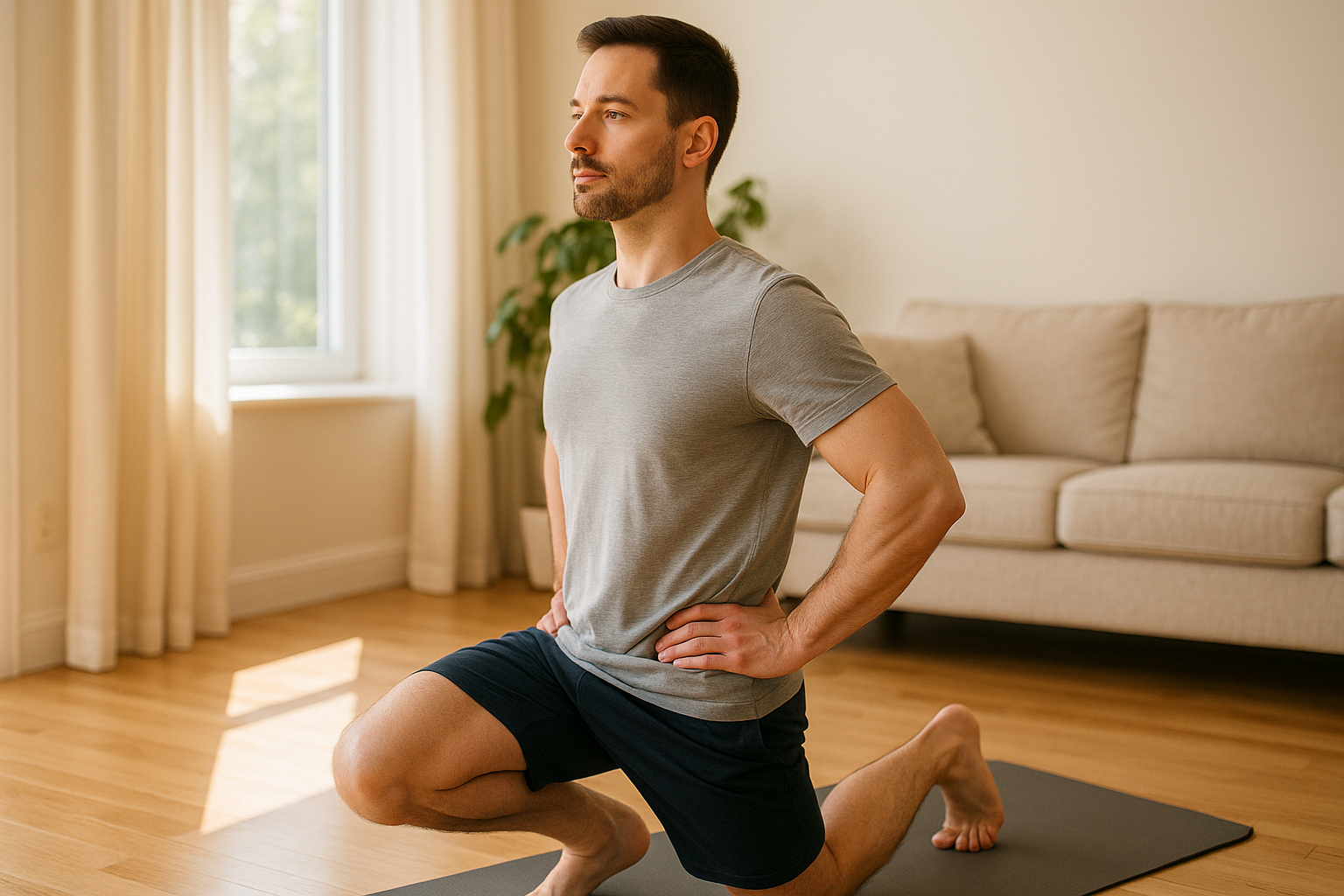
3. Half-Kneeling Hip Flexor Stretch (With Posterior Pelvic Tilt & Reach)
If your hip flexors (especially iliopsoas) are short or overactive from sitting, your pelvis can tip forward and increase lumbar extension stress, which many people perceive as “tight low back.” A targeted half-kneeling stretch with a firm posterior pelvic tilt (PPT) restores hip extension, re-levels the pelvis, and calms cranky erectors. Research notes that limited hip extension flexibility and prolonged sitting commonly coexist and may contribute to low back symptoms; stretching is a practical first step to address this modifiable factor. PMC
3.1 How to do it
- Kneel with your right knee down, left foot forward. Pad the knee.
- Tuck the tail (PPT): imagine pulling your belt buckle toward your ribs.
- Shift the whole pelvis forward a few centimeters without arching your back.
- Reach the right arm up and slightly across to get the front of the hip; breathe.
- Add a gentle side-bend away from the back leg to bias psoas.
3.2 Numbers & guardrails
- 2–3 rounds of 20–40 seconds per side; slow nasal breathing.
- Intensity: 3–4/10 stretch; no numbness/tingling or sharp groin pain.
- If kneeling is uncomfortable, place a thick towel or do a standing version.
Synthesis: Freeing hip extension reduces the urge for your low back to over-arch during standing and walking, easing daily strain.
4. Seated or Supine Sciatic Nerve Slider (Gentle Neurodynamics)
Nerve sliders—very gentle “flossing” movements—can ease sensitivity along the sciatic pathway in people with back-related leg symptoms. The aim isn’t a deep stretch; it’s to move the nerve bed relative to surrounding tissues, which some trials and reviews suggest can reduce pain and disability in the short term. Evidence is mixed: systematic reviews report benefits for back/neck conditions, though not all trials show clear effects; best practice is to keep symptoms calm and ranges modest. Use sliders if you feel hamstring-line tightness with tingling, or as part of a program guided by a clinician when leg pain is present. PLOS
4.1 How to do a slider (seated)
- Sit tall; extend your affected knee as you dorsiflex the ankle while you look up (reduces neural tension).
- Then lower the foot (plantarflex) while you tuck the chin (increases neural tension).
- Move slowly between these positions like a see-saw—never into sharp symptoms.
4.2 Numbers & guardrails
- 1–2 sets of 8–12 gentle reps; 1–2 times/day during flare-ups.
- Aim for “easing” in the leg; stop if symptoms spread or intensify.
- Avoid combining with aggressive hamstring stretching on the same day.
Synthesis: When used judiciously, sliders can calm sensitive leg-line symptoms and make your other mobility work feel safer and smoother.
5. Thoracic Extension Over Foam Roller or Bench
A stiff mid-back (thoracic spine) often pushes extra extension and rotation demands onto the lumbar segments. Restoring thoracic extension reduces that borrowed motion and helps you stand taller without compressing the low back. This is particularly useful for desk workers whose ribcages live in flexion. Exercise therapy that includes mobility and coordination across regions is broadly recommended in major guidelines; adding targeted thoracic work is a practical interpretation of that principle for modern, seated lives.
5.1 How to do it
- Lie on a mat with a foam roller placed horizontally under your mid-back. Support your head.
- Keep ribs lightly down; glutes on the floor.
- Extend over the roller one segment at a time, breathing into your side ribs.
- Shift the roller 2–3 cm up or down to find stiff spots; avoid the low back itself.
- Alternatively, kneel facing a bench, elbows on top, and sit your hips back as you reach.
5.2 Numbers & guardrails
- 2–3 sets of 5–8 extensions; 2–3 slow breaths at each spot.
- Keep the motion in the ribs/mid-back, not the lumbar spine.
- If you get dizziness or shoulder pain, switch to the bench variation.
Synthesis: Freeing the mid-back offloads your lumbar spine; you’ll notice easier overhead reach, squats, and desk posture.
6. Child’s Pose With Side Walk-Outs (Flexion + Lateral Line)
Child’s Pose lengthens the back body in a low-threat position and is excellent for calming tone after long days. Adding side walk-outs introduces lateral flexion—often neglected—that opens the lats and quadratus lumborum, reducing tension that can tug on the low back. This drill is accessible for beginners and soothing for high-stress days when intense stretching isn’t appealing. Because exercise programs and self-care education are recommended by organizations like WHO and NICE, simple floor moves that promote comfort and consistency matter a lot for long-term prevention.
6.1 How to do it
- From hands and knees, sit hips back toward heels, arms long.
- Breathe into your back ribs for 3–4 slow cycles.
- Walk both hands 20–30 cm to the right; keep hips square and sink gently.
- Repeat to the left; think “long side body,” not “jam shoulder to ear.”
- If knees dislike deep flexion, place a pillow between calves and thighs.
6.2 Numbers & guardrails
- 2–3 rounds of 20–40 seconds center + each side.
- Stay under 4/10 intensity; no tingling or sharpness.
- If your ankles or knees are sensitive, try a wide-knee variation.
Synthesis: This is your daily “reset”—a quiet way to lengthen the back body and soften lateral tightness that feeds low-back tension.
7. Side-Lying “Open Book” (Thoracic Rotation With Hip Block)
Open Book restores thoracic rotation without asking the lumbar spine to twist excessively. By blocking the top knee on a pillow (hip/knee flexed to 90°), you lock the pelvis so the ribcage must do the turning, sparing the lower back. People who sit or drive a lot often feel a sticky mid-back that forces the low back to rotate more during walking or reaching; this exercise gives that rotation back to the ribs. Again, addressing the thoracic region is a practical strategy consistent with whole-body exercise guidance for back care.
7.1 How to do it
- Lie on your side, hips and knees at 90°, top knee on a pillow to stabilize the pelvis.
- Arms straight in front, palms together.
- Inhale to prepare; exhale as you open the top arm toward the floor behind you, eyes following the hand.
- Keep the knee heavy; let the chest, not the low back, supply the turn.
- Pause for a breath or two at end-range; return slowly.
7.2 Numbers & guardrails
- 2–3 sets of 5–8 slow reps per side.
- Avoid forcing the shoulder to floor; respect ribcage and pec tightness.
- If you feel low-back pinch, add more pillow height or reduce range.
Synthesis: Open Book reclaims ribcage rotation, so your lumbar spine doesn’t have to twist for both regions.
8. Adductor Rock Backs (“Frog”) Into Hip Hinge
The adductors (inner-thigh) attach to the pelvis and can limit hip abduction and flexion when stiff, nudging the low back to round or arch to compensate during squats or deadlifts. Rock backs in a frog stance both mobilize the groin and groove a neutral hip hinge—arguably the most spine-friendly way to bend and lift. This drill is great before strength sessions and helpful for anyone whose back gets cranky when picking things up. Early-phase mobility blended with simple coordination fits the emphasis many guidelines place on exercise and trunk coordination for back issues.
8.1 How to do it
- Knees wide, feet in line with knees, toes turned slightly out; forearms on the floor or hands elevated.
- Neutral spine; exhale to set ribs softly down.
- Rock hips backward until you feel a firm groin stretch, then forward to neutral.
- Add a hinge finish: from tall kneeling, push hips back keeping shins vertical and spine long.
8.2 Numbers & guardrails
- 2–3 sets of 8–10 rock backs; hold 2–3 breaths at the back.
- Keep stretch at 3–4/10; avoid pinchy front-hip or pubic discomfort.
- For knee comfort, add a thick mat or do a standing lateral lunge rock.
Synthesis: Open the groin and groove the hinge so everyday bending loads the hips—not your low back.
9. “World’s Greatest” Lunge With Reach (Multi-Planar Mobility)
This traveling lunge sequence combines hip flexor length, hamstring glide, thoracic rotation, and ankle dorsiflexion—most of what daily life and sport demand. It’s a time-efficient way to scan your whole lower-body chain while teaching your trunk to stay long as the hips move. When paired with the other drills above, this sequence builds toward resilient, coordinated motion that supports walking, lifting, and recreational exercise. Exercise programs—spanning mobility and coordination—remain a core, guideline-endorsed pillar of back care and long-term prevention.
9.1 How to do it
- Step into a deep lunge; back knee soft, front knee over mid-foot.
- Place both hands inside the front foot; take two slow breaths.
- Rotate the inside arm to the ceiling (Open Book on the floor).
- Straighten the front knee slightly to feel a light hamstring glide.
- Drive the knee forward over toes to open the ankle; switch sides every 2–3 reps.
9.2 Numbers & guardrails
- 2 rounds of 3–5 cycles per side before workouts or after long sits.
- Move smoothly; never jam any position.
- If balance is tricky, do it statically with hands on a chair.
Synthesis: This “greatest hits” flow ties your hips, ribs, and ankles together so your low back can simply ride along.
FAQs
1) How often should I do mobility exercises to prevent lower back pain?
Most people do well with quick daily practice (8–12 minutes) plus 3–5 longer sessions per week. Consistency beats intensity. If you’re in a flare, start with shorter durations and lower ranges, adding volume as symptoms calm. Major guidelines back ongoing exercise as a first-line strategy for back care and prevention.
2) What if I already have persistent low back pain—are these still safe?
Generally yes, provided you stay within mild-to-moderate stretch and avoid positions that reproduce sharp, spreading, or worsening leg symptoms. For chronic primary low back pain, organizations like WHO recommend exercise programs and self-management; adjust volumes and ranges to tolerance and seek individualized guidance if you’re unsure.
3) Do I need a foam roller or special gear?
No. A mat or carpet, a cushion, and a sturdy chair or bench cover most variations. A foam roller helps with thoracic extension, but you can substitute a rolled towel or bench. The key is slow, controlled range—not fancy tools.
4) Can mobility drills replace strength training for prevention?
They complement but don’t replace it. Mobility restores motion; strength and coordination help you control that motion under load. Physical therapy guidelines favor combining trunk coordination, strengthening, and endurance work with mobility for best outcomes over time.
5) Are nerve glides right for everyone with leg symptoms?
Not necessarily. Evidence is mixed: some reviews show short-term benefits, while others find limited effects. If sliders ease symptoms during and after practice, they may earn a place; if they aggravate things, skip them and consult a clinician. Keep ranges gentle and never push into reproducing nerve pain.
6) How long before I notice results?
People often feel immediate relief from stiffness; posture and movement usually feel easier within 2–4 weeks of steady practice. Prevention is about habits: modest daily work pays off over months, not days. If you don’t see progress in 6–8 weeks—or symptoms worsen—get assessed.
7) Should I stretch hamstrings hard to protect my back?
Go easy. For some, a gentle hamstring glide helps; for others (especially with nerve sensitivity), aggressive stretching can backfire. Blend mild hamstring mobility with hip flexor work, thoracic extension, and better hip hinging, then layer strength. Use the seated slider if you feel “zingy” sensations down the leg.
8) Is yoga good for preventing back pain?
Yoga can be a helpful delivery system for mobility and breathing—some guidelines note yoga as a reasonable option. Choose slower styles that emphasize control, alignment, and breath. Avoid poses that spike symptoms, and favor sequences that mirror the drills above. American College of Physicians
9) What about manual therapy or massage?
Manual therapy can feel good and reduce short-term pain, but guidelines recommend using it only as part of a package that includes exercise (and, when useful, behavioral strategies). You still need to move yourself to keep benefits.
10) I work at a desk all day. Any quick “micro-routines”?
Yes: do Cat–Cow (1 minute), 90/90 hip switches (1 minute), and a standing hip flexor stretch (1 minute) twice daily. Sprinkle in 30–60 seconds of thoracic extension over the chair back. Set gentle alarms or pair with breaks you already take (coffee, calls, meetings).
Conclusion
Preventing lower back pain isn’t about one magic stretch—it’s about moving well and often. The 9 drills above restore motion where you need it most (hips and thoracic spine), calm overprotective tone, and groove spine-friendly patterns like the hip hinge. When practiced consistently, they reduce the day-to-day stiffness that accumulates from sitting and repetitive tasks, and they prepare you for strength and cardio work. Importantly, these moves line up with what high-quality guidelines recommend: self-management through exercise programs that are simple, scalable, and sustainable. Treat this routine as a living tool kit. On high-stress days, emphasize Child’s Pose and Cat–Cow; before a lift or run, lean into the 90/90 flow, Open Book, and World’s Greatest. Over the next 4–8 weeks, expect easier bending, smoother walking, and fewer “twinges.” If symptoms persist or you develop red flags, get evaluated and personalize your plan.
Start today: pick three exercises from the list and do 2 sets each—tomorrow, add a fourth.
References
- WHO guideline for non-surgical management of chronic primary low back pain in adults. World Health Organization. Published Dec 7, 2023. World Health Organization
- WHO releases guidelines on chronic low back pain (news release). World Health Organization. Dec 7, 2023. World Health Organization
- Interventions for the Management of Acute and Chronic Low Back Pain: Revision 2021 (Clinical Practice Guideline). Journal of Orthopaedic & Sports Physical Therapy. 2021. JOSPT
- Noninvasive Treatments for Acute, Subacute, and Chronic Low Back Pain: Clinical Practice Guideline. American College of Physicians. Ann Intern Med. 2017. PubMed
- Low back pain and sciatica in over 16s: assessment and management (NG59) – Recommendations. NICE. 2016 (updated 2020/2021). NICE
- Exercise therapy for chronic low back pain (Cochrane Review – Plain language). Cochrane. Sep 28, 2021. Cochrane
- Exercise therapy for chronic low back pain (Full review). Cochrane Library. 2021. Cochrane Library
- The Effectiveness of Neural Mobilization for Neuromusculoskeletal Conditions: Systematic Review and Meta-analysis. JOSPT. 2017. JOSPT
- Neural mobilization in low back and radicular pain (narrative review). Frontiers in Pain Research. 2022. PMC
- Hip biomechanics in patients with low back pain: systematic review. BMC Musculoskeletal Disorders. 2024. BioMed Central
- The effectiveness of hip interventions in patients with low back pain: systematic review and meta-analysis. BMC Musculoskeletal Disorders. 2023. PMC
- ACP Guideline Summary – Low Back Pain. American Academy of Family Physicians. 2017. AAFP