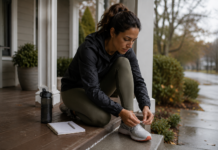
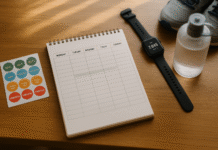




















A great home gym doesn’t require a spare garage or a four-figure budget—it requires clarity, smart choices, and a plan. This guide shows you exactly how to set up a home gym on a budget in nine practical steps: define your goals, map your space, start with bodyweight and bands, add one loadable implement, choose an optional bench, protect your floors, organize safely, pick low-cost cardio, and follow a progressive plan. In one sentence: identify what you’ll actually use, buy only multipurpose essentials, and build up gradually. For context, public health guidelines suggest adults aim for 150 minutes of moderate activity weekly plus two days of muscle-strengthening, which your home setup can support when you choose wisely.
Quick step list (skim first, then dive in):
- Clarify goals, budget, and must-haves →
- Measure space, light, and airflow →
- Start with bodyweight + bands →
- Add one adjustable load (dumbbells or kettlebell) →
- Consider a foldable bench (or DIY substitutes) →
- Protect floors, reduce noise →
- Organize + safety checks (especially when buying used) →
- Choose compact cardio options →
- Program progression and track ROI.
Friendly note: This guide is educational—not medical advice. If you have a health condition or are new to exercise, check with a qualified professional.
1. Decide What You’re Training For—and Cap the Budget
Start by stating your primary outcome in one sentence (e.g., “Build total-body strength at home,” “Improve conditioning without machines,” or “Rehab safely and maintain mobility”). A clear goal narrows what equipment you actually need and prevents impulse purchases. Next, set a hard budget cap (for example, $150, $300, or $500) and a timeline to build in phases. Tie your plan to the activities you’ll do most: if your week centers on three 30–45 minute strength sessions and brisk walks, you probably don’t need a treadmill yet. Public health guidance provides an anchor: 150 minutes of moderate aerobic activity plus two muscle-strengthening days per week is a practical minimum you can hit with bands, bodyweight, and one loadable implement.
1.1 How to do it
- Write one clear training goal and a 3–6 month timeline.
- List must-haves (e.g., bands, adjustable dumbbells) and nice-to-haves (e.g., bench, mirror).
- Set a budget ceiling and split into Phase 1 (essential), Phase 2 (upgrades).
- Schedule 2 strength days and spread aerobic activity across the week.
1.2 Numbers & guardrails
- Minimum weekly target: 150 minutes moderate aerobic activity or 75 minutes vigorous, plus 2 days strength.
- Plan purchase milestones (e.g., Month 1: bands; Month 2–3: adjustable dumbbells; Month 4: bench/flooring).
Bottom line: goals and a hard cap keep you from buying “cool” gear you won’t use—and set the stage for a truly budget-friendly build.
2. Measure Your Space and Plan the Layout Before You Buy
Your room dimensions, ceiling height, and door clearances should dictate equipment—not the other way around. Map the footprint you can dedicate (even 1.5–2.5 m² / 16–27 ft² can host a minimalist setup) and note obstacles: low fans, light fixtures, or wall shelves. If you plan to use a full-length Olympic bar, remember the standard men’s bar is ~2.2 m (7.2 ft)—which affects turning radius and storage. Also check door width; many interior doors are ~30–32 inches, so moving bulky items in/out may require disassembly or smaller components. A simple layout sketch prevents returns and protects deposits if you rent.
2.1 How to do it
- Tape out equipment footprints on the floor; practice movements inside the taped zone.
- Leave reach/overhead clearance for presses and band work.
- Place gear near a window or fan for airflow; heat makes training feel harder.
- Plan a storage wall (shelves/hooks) to keep the floor clear.
2.2 Mini checklist
- Footprint taped?
- Ceiling/overhead checked?
- Door/path measurements noted? (especially if you might add a bench or rack)
- Dedicated storage spot picked?
Synthesis: a tape measure and 20 minutes of planning will prevent 80% of space headaches later.
3. Start With Bodyweight and Resistance Bands (High Value, Low Cost)
The fastest budget win is bodyweight movements—push-ups, rows (with a sturdy table or TRX-style straps), squats, split squats, hinges, planks—plus elastic resistance bands. Research indicates elastic devices can produce strength gains comparable to free weights when programmed progressively, making bands a credible primary tool rather than a consolation prize. Bands pack large resistance ranges in a tiny footprint, travel well, and pair with door anchors to create vertical and horizontal pulls.
3.1 Why it works
- Progressive overload is possible: swap to a thicker band or step farther from the anchor.
- Joint-friendly variable resistance peaks where you’re mechanically stronger.
- Cost/space: a full set fits in a shoebox and often costs less than a single kettlebell (prices vary by region and date).
3.2 Tools & examples
- Loops for glutes/pull-aparts; tubes with handles for rows/presses; long flats for assisted pull-ups.
- A door anchor expands pull angles; add a sturdy broomstick/dowel for landmine-style presses.
- Example: 3×/week full body—band row, push-up, split squat, hip hinge, overhead press, calf raise, core.
Close: if you do nothing else, bands + bodyweight give you a complete strength solution today at the lowest cost.
4. Add One Loadable Implement: Adjustable Dumbbells or a Kettlebell
Once the basics feel easy, add one loadable tool to accelerate strength gains. Adjustable dumbbells offer incremental jumps and bilateral or unilateral work; a kettlebell shines for swings, cleans, and complexes in small spaces. Program progressive overload—for example, when you can exceed your rep target with good form, increase load by ~2–10% depending on the lift and your training level. General resistance-training guidance suggests 2–3 days/week for novices, moving up as you advance—perfect for home training where consistency is king.
4.1 How to choose
- Adjustable dumbbells: broad weight range; compact; great for presses/rows/squats.
- Kettlebell: superb for hinge-based conditioning; less granular jumps.
- Plates + handles: cheapest path if you already have plates; slower to change weights.
4.2 Numbers & guardrails
- Start loads you can lift for 8–12 reps with 1–2 reps in reserve; increase ~2–10% when you exceed the rep target cleanly.
- Plan for two strength days/week minimum; third day optional when recovered.
4.3 Mini case
A beginner doing goblet squats with 12 kg for 3×10 progresses to 14 kg after hitting 12–13 reps across sets with solid form; presses lag a bit, so hold at 12 kg until reps climb—simple, safe, and steady.
Takeaway: pick one loadable tool that matches your goal and space—don’t buy both at once.
5. Consider a Foldable Bench—or Use Smart Substitutes
A bench expands angles for presses, rows, hip thrusts, and step-ups, but it isn’t required on day one. If you add one, look for foldable, light, and lockable hardware that you can store vertically behind a door or under a bed. Check the stated weight rating and make sure your floor is level. On a strict budget, you can mimic many bench patterns via floor press, incline push-ups (hands on a sturdy table), or Bulgarian split squats (rear foot on a stable chair). The key is neutral spine, stable setup, and consistent progression.
5.1 How to decide
- If your program has multiple dumbbell presses/rows, a bench boosts comfort and range.
- If you mainly do bands, kettlebell swings, and goblet lifts, skip it for now.
- Renting or tight on space? Prioritize folding designs and verify folded dimensions fit your storage spot.
5.2 Mini-checklist
- Locking pins feel solid; pad width supports shoulders; feet don’t rock.
- Folded height clears your under-bed or closet space.
- Practice floor press and incline push-ups first—you might find you don’t need a bench.
Bottom line: a bench is a quality-of-life upgrade, not a must-buy; substitutes keep you on budget without limiting progress.
6. Protect Floors and Reduce Noise (Especially in Apartments)
Budget gear lasts longer—and your deposit stays safe—when you address the floor first. Interlocking rubber tiles or dense mats protect against dropped dumbbells and dampen vibrations. If you eventually add a treadmill or rower, a mat underneath helps reduce transmitted noise and prevents dust from clogging the machine. Reviewers who test “quiet” treadmills routinely recommend using equipment mats and scheduling considerate training hours in multi-unit buildings.
6.1 Practical tips
- Use dense rubber (not soft foam) where weights land.
- Place a mat under cardio and under a foldable bench to stop slipping.
- Keep a towel or spray handy; sweat and grit shorten gear life.
- If you’re not on a ground floor, avoid high-impact jumps late at night.
6.2 Region/tenant notes
- Check lease language about heavy equipment and noise windows; talk to neighbors.
- If you feel vibrations through the floor, pivot to low-impact conditioning (e.g., kettlebell swings, step-ups, cycling) to stay neighbor-friendly.
Synthesis: spend a small portion of your budget on mats—it protects both your home and your equipment.
7. Organize Smartly and Buy Used… Safely
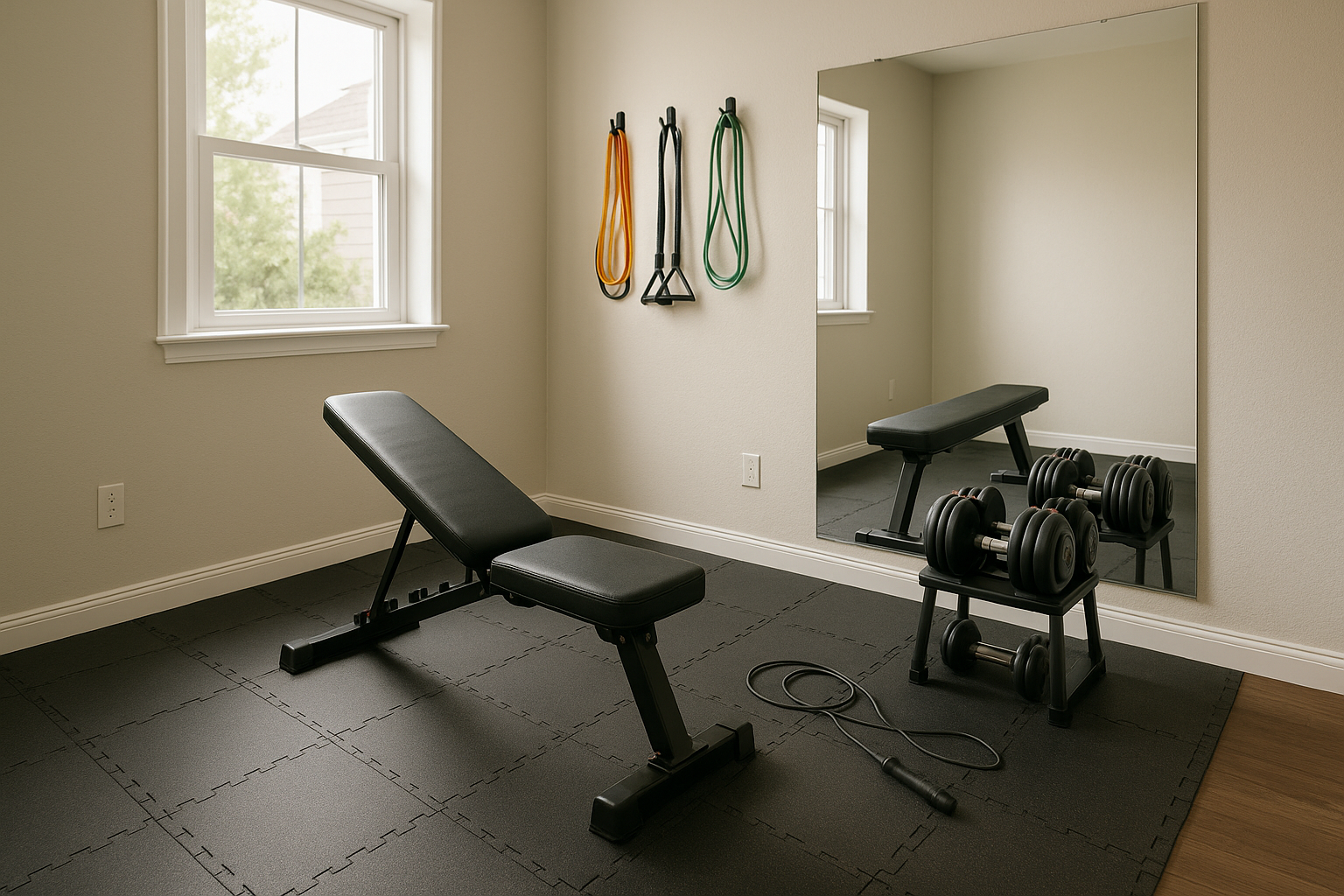
Budget setups shine when everything has a place. Wall hooks for bands, a small rack or shelves for dumbbells, and a bin for jump ropes keep the floor clear and shorten your warm-up time. Buying used can stretch your budget, but add a safety step: check for recalls and obvious defects before you bring gear home. The U.S. Consumer Product Safety Commission reminds resellers (and buyers) that used products can be subject to recalls—exercise equipment is periodically involved—so it’s wise to search the model on the CPSC site before purchasing.
7.1 How to screen used gear
- Search model name + “recall” on the CPSC site.
- Inspect welds, bolts, belts, and cables; replace frayed bands.
- Verify locks/latches on adjustable dumbbells; test increments.
- Ask for original hardware and a quick demo before paying.
7.2 Mini checklist
- No sharp edges; pads intact; handles secure.
- No wobble under load; no slipping on the floor.
- Serial/model recorded for future parts searches.
Takeaway: organization boosts consistency; recall checks keep a great deal from becoming a hazard.
8. Choose Low-Cost Cardio That Fits Your Space (Machines Optional)
You don’t need machines to meet aerobic targets. Brisk walking, cycling, jump rope, shadow boxing, step-ups, or simple bodyweight intervals all count, and they pair well with compact strength tools. If you eventually add a machine, look at folding treadmills or compact rowers; reviewers emphasize pairing them with rubber mats to reduce noise and being mindful of neighbor hours in apartments. Remember, your minimum aerobic target can be met by spreading activity across the week in short, frequent bouts.
8.1 How to build a cardio menu
- Outdoors: brisk 30-minute walks 5 days/week or cycles of 10–15 minutes sprinkled through your day.
- Indoors: jump rope (intervals), step-ups on a sturdy platform, low-impact band circuits.
- Hybrid: 10-minute “finishers” after strength sessions.
8.2 Numbers & guardrails
- Aim for 150 minutes/week moderate aerobic activity (or 75 minutes vigorous), in chunks that fit your schedule—it all counts.
Close: choose cardio that fits your space and you’ll actually do—machines can wait until you know you’ll use them.
9. Program Progression, Track Results, and Calculate Your Payback
A budget home gym pays you back in two ways: better consistency and fewer monthly fees. Program two or three strength sessions per week, start with 8–12 reps for 2–3 sets per move, and increase resistance ~2–10% once you exceed the rep target cleanly. Log sessions (spreadsheet or app) so you can see progression and gaps. For ROI, compare your spend to a typical gym membership: U.S. averages commonly fall around $40–$70/month (varies by location and club tier), so a $300 starter kit can “break even” in ~5–8 months if it replaces a membership (as of August 2025; costs vary by region).
9.1 Simple template
- Mon/Thu: Full-body strength (5–6 moves; 2–3 sets; 8–12 reps).
- Wed/Sat: Brisk walks or intervals to accumulate weekly minutes.
- Progress: when all sets exceed the top rep target with good form, increase load ~2–10%.
9.2 Mini case
If you were paying $55/month for a gym (within typical ranges), and you spend $320 on bands, adjustable dumbbells, and mats, your breakeven is ~6 months. After that, your only costs are occasional replacements (e.g., a band set every year or two if worn).
Bottom line: progression plus basic tracking drives results—and your setup can pay for itself quickly if it replaces a membership you weren’t using.
FAQs
1) What’s the absolute minimum I need to start a home gym on a tight budget?
A pair of resistance bands (one light, one medium or heavy) plus bodyweight movements cover full-body strength and mobility. A door anchor expands pulling options without buying a machine. As you progress, add one loadable implement (adjustable dumbbells or a kettlebell) to make overload easier and faster. This phased approach keeps upfront costs low while still aligning with weekly strength and aerobic targets. CDC
2) Are resistance bands really as effective as weights?
Multiple trials and reviews suggest comparable strength gains between elastic resistance and free weights when programs are matched for intensity and volume. Bands provide variable resistance and portability; free weights offer easy, precise load steps. Many people use both—bands for accessory work and weights for main lifts—based on space and budget.
3) How much space do I need?
For a minimalist setup (bands, adjustable dumbbells, floor work), you can operate in roughly the footprint of a yoga mat. If you plan to add a full-length barbell later, remember the ~2.2 m (7.2 ft) bar length and ensure doorways and storage can accommodate it. Measure ceiling height for overhead presses and fan clearance.
4) Should I buy a bench now or later?
Later, unless you already follow a program that relies on multiple pressing/rowing angles. You can replicate many bench patterns via floor press and incline push-ups on sturdy furniture. If you add a bench, look for foldable designs with reliable locking pins and verify the folded size fits your storage spot.
5) What’s the safest way to buy used equipment?
Inspect moving parts, check locks, and search the CPSC database for recalls on the exact model you’re buying (treadmills, rowers, racks, benches are periodically recalled). Avoid frayed bands and cracked plates. Ask sellers to demo adjustments and load changes. A few minutes of screening can prevent an unsafe purchase.
6) I live in an upstairs apartment—how do I keep noise down?
Use dense rubber mats under any machine or lifting area, skip high-impact plyometrics late at night, and communicate training times to neighbors. If you add a treadmill, a mat helps reduce vibration transfer; consider low-impact alternatives like incline walking outdoors, cycling, or kettlebell swings if footfall noise remains an issue.
7) How do I program beginner strength sessions at home?
Start with two days/week total-body routines: squat pattern, hinge, push, pull, and a core brace. Work in the 8–12 rep range for 2–3 sets per move. When all sets exceed the top rep target with good form, increase load ~2–10%, deload if joints feel irritated, and add a third day only when recovery is solid.
8) Do I need cardio machines to meet weekly aerobic goals?
No. Brisk walks, stair climbs, cycling, jump rope, shadow boxing, or circuiting bodyweight moves all count. The key is accumulating ~150 minutes/week at a moderate effort (you can talk but not sing) or 75 minutes vigorous, spread across days that fit your schedule.
9) Adjustable dumbbells vs. a kettlebell—what’s better on a budget?
It depends on your goal and space. Adjustable dumbbells give granular weight jumps and suit pressing and rowing; a kettlebell excels for swings and metabolic complexes. If your priority is general strength and flexibility in loading, start with adjustable dumbbells; if you love hinges and conditioning, start with a kettlebell and add a second bell later.
10) How fast will a budget home gym pay for itself?
If your membership runs ~$40–$70/month and you spend $250–$400 on bands, adjustable dumbbells, and mats, breakeven often lands around 5–10 months, assuming your home workouts replace your gym attendance. After that, ongoing costs are minimal (occasional band or mat replacement). Actual timelines vary by region and what you buy.
Conclusion
A budget home gym is less about buying “the perfect gear” and more about matching tools to your goals, respecting your space, and building progressive habits you’ll sustain. Start with what you’ll use right away—bodyweight patterns and bands—and add one loadable implement when it meaningfully removes a bottleneck. Protect your floors, keep your layout tidy, and screen used items with a quick recall check. Then program two or three thoughtful strength sessions per week, accumulate your aerobic minutes in short chunks, and log everything so you can see progress.
If you follow the nine steps here, you’ll avoid the common money pits, build a setup that fits your home and budget, and hit those weekly strength and cardio targets without leaving the house. Ready to begin? Tape your space, order a band set, and schedule your first two strength days this week.
References
- Adult Activity: An Overview — CDC (updated Apr 16, 2024). CDC
- What Counts as Physical Activity for Adults — CDC (Dec 6, 2023). CDC
- Physical Activity Guidelines for Americans, 2nd ed. — U.S. HHS (2018). Health.gov
- Physical Activity Guidelines — American College of Sports Medicine (accessed Aug 2025). ACSM
- American College of Sports Medicine Position Stand: Progression Models in Resistance Training — Med Sci Sports Exerc (2009). PubMed
- Effects of Training With Elastic Resistance vs. Conventional Devices on Strength — Lopes et al., SAGE Open Med. (2019). PMC
- IWF Weightlifting Competition Bar 20 kg — Eleiko (accessed Aug 2025). https://eleiko.com
- Standard Size for Doors — BobVila.com (Nov 15, 2023). Bob Vila
- Resale/Thrift Stores Information Center — U.S. Consumer Product Safety Commission (accessed Aug 2025). U.S. Consumer Product Safety Commission
- Exercise Equipment Recalls — U.S. Consumer Product Safety Commission (accessed Aug 2025). U.S. Consumer Product Safety Commission
- Best Quiet Treadmills (2025) — Treadmill Review Guru (Dec 31, 2024). Treadmill Review Guru
- What Is the Average Cost of a Gym Membership? — GoodRx (2023). GoodRx
- Gym Membership Statistics (2025) — Gymdesk (Mar 2, 2025). Gymdesk