





















If you sit a lot, wake up stiff, or just want to feel looser all day, a smart “Daily Flexibility and Stretching Routine” is hard to beat. In about 15 minutes you can circulate blood, restore range of motion (ROM) in tight areas, and downshift your nervous system so movement feels easy rather than rigid. The best sequence blends dynamic moves first to warm the body, then static holds to lock in mobility. In one line: a daily flexibility and stretching routine is a short flow of dynamic warm-ups followed by targeted static stretches that you can perform anywhere, anytime to maintain and improve ROM. For quick wins, start light, move smoothly, and hold comfortable positions—never painful ones. Dynamic before effort, static after or anytime you want to restore motion.
Quick flow at a glance (10 steps):
1) Gentle warm-up and breath, 2) Neck & upper-back reset, 3) Shoulder & chest opener, 4) Wrists & forearms care, 5) Hip flexor & quad release, 6) Glute/piriformis focus, 7) Hamstrings + neural glide, 8) Adductors/groin, 9) Calf & ankle dorsiflexion, 10) Spine flow & cooldown.
Medical note: This guide is general information, not medical advice. If you have pain, recent injury, neurological symptoms, or a condition affecting joints or connective tissue, consult a clinician before changing your routine.
1. Gentle Warm-Up & Breath (1–2 minutes)
Start with 60–120 seconds of easy, rhythmic motion to elevate tissue temperature and “wake up” joints. This sets the stage for safer, more effective stretching by increasing blood flow, reducing stiffness, and priming the nervous system for movement. Think of it as greasing the hinges: light marching in place, arm circles, spinal roll-downs, and ankle rocks are enough. Keep your breathing quiet and steady through the nose, expanding the lower ribs. The goal is not to sweat, but to feel warm and loose. Dynamic movements are ideal here; static holds are less effective at the very start. As a rule of thumb, you should feel like your first true stretch will “give” more easily after this.
1.1 How to do it
- March in place 30–45 seconds with relaxed shoulders.
- Add arm circles (10 forward/10 backward) and gentle trunk rotations.
- Perform 10 slow spinal roll-downs and roll-ups.
- Finish with 10 ankle rocks per side (knee over toes).
1.2 Numbers & guardrails
- Duration: 60–120 seconds total.
- Intensity: Easy; you should be able to breathe through your nose and talk.
- Red flags: Dizziness, sharp pain, or breathlessness—slow down or stop.
Close by scanning for tight spots you want to prioritize next; today’s body may ask for more hip or shoulder emphasis.
2. Neck & Upper-Back Reset
Lead with a simple reset: reclaim length in the back of the neck and movement in the mid-back (thoracic spine). Many people hold their head forward while sitting, which shortens suboccipitals and stiffens the upper thoracic segments. Start with chin tucks to re-center the head over the torso, then mobilize your thoracic spine with “open-book” rotations and seated or floor-based extensions. Improving thoracic mobility often decreases perceived neck tightness because the neck stops compensating for a rigid upper back. This combo is efficient, joint-friendly, and it prepares shoulders to move without pinching. In just a few minutes, you’ll notice easier turning and less shrugging. Evidence links better thoracic mobility with improvements in neck ROM and pain scores. PMC
2.1 How to do it
- Chin tucks: Sit or stand tall; glide chin straight back (not down) for 5 seconds x 8–10 reps.
- Open-book: Side-lying, knees bent; rotate top arm across chest to open the thorax. 8–10 reps each side.
- Thoracic extension: Sit on a chair; interlace fingers behind head, gently extend over the chair back for 5 seconds x 6–8 reps.
2.2 Common mistakes
- Craning upward instead of sliding the chin back.
- Forcing rotation by the shoulder rather than from the rib cage.
- Holding breath or shrugging.
Seal the reset with two calm breaths in tall posture; notice the head stacking more easily over the chest.
3. Shoulder & Chest Opener
Tight pectorals plus a stiff thoracic spine can drag shoulders forward, limiting overhead reach and making push-ups or pressing feel cramped. This step restores front-of-chest length and scapular control. Use a doorway pec stretch and slow wall slides to open the anterior shoulder while teaching the shoulder blades to glide. Do not jam the shoulder; you’re looking for a broad, front-of-chest stretch, not a pinch. Warm tissue responds better, which is why this follows the upper-back reset. Over days and weeks, consistent practice improves overhead comfort and posture in daily tasks like reaching shelves or carrying bags.
3.1 How to do it
- Doorway pec stretch: Elbow at ~90°, forearm on the frame; step through until you feel a chest stretch. Hold 20–30 seconds; 2–3 times each side.
- Wall angels/slides: Back to wall, ribs down; slide arms upward without arching. 8–12 reps, slow.
3.2 Mini-checklist
- Shoulder sensation should be front-of-chest, not deep joint pain.
- Keep ribs gently down; avoid flaring to “fake” mobility.
- If numbness/tingling occurs, ease off and change arm angle.
Finish with three relaxed shoulder rolls; you should feel broader across the collarbones and lighter through the neck.
4. Wrists & Forearms Care (for Typers, Lifters, and Yogis)
Hands live busy lives—typing, carrying, gripping bars or dumbbells. Yet most routines ignore the wrist/forearm complex. Brief mobility work here reduces naggy stiffness and prepares tissues for weight-bearing (planks) and gripping (pulls). Start with gentle wrist circles, then stretch the flexors and extensors with palm-up and palm-down positions against a wall or on the floor, keeping the elbow straight to load the full chain. Finish with tendon-glide movements—finger sequences that floss the hand’s soft tissues. These small details add up to fewer aches, stronger grips, and happier push-ups.
4.1 How to do it
- Wrist circles: Elbows straight; 10 circles each direction.
- Flexor stretch: Palm on wall/floor, fingers down; straighten elbow and gently lean until a forearm stretch. Hold 20–30 seconds; 2 sets.
- Extensor stretch: Palm down, fingers toward you; same hold.
- Tendon glides: Open hand → hook → fist → straight fist; 5 cycles.
4.2 Common mistakes
- Bending the elbow (you’ll miss the forearm).
- Forcing end-range; tingling or sharp pain means back off.
- Collapsing shoulders during floor work.
When you shake your hands out now, they should feel springy, not creaky.
5. Hip Flexor & Quad Release
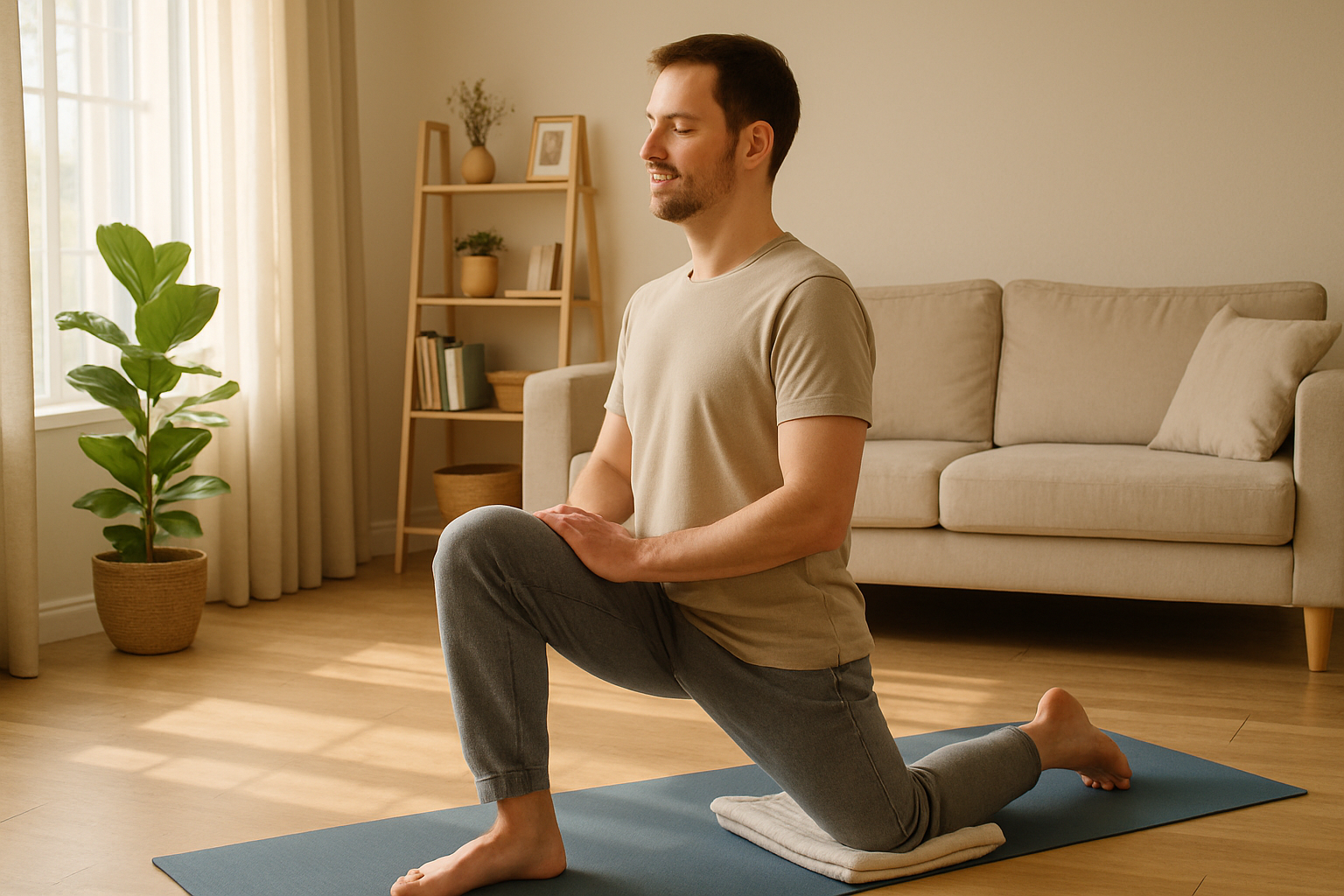
Hours of sitting shorten the front of the hips, which can tilt the pelvis forward, compress the low back, and steal hip extension. Reclaiming length in the iliopsoas and rectus femoris (front thigh) often improves stride, standing comfort, and even the ease of squats. The half-kneeling lunge with a gentle posterior pelvic tilt (PPT)—think “tuck your tail”—is your anchor here. Add a reach overhead and slight side bend to bias the psoas. This stretch is low-equipment and highly effective when you keep the ribs down and avoid leaning forward. Expect a deep front-of-hip stretch without knee strain; pad the back knee as needed.
5.1 How to do it
- Half-kneeling PPT lunge: Front knee over ankle, back knee on pad. Tuck tail (PPT), squeeze the rear glute, and shift hips an inch forward. Hold 20–30 seconds; 2–3 sets/side.
- Psoas bias: Reach same-side arm up; exhale and add a tiny side bend away from the rear leg.
- Progression: Elevate the rear foot on a low box if pain-free to target rectus femoris.
5.2 Numbers & guardrails
- Hold: 20–30 seconds; repeat to total ~60 seconds/side.
- Sensation: Deep front-hip stretch, not knee pressure; add more pad if needed.
- Knees sensitive on hard floors? Use a cushion, folded towel, or mat.
After two sets each side, stand and walk—your stride should feel longer and freer.
6. Glute & Piriformis Focus
Stiffness around the deep glutes and piriformis can refer as buttock tightness and limit hip rotation, affecting walking, squatting, and even how your lower back feels. The lying figure-4 stretch is dependable, and the seated 90/90 adds rotation control. Target a firm but not aggressive stretch; this tissue responds to calm holds and smooth breathing, not cranking. If you sit much of the day, prioritize this step—you’ll notice less tug through the lower back and more comfortable cross-legged sitting.
6.1 How to do it
- Figure-4: Lying on your back, cross ankle over opposite knee; pull the uncrossed thigh toward chest. Hold 20–30 seconds; 2–3 sets/side.
- 90/90 sit: Front leg at ~90°, back leg also ~90°; hinge over the front shin. 5 slow breaths; switch sides.
6.2 Common mistakes
- Yanking on the knee; hold the thigh instead.
- Rounding the low back to “get more” stretch—stay long through the spine.
- Pushing into numbness or tingling.
Wrap up with a few gentle hip circles standing; rotation should feel less “blocked.”
7. Hamstrings + Neural Glide
Hamstrings often feel “tight,” but pure muscle shortness isn’t always the driver—nervous system sensitivity and posterior chain stiffness often co-conspire. Balance a classic hamstring stretch with gentle nerve-flossing: the supine strap stretch (knee slightly bent if needed) to lengthen the posterior thigh, plus a controlled “dorsiflex-point” ankle sequence to mobilize the sciatic tract. Keep the intensity mild; if you feel sharp, zappy sensations, reduce range. Over time, consistent 10–30 second holds repeated to ~60 seconds total can increase ROM without compromising strength or performance in everyday movers.
7.1 How to do it
- Supine strap stretch: Loop a band/towel around mid-foot; extend the knee to tolerance and raise leg until a firm stretch. Hold 20–30 seconds; 2–3 sets/side.
- Neural glide: In the same position, slowly point and flex the ankle for 5–8 reps without intensifying the stretch.
7.2 Numbers & guardrails
- Total time per side: ~60 seconds.
- Sensation: Back of the thigh; sharpness/tingling → reduce range.
- Progression: Straighten the knee a bit more over weeks, not days.
Stand and hinge into a hip-width deadlift stance: you’ll likely notice you can tip farther while keeping a flat back.
8. Adductors (Inner Thighs) & Groin
Adductors are powerful stabilizers for gait, squatting, and changing direction. When stiff, they tug the pelvis and can make side-to-side motions feel awkward. Combine a dynamic Cossack (side) squat to warm tissues with a static butterfly or long-lunge adductor stretch to cement gains. Keep range modest and weight in the heel of the bending leg during Cossacks; your trailing foot stays light and your spine long. These patterns help knees track well and make daily shuffling, stepping over obstacles, or lateral sports drills feel secure.
8.1 How to do it
- Cossack squats: Feet wide; sit into one hip while the other leg stays straight, torso tall. 6–10 reps/side.
- Butterfly: Soles together; hands on shins, hinge forward. Hold 20–30 seconds x 2.
- Long adductor lunge: One knee down, other leg straight out to the side; hinge toward the straight leg. 20–30 seconds/side.
8.2 Common mistakes
- Collapsing the arch of the straight leg’s foot.
- Rounding the low back; hinge at the hips.
- Forcing range instead of breathing into it.
When you come back to standing, side steps should feel smoother and more symmetrical.
9. Calf & Ankle Dorsiflexion
Limited ankle dorsiflexion (shin moving over the foot) affects squats, lunges, walking speed, and even balance. Restoring motion here pays off across your day. Use the knee-to-wall test position for a progressive stretch that targets both gastrocnemius (knee straight) and soleus (knee bent). Consistent static stretching can yield small but meaningful increases in dorsiflexion; pair that with dynamic ankle rocks for carryover to walking. If your heels pop up in squats or your ankles feel “blocked,” this is your section. The literature shows static calf stretching improves dorsiflexion, though changes can be modest—think function, not splits. NCBI
9.1 How to do it
- Knee-to-wall: Stand facing a wall; toes ~5–10 cm away. Drive knee toward wall without lifting heel. Adjust foot distance to find a firm stretch. 20–30 seconds; 2–3 sets/side.
- Straight-knee wall calf: Hands on wall, back leg straight, heel down. 20–30 seconds; 2 sets/side.
- Ankle rocks: 10–15 controlled repetitions per side.
9.2 Numbers & guardrails
- Total time per side: ~60 seconds per muscle (gastroc and soleus).
- Sensation: Tug behind lower leg, not sharp pain in the Achilles or front ankle.
- Footwear: Barefoot or flat shoes helps you feel heel contact.
Re-test a body-weight squat after this step; heels should stay down more naturally.
10. Spine Flow & Cooldown (Downshift the Nervous System)
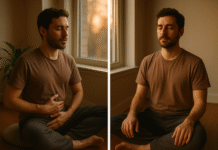
Finish with a gentle spinal flow and a deliberate cooldown. Cat-cow, child’s pose side reaches, and an easy lying twist give your spine multi-planar movement without strain. Slow nasal breathing (e.g., 4-second inhale, 6-second exhale) taps the parasympathetic nervous system, helping tone drop and muscles “accept” new ranges. This closing section is also your check-in: notice where you gained motion and where you still feel guarded. Minutes from now you’ll walk away looser, calmer, and ready for the day.
10.1 How to do it
- Cat-cow: On all fours, alternate rounding/arching the spine with smooth breathing. 6–10 reps.
- Child’s pose side reach: Hips back; walk hands to one side, 3–4 breaths; switch.
- Supine twist: Knees bent; drop to one side, arms wide, 3–5 breaths each side.
- Box breathing (optional): Inhale 4s, hold 4s, exhale 4s, hold 4s for 4–6 rounds.
10.2 Mini-checklist
- Move pain-free; ease range if joints feel pinchy.
- Keep breath quiet through the nose; exhale longer than inhale to down-regulate.
- If you lift later in the day, save deep static holds for after training.
End feeling both mobile and settled; tomorrow’s body will thank you for today’s 15 minutes.
How Long Should You Hold Stretches—and How Often?
For adults, static holds of 10–30 seconds performed 2–4 times per muscle (about 60 total seconds) are widely recommended, with older adults sometimes benefiting from 30–60 second holds. Aim for at least 2–3 days per week, with daily practice delivering the most consistent gains. Place dynamic work at the start of activity and use static holds after training or during dedicated flexibility sessions. Evidence shows stretching improves ROM, while effects on post-exercise soreness are small. netafit.org
FAQs
1) What’s the difference between dynamic and static stretching, and which should I do daily?
Dynamic stretches are controlled, repetitive movements through range (e.g., leg swings), best for warming up. Static stretches are pauses at end-range (e.g., a 20–30 second calf stretch), better for calming down or dedicated flexibility sessions. For daily practice, combine both: a brief dynamic warm-up to raise temperature, then static holds to “lock in” range. Dynamic before intense activity; static after or at any low-intensity time.
2) Will stretching prevent muscle soreness (DOMS) after workouts?
Stretching may feel good, but high-quality evidence finds little to no meaningful reduction in soreness over the following week. One review showed changes only a few points on a 100-point scale—statistically detectable but not practically impactful. Don’t rely on stretching to erase DOMS; prioritize gradual training progressions, sleep, hydration, and light active recovery.
3) How many days per week do I need to stretch to see progress?
Consistency beats heroics. Stretch at least 2–3 times per week to maintain gains; daily practice typically yields the best results. Think of flexibility like savings: small, regular “deposits” accumulate. Even five minutes counts on busy days—sprinkle micro-sessions between meetings or after walks. Harvard Health
4) Should I stretch before or after running/strength training?
Warm up dynamically before you run or lift (e.g., leg swings, marching, lunges). Save longer static holds for after training or at a separate time. This sequence prepares tissues without temporarily reducing explosive output, and it feels better on most joints.
5) How hard should a stretch feel?
Aim for “mild to moderate tension,” not pain. A tingling, zappy, or joint-pinchy feel is your signal to ease off or change the angle. Breathe slowly; if you can’t breathe quietly through your nose, the intensity is probably too high. Respect sensitive days—your range will ebb and flow.
6) Can I do this routine at the office or without equipment?
Yes. Almost all steps can be performed with body weight using a wall, doorway, or chair. The NHS even publishes accessible at-home stretches you can adapt in small spaces. Keep shoes flat and clothing comfortable; sprinkle 2–3 mini-blocks (3–5 minutes) across your workday if lying down isn’t practical.
7) Does calf stretching really change ankle mobility?
It can—typically modestly. Research shows small but statistically significant increases in dorsiflexion after dedicated calf stretching blocks. The functional payoff is smoother squats and steps, even if raw centimeters of change are limited. Combine static holds with ankle rocks and strong, full-range calf raises for best results.
8) Is foam rolling necessary for flexibility?
It’s optional. Self-myofascial release can temporarily reduce tenderness and make moving into a stretch feel easier, but evidence quality varies. If rolling helps you relax and you tolerate it well, use 30–90 seconds per area before stretches; if you dislike it, skip it and focus on the sequence above. Verywell Health
9) What if I only have 5 minutes?
Do steps 1 (warm-up), 5 (hip flexor), and 9 (ankles) for 60 seconds each, then a 1-minute spine flow (step 10). Those areas are “rate-limiters” for walking, squats, and standing. On the next short day, hit shoulders (step 3) and hamstrings (step 7). Alternate micro-blocks through the week.
10) Do these minutes count toward my weekly exercise totals?
Stretching is valuable, but by itself it doesn’t count as moderate or vigorous physical activity in health guidelines. Think of it as essential maintenance alongside your cardio and strength. Pair this routine with walks, rides, or strength sessions to meet weekly targets.
Conclusion
A daily flexibility and stretching routine isn’t about chasing extreme ranges—it’s about moving without hesitation. Ten focused steps, in about 15 minutes, gently heat tissues, restore joint motion, open common sticky spots (hips, shoulders, ankles), and then help your nervous system relax so changes “stick.” The rhythm matters: dynamic movement first, then patient static holds; smooth nasal breathing throughout; never pain, always control. Over the next few weeks you’ll notice longer strides, easier overhead reach, and a calmer posture, even if your job keeps you at a desk. Most importantly, you’ll build a sustainable habit: short, consistent sessions that keep your body ready for whatever the day asks.
Action step: Roll out a mat tomorrow morning and run through all 10 steps—set a 15-minute timer and let movement be the best part of your day.
References
- Take time to stretch. Harvard Health Publishing. January 1, 2025. Harvard Health
- Current Concepts in Muscle Stretching for Exercise and Rehabilitation. International Journal of Sports Physical Therapy (P. Page). 2012. PMC
- Stretching to prevent or reduce muscle soreness after exercise. Cochrane Review. May 1, 2022. Cochrane
- Does stretching increase ankle dorsiflexion range of motion? Physical Therapy (Radford et al.). 2006. PMC
- Flexibility exercises (at home). NHS. Accessed 2021–2022 (page updated ~2021). nhs.uk
- Physical Activity Breaks for the Workplace: Resource Guide. CDC. June 2024. CDC
- Stretching before exercise—Ask the Doctor. Harvard Health Publishing. July 17, 2015. Harvard Health
- Physical Activity Guidelines for Americans, 2nd ed. U.S. HHS. 2018. Health.gov
- Thoracic Posture and Mobility… Mechanical Neck Pain (Systematic review). Journal of Manual & Manipulative Therapy. 2019. PMC
- Stretching to prevent or reduce muscle soreness after exercise: systematic review. BMJ (Herbert et al.). 2011. PubMed