


























Building muscle isn’t just about training hard; it’s about eating with intent. Below you’ll find practical, numbers-backed nutrition strategies that help you add lean mass while keeping fat gain in check. This guide is for beginners through advanced lifters who want clear targets, food examples, and a simple way to implement them without falling into fads or fluff. Brief note: this article provides general information for healthy adults; if you have medical conditions or take medications, speak with a qualified professional before making changes.
Quick answer: To build muscle efficiently, eat in a small calorie surplus, hit daily protein (about 1.6–2.2 g/kg), distribute protein across 3–5 meals with 20–40 g each, fuel training with carbs, keep dietary fats in a healthy range, hydrate well, and use a few proven supplements (creatine, caffeine) as needed.
Fast-start checklist (skim this, then dive into the details):
- Set a 5–15% calorie surplus to lean-bulk without unnecessary fat.
- Consume 1.6–2.2 g protein/kg/day, 0.4–0.55 g/kg per meal (20–40 g for most).
- Aim for 3–6 g carbs/kg/day depending on training volume; place more around workouts.
- Keep fats at 20–35% of calories, with omega-3s most days.
- Pre-workout: protein + easy carbs; post-workout: protein 20–40 g + carbs.
- Hydrate: start euhydrated, sip during training; replace ~150% of sweat losses after.
- Consider creatine (3–5 g/day) and caffeine (3–6 mg/kg pre).
1. Set a Small Calorie Surplus (5–15%) To Drive Lean Gains
Starting point: You build muscle best when you consistently eat a bit more than you burn. A small surplus gives your body the energy to synthesize new tissue without pushing calories so high that most of the gain is fat. For many lifters, that means +150 to +400 kcal/day (smaller bodies) or +300 to +600 kcal/day (larger bodies), translating to roughly 0.25–0.5% of bodyweight gain per week. Bigger surpluses do add weight faster, but a lot of that weight is fat; conservative surpluses tend to improve the muscle:fat ratio of your gains.
1.1 Numbers & guardrails
- Weekly gain target: 0.25–0.5% BW (e.g., 75 kg → +0.19–0.38 kg/week).
- Timeframe: Commit to at least 8–12 weeks, reassessing every 2–4 weeks.
- Evidence snapshot: Reviews in physique athletes recommend ~10–20% calorie surplus with conservative weekly gain, and recent observational work suggests larger surpluses add more fat without clear extra hypertrophy.
1.2 How to do it
- Estimate maintenance with a calculator or track your current intake and bodyweight for 10–14 days.
- Add +200–300 kcal/day to start; after two weeks, adjust by ±100–150 kcal based on the scale and mirror.
- Prioritize whole foods first; use liquid calories (milk, lassi, smoothies) only if appetite lags.
1.3 Common mistakes
- “Dirty bulks” with huge surpluses; yo-yo bulking/cutting every few weeks; ignoring training quality (volume, progression).
Bottom line: Keep the surplus small, be patient, and review trends every couple of weeks.
2. Hit Daily Protein: 1.6–2.2 g/kg (With an Eye on the Upper CI)
Direct answer: Most lifters maximize gains by eating ~1.6 g protein per kg bodyweight/day, with benefits plateauing around that point; the upper 95% confidence interval approaches ~2.2 g/kg, which is a practical ceiling for highly trained or lean individuals. This range supports muscle repair, growth, and training adaptations.
2.1 Numbers & guardrails
- Core target: 1.6 g/kg/day; consider 1.8–2.2 g/kg/day when very lean, in a deficit, or training hard.
- Example (75 kg): 120 g/day (base) to 165 g/day (upper end).
- Evidence snapshot: Meta-analyses show supplemental protein enhances strength and hypertrophy with diminishing returns beyond ~1.6 g/kg/day; upper CI ~2.2 g/kg/day. PMC
2.2 How to do it
- Anchor each meal with 20–40 g of high-quality protein (eggs, dairy, lean meats, soy).
- Combine plant proteins (e.g., dal + roti; rice + beans) to cover essential amino acids.
2.3 Tools/Examples
- Pakistan-friendly day: Breakfast: 3 eggs + paratha + yogurt; Lunch: chicken pulao + salad; Snack: whey shake + banana; Dinner: lentil dal + roti + paneer.
Bottom line: Hit daily protein first; it’s the non-negotiable foundation.
3. Distribute Protein: 3–5 Feedings of 0.4–0.55 g/kg (20–40 g), Plus Pre-Sleep
Direct answer: You’ll get more “anabolic reps” by spreading protein through the day. Aim for 0.4–0.55 g/kg per meal (often 20–40 g), across 3–5 meals, with one feeding in the evening or pre-sleep to support overnight recovery.
3.1 Numbers & guardrails
- Per-meal target: 0.4 g/kg; up to 0.55 g/kg at higher daily intakes.
- Pre-sleep casein: 30–40 g (milk, Greek yogurt, cottage cheese, or casein shake) about 30–60 min before bed.
- Evidence snapshot: Reviews recommend 0.4–0.55 g/kg/meal across ≥4 meals; evenly spaced doses (~20 g every 3 h) improve day-long MPS; pre-sleep casein can boost overnight MPS in trained individuals.
3.2 How to do it
- Template (75 kg): 30 g breakfast, 30 g lunch, 30 g post-workout, 30 g pre-sleep.
- Food examples: Milk (doodh), lassi, paneer, dal + roti, eggs, chicken, fish, soy.
3.3 Common mistakes
- Protein “skewed” to dinner; skipping breakfast; relying only on fast-digesting whey with no slower evening source.
Bottom line: Think “protein pulses” throughout the day, including before bed.
4. Choose High-Quality Proteins—and Optimize Plant Proteins
Direct answer: The quality of protein (amino acid profile and digestibility) influences how efficiently your body builds muscle. Animal proteins (whey, dairy, eggs, meat, fish) typically score higher, but plant-based diets can match outcomes by combining sources and slightly increasing total protein.
4.1 Why it matters
- Protein quality is quantified with PDCAAS or DIAAS; DIAAS is the FAO-recommended modern method and better reflects essential amino acid digestibility at the ileum.
4.2 How to do it
- Omnivores: Rotate eggs, dairy (lassi, dahi, paneer), chicken, fish (e.g., rohu), and lean beef/mutton.
- Vegetarian/Vegan: Combine legumes + grains (dal + rice), include soy (tofu, soy milk), seitan, and plant protein blends; aim toward the upper end of the protein range (e.g., 1.8–2.2 g/kg).
- Consider leucine content: many plant proteins are lower; add soy, pea+wheat blends, or leucine-rich options to help hit ~2–3 g leucine per meal. Emerging evidence keeps refining leucine thresholds, particularly in older adults. Frontiers
4.3 Mini-checklist
- At least 20–40 g protein per meal.
- Include a complete or complementary protein at each feeding.
- Use whey (fast) post-workout and casein (slow) in the evening if convenient.
Bottom line: You can build muscle on any dietary pattern—just ensure complete amino acids and adequate amounts.
5. Use Carbohydrates to Fuel Training and Recovery
Direct answer: Carbs don’t build muscle directly, but they power hard training and help maintain training volume—key drivers of hypertrophy. Most lifters do well with ~3–6 g/kg/day, skewed higher on hard training days and around workouts.
5.1 Numbers & guardrails
- Daily: 3–6 g/kg for typical hypertrophy training; more with two-a-days or very high volumes.
- Around training: 1–2 g/kg in the 1–4 hours pre; ~0.5–1.0 g/kg post with protein, especially if you have another session within 24 h.
- Evidence snapshot: Consensus papers for athletes place carb needs broadly 3–10 g/kg based on volume/intensity; bodybuilders and strength athletes commonly sit ~2.8–7.5 g/kg.
5.2 How to do it
- Pre-workout: basmati rice, roti, potatoes, fruit, or a honey-sweetened yogurt.
- Post-workout: rice + lean protein, milk + dates, or a banana with a whey shake.
5.3 Common mistakes
- Very low-carb bulks that limit training volume; only eating carbs at night.
Bottom line: Let training dictate carbs. More volume = more carbs; off days = moderate.
6. Keep Fats in the 20–35% Range and Don’t Skip Omega-3s
Direct answer: Dietary fat supports hormones, provides energy, and carries fat-soluble vitamins. Most lifters should keep fats at ~20–35% of total calories, adjusting up or down based on preference and tolerance. Include omega-3 fats several times per week for general health and possible support of anabolic signaling.
6.1 Numbers & guardrails
- Fat range: 20–35% of calories (or ~0.5–1.0 g/kg/day).
- Omega-3s: Aim for 2–3 fish meals/week or ~1–2 g EPA+DHA/day via fish oil if you don’t eat fish.
- Evidence snapshot: Position statements anchor athletes in these ranges; omega-3s may enhance anabolic responsiveness in older adults (applies to muscle remodeling generally).
6.2 Food examples
- Local: rohu or pomfret fish, walnuts, canola or olive oil, egg yolks.
- If vegetarian: flaxseed, chia, walnuts (ALA sources) plus consider an algae-based EPA/DHA supplement.
6.3 Common mistakes
- Going extremely low fat for long periods; skipping omega-3s entirely.
Bottom line: Balance fats and ensure regular omega-3 intake for health and training support.
7. Time Your Nutrition to Support Training (Pre, Intra, Post)
Direct answer: You don’t need a mythical 30-minute “anabolic window,” but planning protein and carbs before and after lifting improves readiness and recovery. For most, eat a balanced meal 1–3 hours pre-workout and a protein-centric meal 0–3 hours post-workout.
7.1 Numbers & guardrails
- Pre-workout (1–3 h): 20–40 g protein + 1–2 g/kg carbs if it’s a hard session.
- During (optional): water/electrolytes; for long/high-volume sessions, ~30 g carbs/h can help.
- Post-workout (0–3 h): 20–40 g protein + ~0.5–1.0 g/kg carbs.
- Evidence snapshot: The ISSN nutrient timing position stand supports pragmatic timing to benefit performance and body comp; the “window” spans several hours around training, not minutes.
7.2 Mini-checklist
- If you train early: a banana + milk or a small whey smoothie 30–60 min before.
- Evening lifters: eat dinner after (protein + carbs); consider the pre-sleep protein in Tip #3.
Bottom line: Place more protein and carbs around training—simple, effective, and sustainable.
8. Hydrate and Replace Electrolytes Like It Matters (Because It Does)
Direct answer: Even 1–2% dehydration can reduce performance. Start workouts euhydrated, sip fluids during, and replace ~150% of sweat losses after. Include sodium during long/hot sessions to maintain fluid balance.
8.1 Numbers & guardrails
- Before: About 5–7 mL/kg of fluid ~4 hours pre-exercise (e.g., 75 kg → 375–525 mL); another 3–5 mL/kg 2 hours pre if urine is dark/scant.
- After: 1.25–1.5 L per kg body mass lost (e.g., down 0.8 kg → drink 1.0–1.2 L over a couple of hours).
- Sodium: ~460–1150 mg per liter of fluid during heavy sweating.
- Evidence snapshot: ACSM and NSCA summarize these hydration and sodium targets; meta-analysis supports the 1.25–1.5 L/kg rehydration guideline.
8.2 Region-specific note
- Training in hot, humid climates (e.g., South Asian summers) raises sweat sodium losses—use salted lassi, ORS, or sports drinks on longer sessions.
8.3 Mini-checklist
- Weigh before/after key sessions to learn your sweat rate.
- Keep a water bottle at your desk; urine pale-yellow is the goal.
- Add a pinch of salt to water or meals if you’re a salty sweater.
Bottom line: Hydration is free performance. Follow the numbers and personalize with your sweat rate.
9. Creatine Monohydrate: The One Proven Mass-Builder Supplement
Direct answer: Creatine monohydrate is safe, inexpensive, and consistently improves training capacity and lean mass over time. Use 3–5 g/day (no cycling needed). A loading phase (~20 g/day for 5–7 days) just saturates faster.
9.1 Numbers & guardrails
- Daily: 3–5 g with any meal; creatine accumulates—timing isn’t critical.
- Loading (optional): 4 × 5 g/day for 5–7 days, then 3–5 g/day.
- Type: Stick with monohydrate; it’s the gold standard.
- Evidence snapshot: The ISSN position stand affirms safety and efficacy for performance and lean mass across many populations.
9.2 Common questions
- Water retention? Mostly intramuscular, not under the skin.
- Kidneys? Safe in healthy people at recommended doses (see position stand).
Bottom line: If you only buy one supplement, make it creatine monohydrate.
10. Caffeine (and Beta-Alanine) to Train Harder
Direct answer: Caffeine (taken before lifting) reliably boosts effort and performance, helping you accumulate more quality training—fuel for hypertrophy. Beta-alanine may help in sets or intervals where 1–4 minutes of sustained effort limits you via acidosis.
10.1 Numbers & guardrails
- Caffeine: 3–6 mg/kg ~60 min pre-workout; test your tolerance; avoid near bedtime.
- Beta-alanine: 3.2–6.4 g/day for ≥4 weeks (split doses to limit tingling).
- Evidence snapshot: The ISSN caffeine stand supports 3–6 mg/kg dosing; meta-analyses and the ISSN beta-alanine stand support benefits mainly for efforts in the ~60–240+ s range.
10.2 Practical tips
- If anxious or sensitive, start at ~2–3 mg/kg or skip caffeine entirely.
- Beta-alanine pairs fine with creatine; expect tingles (paresthesia) with bigger boluses.
Bottom line: Use stimulants and buffers strategically to train harder, not as crutches.
11. Micronutrients & Blood Work: Vitamin D, Iron, and Friends
Direct answer: Vitamins and minerals don’t build muscle by themselves, but deficiencies (notably vitamin D and iron) can impair performance, recovery, mood, and training quality. Get routine labs if you’re frequently fatigued, lightheaded, or train indoors a lot.
11.1 What to check
- Vitamin D (25-OH-D): Low status is common; correcting it supports general health and may aid muscle function and immunity.
- Iron panel (ferritin, Hb, transferrin saturation): Especially important for menstruating athletes and those with high sweat losses or low intake.
11.2 Evidence snapshot
- Reviews in athletes highlight roles for vitamin D in muscle and immune function, and for iron status in performance; address deficiency first before adding other supplements.
11.3 Food focus
- Vitamin D: sunlight, fortified milk, eggs, oily fish.
- Iron: red meat, chicken liver, beans, lentils, spinach + vitamin C (e.g., lemon) to enhance absorption.
Bottom line: Fix deficiencies early; you can’t out-train or out-supplement low vitamin D or iron.
12. Implement Like a Pro: Plan, Track, Adjust
Direct answer: The best plan is the one you actually follow. Build a repeatable routine—shop once or twice a week, prep basics, eat similar meals on training days, and adjust using bodyweight and performance trends.
12.1 Mini-checklist
- Plan the week: Pick 2–3 breakfasts, 3–4 lunches/dinners, 2 snacks you enjoy and can repeat.
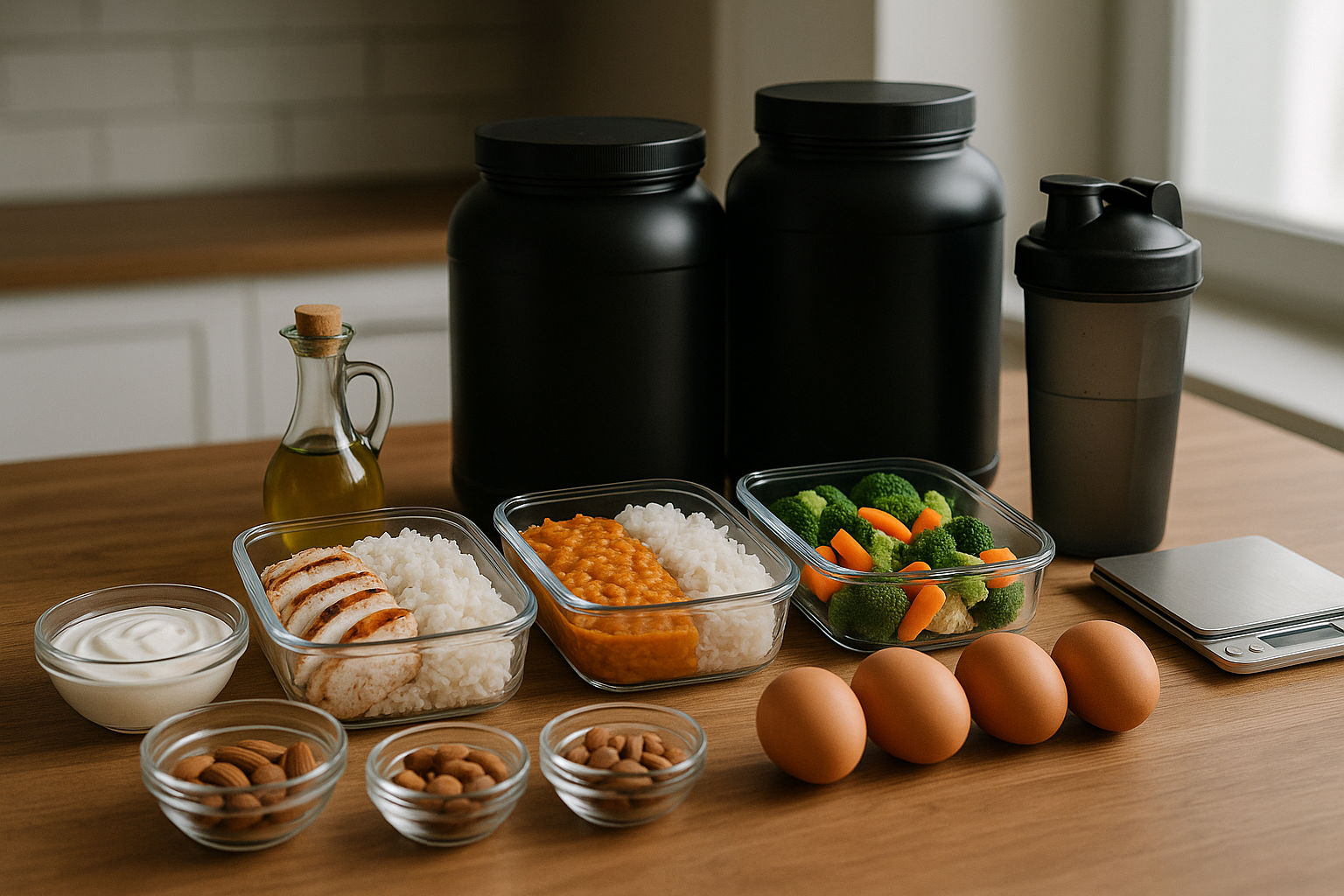
- Meal prep anchors: Cook a pot of dal, batch grilled chicken, boil eggs, chop fruit/veg.
- Carry-overs: Keep whey or milk powder, peanut butter, canned tuna, and nuts on hand.
- Track simply: Weigh yourself 3–4 mornings/week; log workouts.
- Adjust every 2–4 weeks: If weight isn’t moving and training is solid, add +100–150 kcal/day; if fat climbs too fast, shave –100–150 kcal/day.
12.2 Example (75 kg lifter)
- Targets: 2,700 kcal; protein 150 g, carbs 350 g, fat 80 g.
- Sample day:
- Breakfast: 3 eggs, 2 rotis, yogurt (30 g protein)
- Lunch: chicken pulao + salad (40 g)
- Snack (pre-workout): banana + milk (10–15 g)
- Post-workout: whey shake + dates (25 g)
- Dinner: lentil dal, paneer, roti (40 g)
- Pre-sleep: cottage cheese or milk (20–30 g)
Bottom line: Simple systems beat perfect plans. Build habits that make the right choice the easy choice.
FAQs
1) Do I need to be in a calorie surplus to build muscle?
If you’re new to lifting or returning after a break, you can gain some muscle at maintenance calories. Long term, a small surplus (5–15%) generally improves the rate and quality of lean gains compared with maintenance—without the excessive fat that large surpluses add. Track weekly averages and adjust by ~100–150 kcal as needed.
2) What’s the simplest protein target if I don’t want to calculate?
Use 0.7–1.0 g per pound (1.6–2.2 g/kg) of goal bodyweight daily. Split across 3–5 meals of 20–40 g each (or 0.4–0.55 g/kg/meal). This captures most benefits for strength and size while being easy to remember.
3) Is there a “post-workout window”?
The “window” is bigger than 30 minutes—think 0–3 hours pre or post. Eat protein and some carbs before or after training based on your schedule; the total over the day matters most, with timing providing incremental benefits for performance and glycogen.
4) What’s better: whey or casein?
Whey digests faster and suits pre-/post-workout; casein digests slower and is great before bed to support overnight MPS. Many lifters use both depending on timing and preference. Whole foods (milk, yogurt, paneer, eggs) can cover either role.
5) How many carbs do I need for hypertrophy?
Base carbs on training. Most lifters do fine with ~3–6 g/kg/day, higher with two-a-days or very high volumes. Place more carbs 1–4 hours pre and post to support performance and recovery.
6) Are omega-3 supplements worth it if I don’t eat fish?
If you rarely eat fish, 1–2 g EPA+DHA/day is a practical option. Evidence in older adults shows omega-3s can enhance anabolic signaling and MPS; for younger lifters, the benefits are plausible but less certain.
7) What about intermittent fasting for muscle?
You can gain muscle while time-restricted eating if total protein and calories are sufficient. The trade-off is fewer “protein pulses,” so hit 0.4–0.55 g/kg at each meal and ensure daily protein is on target.
8) How much water should I drink when lifting in the heat?
Start euhydrated (clear to pale-yellow urine), sip during training, and replace ~150% of body mass lost after sessions. If you’re a salty sweater, include ~460–1150 mg sodium per liter of fluid for long/hot workouts. PMC
9) Is creatine safe to use long term?
Yes—for healthy individuals at standard doses. Use 3–5 g/day; no need to cycle. It improves training capacity and supports lean mass over time. Stick with creatine monohydrate.
10) Should I take beta-alanine?
If your training includes sustained high-intensity efforts ~1–4 minutes (metcon pieces, repeated machines or circuits), 3.2–6.4 g/day can help. If you mainly do sets of 5–12 reps with long rests, benefits are smaller. PMC
11) Do plant-based lifters need more protein?
Often yes—or they need to combine proteins and emphasize higher-quality plant sources (soy, blends). Aim toward 1.8–2.2 g/kg and include leucine-rich foods per meal.
12) Which blood tests are most useful for chronic fatigue in training?
Ask your clinician about 25-OH-vitamin D, CBC with ferritin and transferrin saturation, B12, and TSH. Address abnormalities before chasing supplements.
Conclusion
Muscle is built in the gym and finished in the kitchen. The keys are simple and repeatable: keep a modest calorie surplus, hit daily protein with smart distribution, fuel training with the right amount of carbs, keep fats in a healthy range with omega-3s, hydrate intelligently, and consider only the supplements that work. Anchor your day with 20–40 g of protein per meal, place more carbs around lifting, and close the evening with a pre-sleep protein. Track bodyweight and training, adjust calories slowly, and prioritize meals you’ll actually cook and enjoy—dal and roti with paneer can be as effective as chicken and rice when macros are matched.
If this feels like a lot, start with the Fast-start checklist at the top and implement two habits this week: (1) bring protein to 1.6–2.2 g/kg/day and (2) set a small surplus. Once those are automatic, add timing, hydration, and (if you choose) creatine. Build your plan around consistency, not perfection—and the results will follow. Ready to start? Pick your daily protein target, plan tonight’s dinner, and set tomorrow’s pre- and post-workout meals.
References
- Morton RW et al. “A systematic review, meta-analysis and meta-regression of the effect of protein supplementation on resistance training–induced gains in muscle mass and strength in healthy adults.” Br J Sports Med. 2018. https://bjsm.bmj.com/content/52/6/376 British Journal of Sports Medicine
- Schoenfeld BJ, Aragon AA. “How much protein can the body use in a single meal for muscle-building? Implications for daily protein distribution.” J Int Soc Sports Nutr. 2018. BioMed Central
- Areta JL et al. “Timing and distribution of protein ingestion during prolonged recovery from resistance exercise alters myofibrillar protein synthesis.” J Physiol. 2013. PMC
- Kim J et al. “Pre-sleep casein protein ingestion: new paradigm in post-exercise recovery nutrition.” Phys Act Nutr. 2020. PMC
- Thomas DT, Erdman KA, Burke LM. “Nutrition and Athletic Performance.” J Acad Nutr Diet. 2016. https://www.jandonline.org/article/S2212-2672(15)01802-X/fulltext JAN Online
- Sawka MN et al. “American College of Sports Medicine Position Stand: Exercise and Fluid Replacement.” Med Sci Sports Exerc. 2007. PubMed
- NSCA—Hydration & Performance. “Pre-exercise: 5–7 mL/kg; sodium 20–50 mEq/L.” 2019 (web resource). NSCA
- Kreider RB et al. “ISSN position stand: safety and efficacy of creatine supplementation in exercise, sport, and medicine.” J Int Soc Sports Nutr. 2017. PubMed
- Guest NS et al. “International society of sports nutrition position stand: caffeine and exercise performance.” J Int Soc Sports Nutr. 2021. BioMed Central
- Trexler ET et al. “ISSN position stand: Beta-alanine.” J Int Soc Sports Nutr. 2015. PubMed
- FAO. “Dietary protein quality evaluation in human nutrition: Report of an FAO Expert Consultation (DIAAS).” 2013. FAOHome
- Smith GI et al. “Dietary omega-3 fatty acid supplementation increases the rate of muscle protein synthesis in older adults.” Am J Clin Nutr. 2011. PMC
- Iraki J et al. “Nutrition Recommendations for Bodybuilders in the Off-Season.” Sports (Basel). 2019. MDPI
- Helms ER et al. “Effect of Small and Large Energy Surpluses on Strength and Hypertrophy.” Sports Med Open. 2023. SpringerOpen
- Henselmans M, Schoenfeld BJ. “The Effect of Carbohydrate Intake on Strength and Resistance Training Performance.” Nutrients. 2022. PMC
- Owens DJ et al. “Vitamin D and the Athlete: Current Perspectives and New Challenges.” Sports Med. 2018. PMC
- Sim M, Peeling P. “Iron considerations for the athlete: a narrative review.” Eur J Appl Physiol. 2019. PubMed
- Kerksick CM et al. “International society of sports nutrition position stand: Nutrient timing.” J Int Soc Sports Nutr. 2017. BioMed Central