


















Evidence Review · Fitness · Recovery
By Laila Qureshi
Alternating hot and cold water is one of the oldest recovery rituals in sport. The theory behind it sounds convincing. The data behind it is a lot messier than most protocol charts let on.
What Contrast Water Therapy Actually Is
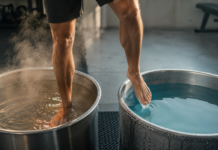
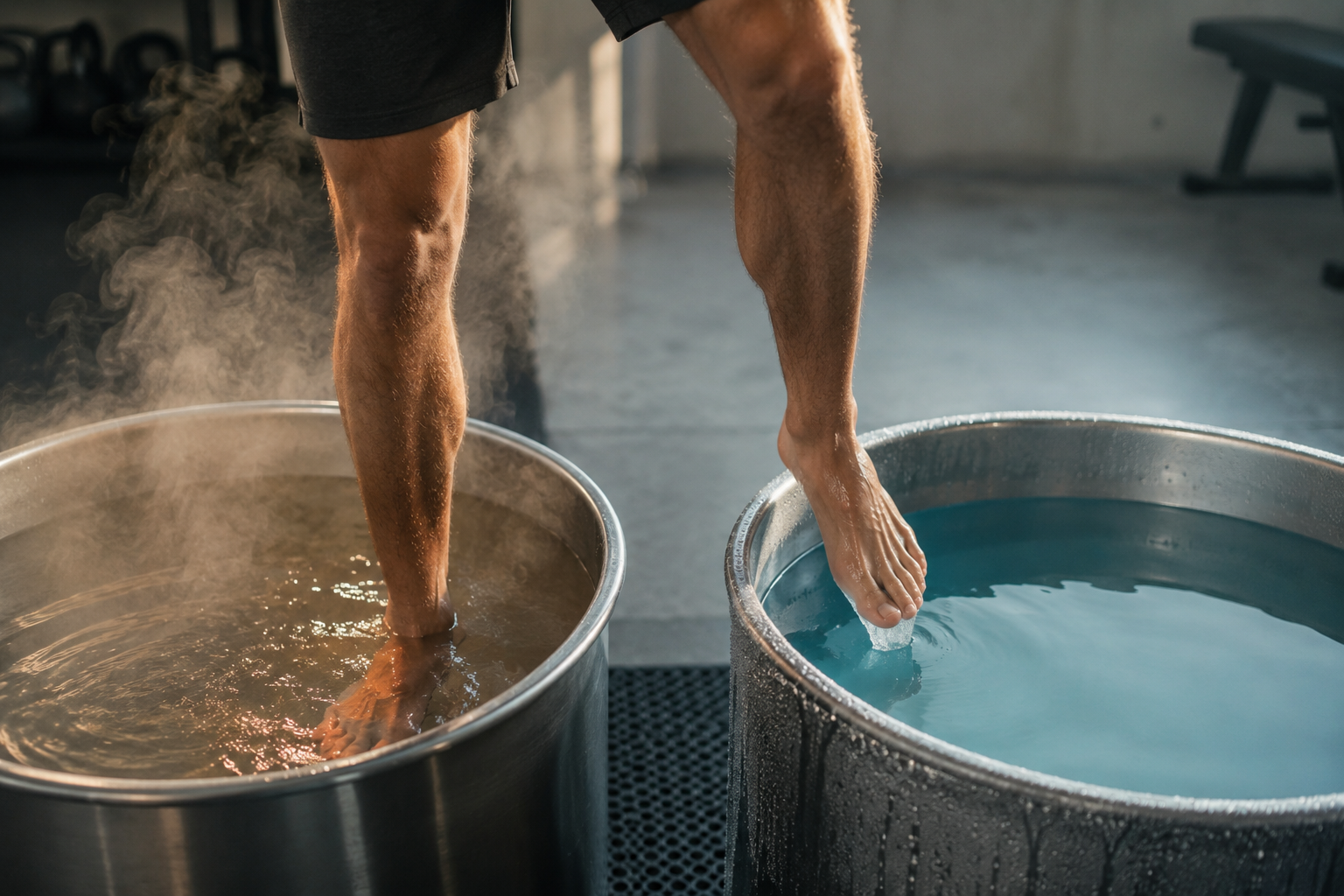
Contrast water therapy (CWT), sometimes called contrast bathing or hot-cold immersion, means moving the body back and forth between hot water and cold water in a repeated cycle, usually within a single session. It is distinct from a single cold plunge after a lifting session, and it is distinct from a post-workout sauna visit. Both of those are single-modality interventions using one temperature extreme. CWT specifically depends on the alternation itself, the switching between vasoconstriction and vasodilation, as its proposed active ingredient.
That distinction matters because it shapes what the research can and cannot tell us. A study on cold water immersion alone answers a different question than a study on contrast bathing, even when both report reduced soreness scores. This article focuses only on the alternating protocol: what happens physiologically when the body is cycled between temperature extremes, what the trial evidence shows for soreness versus actual performance, what protocols researchers have actually tested, and who should be cautious before stepping into either tub.
- Focus of this article: alternating hot-cold immersion (contrast water therapy) as a full protocol.
- Not covered here in depth: single cold-plunge timing after resistance training, or post-training sauna use in isolation. Those are separate topics with their own evidence bases.
- Population in most cited trials: trained athletes and recreationally active adults, mostly male, mostly in controlled lab or team-sport settings.
The “Pumping Action” Theory
The mechanism most often cited to explain contrast therapy is a vascular pump. Cold water causes peripheral vasoconstriction, narrowing the blood vessels near the skin and in working muscle. Hot water causes vasodilation, widening those same vessels. The theory holds that cycling rapidly between the two states forces blood in and out of the muscle tissue like a bellows, and that this repeated flushing helps clear metabolic byproducts such as lactate, reduce swelling (oedema), and deliver oxygenated blood back to fatigued tissue faster than either temperature alone would.
It is an intuitive story, and it shows up in nearly every consumer-facing article about contrast therapy. It is worth being direct about its evidentiary status: the researchers who have most closely reviewed the topic describe it as a hypothesis, not a confirmed mechanism. In their 2013 systematic review and meta-analysis published in PLOS ONE, Bieuzen, Bleakley, and Costello write that CWT may work through this alternating vasoconstriction-vasodilation “pumping action,” but add plainly that “the exact mechanisms by which CWT may improve athletic recovery have yet to be established and presently there is little evidenced-based consensus” (Bieuzen et al., 2013). The same review notes that direct evidence for increased blood flow or faster lactate clearance from the alternating protocol, as opposed to a single cold immersion, remains thin, and calls for future research to determine “whether CWT offers any additional physiological effect to single immersions in cold water.”
“The exact mechanisms by which contrast water therapy may improve athletic recovery have yet to be established.”
In plain terms: the pumping story is plausible physiology, but it has not been directly measured in a way that proves it is the reason people feel better after alternating hot and cold. Reduced nerve conduction velocity from the cold phase, which blunts pain signaling, and the simple psychological effect of a structured recovery ritual are both live alternative explanations that have not been ruled out.
What the Research Shows: Soreness and Perceived Recovery
Where contrast water therapy has its strongest evidence is in subjective, self-reported outcomes, and even there the picture is nuanced. The Bieuzen meta-analysis pooled 18 randomized controlled trials with 356 total participants and found that, compared with passive rest, CWT significantly reduced muscle soreness ratings at every time point measured: under 6 hours, 24 hours, 48 hours, 72 hours, and 96 hours post-exercise. Fifteen of those studies used visual analogue or Likert soreness scales as their outcome measure.
The caveat that rarely makes it into marketing copy: when the authors converted those soreness reductions onto a standardized 0-10 scale to judge clinical relevance, the improvements ranged from roughly 0.8 to 8.7 percent, and they concluded that “many of the reductions were not clinically relevant.” A statistically significant result and a meaningfully noticeable result are not the same thing, and this review found both patterns depending on the specific comparison.
A more recent controlled study offers a useful real-world snapshot. Kida and colleagues studied 15 male collegiate swimmers after high-intensity interval swim sets, comparing a structured contrast water protocol against passive rest. Blood lactate was significantly lower after CWT (7.75 mmol/L versus 10.86 mmol/L, p = 0.002), and subjective fatigue on a visual analogue scale was also reduced (6.60 versus 7.60 cm, p = 0.021) (Kida et al., Sports, 2026). Both markers moved in the direction athletes want. The perceptual and metabolic signal was real in that trial.
What the Research Shows: Actual Performance and Adaptation
This is where the story splits. Feeling less sore is not the same as swimming faster, jumping higher, or adapting better to a training block, and the evidence for those harder outcomes is inconsistent.
Start with the swimmers above: despite the lactate and fatigue improvements, the same study found “no significant differences in blood pressure or swimming performance” between the CWT and passive-rest conditions. The authors’ own conclusion is worth quoting directly: CWT “facilitates physiological and perceptual recovery without producing immediate performance enhancement.” Feeling recovered and performing better were not the same result in this trial.
Other studies point the opposite direction under specific conditions. Vaile and colleagues had strength-trained men complete a soreness-inducing leg press protocol, then applied 14 minutes of daily hydrotherapy for 72 hours using cold immersion, hot immersion, or contrast therapy. Both cold water immersion and contrast water therapy reduced the physiological and functional deficits associated with delayed-onset muscle soreness (Vaile et al., European Journal of Applied Physiology, 2008). In a companion study with 12 cyclists repeating five consecutive days of high-intensity training with daily recovery interventions, both cold water immersion and contrast water therapy improved sprint and time-trial performance across the five days compared with passive recovery (Vaile et al., International Journal of Sports Medicine, 2008).
Dose and duration appear to matter, and more is not automatically better. Versey, Halson, and Dawson tested cyclists across two 75-minute rides separated by two hours, comparing 6 minutes of contrast therapy, 12 minutes of cold-only immersion, 18 minutes of contrast therapy, or passive rest. The 6-minute contrast protocol substantially improved subsequent time-trial and sprint performance relative to control, but the longer 12- and 18-minute protocols showed no additional improvement, meaning there was no simple dose-response relationship (Versey et al., European Journal of Applied Physiology, 2011).
A Cochrane systematic review takes this a step further by comparing cold water immersion directly against contrast immersion rather than against passive rest. Pooling the available trial data, the reviewers found “no evidence of differences between the two groups” for pain at any measured time point from immediately after exercise through 72 hours later (Bleakley et al., Cochrane Database of Systematic Reviews, 2012). In other words, when contrast therapy is measured against a plain cold soak rather than against doing nothing, the extra step of adding heat cycles does not show a clear additional benefit for soreness. The same review notes that trial quality across this literature was low overall, and that most trials did not actively track adverse events, so safety data is thinner than the enthusiasm around the practice would suggest.
Put together, the honest summary is this: contrast water therapy consistently beats doing nothing for how sore and fatigued someone feels in the following days. It does not consistently beat a single cold-water soak for that same soreness outcome. And its effect on objectively measured performance and long-term training adaptation depends heavily on the sport, the protocol length, and the outcome being measured, with several studies showing benefit and at least one well-controlled trial showing none.
Evidence Strength at a Glance
| Reduces perceived soreness vs. passive rest | Moderate — consistent across trials, but many individual effects rated not clinically meaningful |
| Outperforms cold-only immersion for soreness | Weak — Cochrane pooled data found no difference from cold water immersion alone |
| Improves same-day/next-day performance | Mixed — benefit shown in some cycling and multi-day trials, absent in a swimming trial |
| “Pumping action” mechanism confirmed | Weak — described by reviewers as an unconfirmed hypothesis, not established fact |
| Overall trial quality in this literature | Low — small samples, inconsistent protocols, limited blinding, described as low quality by two independent reviews |
Protocols Actually Used in Research
One reason the evidence is hard to compare across studies is that “contrast water therapy” covers a wide range of specific protocols. There is no single agreed-upon standard. Below are the parameters drawn directly from the studies cited in this article, shown as a reference rather than a universal prescription.
Protocol Reference Box: What Studies Actually Tested
Cold phase
8–21°C
(46–70°F), typically 30–60 seconds
Hot phase
35.5–45°C
(96–113°F), typically 60–180 seconds
Total session length
6–24 minutes
6-minute protocols showed benefit in at least one dose-response trial; 12–18 minute versions showed no added gain
Cycle pattern
1–10 cycles
Most protocols end on cold; frequency ranged from a single session to daily use over 72 hours
Example from a 2013 meta-analysis of 18 trials: cold water at 8–15°C for about 1 minute, alternated with hot water at 35.5–45°C for 1–3 minutes, repeated for a total session of 6–24 minutes, applied 1–4 times across 24–72 hours (Bieuzen et al., 2013). Example from a 2026 swimming study: 40–41°C for 60 seconds alternated with 20–21°C for 30 seconds, across 10 cycles, ending cold, for a total of about 15 minutes (Kida et al., 2026).
A few patterns are consistent enough across the literature to note. Sessions almost always end on the cold phase rather than the hot phase, on the theory that finishing with vasoconstriction limits residual swelling. Hot-to-cold ratios cluster around 1:1 to 3:1 in favor of the hot phase, since cold tolerance is the limiting factor for most people. And contrary to the “more is better” instinct, the dose-response data that exists suggests a short protocol may work as well as or better than a long one, at least for cycling performance in the one trial that directly tested duration.
Safety and Contraindications
Contrast therapy asks the cardiovascular system to swing between two opposite states in quick succession: vasoconstriction under cold stress and vasodilation under heat stress, each with its own effect on heart rate and blood pressure. For most healthy adults that swing is well tolerated. For certain groups, it introduces real risk, and this is not a section to skim.
Who Should Talk to a Doctor Before Trying Contrast Therapy
- Cardiac arrhythmias: cold-water exposure can lower the threshold for irregular heart rhythms.
- Uncontrolled high blood pressure or known heart disease: the rapid vasoconstriction of the cold phase, and the added cardiac workload of the hot phase, can compound existing strain.
- Peripheral vascular disease: narrowed arteries make forced vasoconstriction and vasodilation riskier.
- Raynaud’s phenomenon: an exaggerated vasoconstrictive response to cold that can trigger painful color changes, numbness, and in secondary Raynaud’s linked to autoimmune conditions, tissue damage.
- Pregnancy: the hot phase carries the real caution here, not the cold phase. Guidance from the American College of Obstetricians and Gynecologists advises against letting core body temperature exceed 102.2°F, and body temperature can climb to 102°F or higher within 10–20 minutes in a standard hot tub.
- Open wounds, active skin infections, or impaired sensation: alternating extreme temperatures can worsen tissue injury when normal protective sensation or healing response is compromised.
This list is informational, not a diagnosis or personalized medical clearance. If any of the above applies to you, or if you are simply unsure, talk with your doctor before starting a hot-cold alternating protocol. This caution is separate from ordinary post-workout muscle soreness, which contrast therapy is generally considered reasonably safe to address in healthy adults.
On the cardiovascular point specifically, a sports medicine physician interviewed by the American Medical Association put it plainly: the short-term physiological swings from contrast therapy “may also pose risks in patients with cardiovascular disease,” and she recommends a cautious, gradual approach for anyone in an at-risk group rather than jumping straight into extreme temperatures (American Medical Association, 2025). The same source frames contrast therapy as “a supportive recovery tool,” not a treatment capable of reversing disease, which is a useful check against some of the more sweeping wellness-industry claims attached to hot-cold protocols.
On Raynaud’s specifically, the underlying issue is that the normal cold-induced narrowing of skin blood vessels is exaggerated in people with the condition, causing fingers or toes to turn white or blue, go numb, and then throb painfully as blood flow returns. Primary Raynaud’s, the more common and generally milder form, most often appears in people age 15 to 30. Secondary Raynaud’s, associated with autoimmune conditions such as scleroderma or lupus, tends to appear later in life and carries a higher risk of complications including skin ulcers. Anyone with either form should get individualized guidance from a physician before using cold-immersion protocols of any kind, including the cold phase of contrast therapy.
How This Differs From a Cold Plunge or a Post-Training Sauna
It is worth being explicit about scope, since these three practices get lumped together constantly. A cold plunge taken specifically after a lifting session, timed around strength and hypertrophy adaptation, is its own research question, largely centered on whether cold exposure blunts the muscle-building signal from resistance training when used too soon afterward. A sauna session used after training, with no cold phase involved, is a heat-only intervention studied mostly for cardiovascular and possibly separate recovery benefits. Contrast water therapy is neither of those. It is specifically the alternation, the repeated switch between hot and cold within one session, and the research questions around it, the pumping mechanism, the soreness-versus-performance gap, the lack of a clear dose-response curve, are particular to that alternating structure. If your goal is narrowly about cold-plunge timing after a lifting day, or about sauna habits, those deserve their own dedicated look rather than being folded into a contrast-therapy framework.
Practical Takeaways
For a healthy adult without any of the contraindications above, the evidence supports contrast water therapy as a reasonable tool for feeling less sore and less fatigued after hard training, particularly around competition or multi-day events where subjective readiness matters. It should not be marketed or expected as a guaranteed performance enhancer, since at least one well-controlled trial found improved lactate clearance and reduced fatigue ratings with no corresponding gain in actual swim times.
If you decide to try it, the research suggests keeping sessions relatively short, in the 6 to 15 minute range, alternating roughly one minute of cold with one to three minutes of hot, ending on cold, and reserving longer or more frequent protocols for situations where you have specifically tested that they help rather than assuming more exposure equals more benefit. Given that a Cochrane-level review found no clear soreness advantage over plain cold water immersion, there is also a legitimate simpler option: a single cold soak with no heat cycling, which is far easier logistically and appears to perform comparably for pain relief in the pooled data.
Frequently Asked Questions
Does contrast water therapy actually flush out lactic acid?
The “pumping” theory proposes faster lactate clearance through alternating blood flow changes, and at least one recent trial in swimmers did find significantly lower blood lactate after contrast therapy compared with passive rest. But the broader mechanism, that alternating temperatures create a superior flushing effect compared with a single cold or hot immersion, has not been directly confirmed, and reviewers describe it as an unestablished hypothesis rather than settled physiology.
Is contrast therapy better than just a cold plunge for soreness?
Not according to the pooled trial data. A Cochrane systematic review comparing cold water immersion directly against contrast immersion found no evidence of a difference in pain at any time point from immediately after exercise through 72 hours later. Both appear to help compared with doing nothing, but neither has shown a clear edge over the other for soreness specifically.
What water temperatures and timing do studies actually use?
Protocols vary, but a common pattern from the research is roughly 8–15°C (46–59°F) cold water for about one minute, alternated with 35.5–45°C (96–113°F) hot water for one to three minutes, repeated for a total session of 6 to 24 minutes, most often finishing on the cold phase. See the protocol box above for specific examples drawn from individual studies.
Can contrast therapy actually improve athletic performance, not just soreness?
The evidence is mixed. Some cycling studies found improved sprint and time-trial performance with contrast therapy compared with passive recovery, including across a five-day high-intensity training block. A separate controlled study in collegiate swimmers found improved lactate and fatigue markers but no significant difference in actual swim performance. The effect appears to depend on the sport, the protocol, and possibly the specific performance metric being measured.
Who should avoid alternating hot and cold water therapy?
People with cardiac arrhythmias, uncontrolled high blood pressure, known heart disease, peripheral vascular disease, or Raynaud’s phenomenon should consult a doctor before trying it, given the cardiovascular demands of rapid temperature swings. Pregnant individuals should be cautious specifically about the hot phase, since core body temperature above roughly 102.2°F is a recognized risk threshold, and standard hot tub temperatures can reach that within 10 to 20 minutes.
Is longer contrast therapy always more effective?
No. In one dose-response study with cyclists, a 6-minute contrast protocol improved subsequent performance while 12- and 18-minute versions of the same protocol showed no additional benefit. Longer exposure has not been shown to reliably outperform shorter, well-structured sessions in the available research.
References
- Bieuzen F, Bleakley CM, Costello JT. Contrast Water Therapy and Exercise Induced Muscle Damage: A Systematic Review and Meta-Analysis. PLOS ONE. 2013;8(4):e62356. doi.org/10.1371/journal.pone.0062356
- Kida K, et al. Effects of Contrast Water Therapy on Physiological and Perceptual Recovery Following High-Intensity Interval Swimming in Collegiate Swimmers. Sports. 2026;14(1):26. doi.org/10.3390/sports14010026
- Bleakley CM, Bieuzen F, Davison GW, Costello JT. Cold-water immersion (cryotherapy) for preventing and treating muscle soreness after exercise. Cochrane Database of Systematic Reviews. 2012. doi.org/10.1002/14651858.CD008262.pub2
- Vaile J, Halson S, Gill N, Dawson B. Effect of hydrotherapy on the signs and symptoms of delayed onset muscle soreness. European Journal of Applied Physiology. 2008;102(4):447-455. doi.org/10.1007/s00421-007-0605-6
- Vaile J, Halson S, Gill N, Dawson B. Effect of hydrotherapy on recovery from fatigue. International Journal of Sports Medicine. 2008;29(7):539-544.
- Versey N, Halson S, Dawson B. Effect of contrast water therapy duration on recovery of cycling performance. European Journal of Applied Physiology. 2011;111(1):37-46. doi.org/10.1007/s00421-010-1614-4
- American College of Obstetricians and Gynecologists guidance, as summarized by American Pregnancy Association. Hot Tubs During Pregnancy. americanpregnancy.org/pregnancy/hot-tubs-during-pregnancy
- American Medical Association. 4 things to know about cold plunges and contrast therapy. 2025. ama-assn.org
This article is for general educational purposes and does not replace individualized medical advice. If you have a heart condition, circulatory disorder, Raynaud’s phenomenon, or are pregnant, talk with your doctor before starting any hot-cold contrast protocol.