



























If you want climbs to feel strong instead of soul-sucking, focus your Training for Hiking on the specific demands of going uphill: steady aerobic power, efficient technique, resilient legs, and smart fueling. Uphill endurance is your ability to sustain effort against gravity over long grades; you build it by combining aerobic base work, hill-specific intervals, strength, and progressive pack time. Below is a practical, step-by-step plan built for hikers who want confidence on sustained climbs, whether that’s local hills or big mountain days.
Quick-start plan (snapshot): Train 4–5 days/week. Do one long incline session, one hill-interval day, two strength/mobility sessions, and one loaded-pack hike. Keep easy days truly easy. Fuel with 30–60 g carbs per hour on longer climbs, drink to thirst with electrolytes, and pace by breathing/talk test early, heart rate if you track it.
Brief safety note: If you have a medical condition or you’re new to exercise, check with a qualified clinician before starting a new training plan.
1. Benchmark Your Starting Point (So You Can Progress on Purpose)
Start by measuring where your uphill fitness is today; this turns a vague goal into a clear progression. A simple benchmark is a 20–30 minute steady climb on an incline treadmill (5–10% grade) or a local hill, paced by the talk test (you can speak in phrases, not full sentences). Record average pace, heart rate, vertical gain, and how it felt. You can also estimate training zones with age-based heart-rate ranges or RPE, but the talk test is a reliable, no-cost anchor for intensity. Finally, estimate time-on-route with Naismith’s Rule to frame realistic weekend objectives and recovery needs.
1.1 How to do it
- Talk test + HR: Moderate intensity = can hold a conversation; vigorous = only short phrases (roughly 50–70% vs 70–85% HRmax).
- Field test: 20–30 min continuous climb at steady, “can-talk” effort; log pace, HR, gain, and RPE 1–10.
- Route timing: For planning, allow 1 hour per 5 km plus 1 hour per 600 m ascent; adjust for terrain and load.
1.2 Numbers & guardrails
- Example: If your 25-minute 10% grade test covers 2.0 km with 200 m gain, log that as Baseline A. Retest every 3–4 weeks at the same grade.
- Keep moderate work near 50–70% HRmax; use 220–age for a rough max if you don’t lab-test.
Bottom line: Clear baselines make progress obvious and help you size workouts, hiking days, and recovery intelligently.
2. Build an Aerobic Base on Inclines (Your Weekly “Bread and Butter”)
The fastest way to feel better on climbs is more easy uphill time—low-to-moderate intensity walking on an incline that you can repeat often. This improves mitochondrial density and fatigue resistance without crushing you. Do 1–2 base sessions weekly: 30–90 minutes on rolling terrain or treadmill at 4–10% grade where you can maintain conversation. Keep it easy enough that you could add 10–15 minutes more if asked; consistency beats hero days.
2.1 How to do it
- Treadmill: 45–60 min at 5–8% grade, comfortable pace, steady breathing.
- Trail: 60–120 min gentle climbs; prioritize continuous movement over speed.
- Pacing cue: If you can’t talk in complete sentences, back off to moderate.
2.2 Mini-checklist
- Aim for 150+ minutes/week of moderate cardio across all activities.
- Keep stride short and cadence light to save calves; use poles lightly if you plan to hike with them. www.heart.org
Bottom line: Easy climbing volume builds the aerobic engine that everything else sits on.
3. Add Hill Repeats & Grade Intervals (Target VO₂ and Power)
Once the base is rolling, inject structured hill work 1x/week to raise your ceiling: short to medium repeats at vigorous intensity on 6–12% grades. Intervals stress VO₂ and leg power with less pounding than flat speed work. Expect breathing to be hard but controlled; walk between reps to recover. This is where you teach your body to tolerate steeper grades without spiking effort.
3.1 Numbers & guardrails
- Session ideas:
- 6–10 × 1 minute hard (8–9/10 RPE) @ 8–12% grade; walk back 90 sec.
- 5–8 × 2–3 minutes @ 6–10% grade; equal-time easy walk recovery.
- 3–5 × 4–5 minutes @ 6–8% grade; 2–3 minutes easy walk.
- Research shows hill intervals improve VO₂-related measures and running economy; even level vs uphill intervals both help, with context-dependent benefits. openprairie.sdstate.edu
3.2 Common mistakes
- Going too hard on rep 1 and fading.
- Cutting recoveries too short (quality > quantity).
- Doing hill sprints the day before a long climb.
Bottom line: One weekly dose of focused grade work improves power and keeps your climbing from bogging down.
4. Strengthen the Climb Muscles (Quads, Glutes, Calves, Core)
Dedicated strength work gives you “free gears” on steep grades and protects knees on the descent. Prioritize compound lower-body moves, unilateral control, and eccentric strength (important for downhill resilience and overall durability). Two sessions per week, 35–50 minutes each, is enough for most hikers alongside cardio.
4.1 How to do it
- Primary lifts (2–4 sets each): Back or goblet squat, Romanian deadlift, step-ups, walking lunges.
- Accessories: Calf raises (straight and bent-knee), side-plank variations, hip airplanes.
- Eccentric bias: Slow 3–4 s lowers on squats/step-downs; controlled downhill treadmill walking (–5% to –10%) for 5–10 min. Eccentric training builds resilience but can cause soreness when new—progress gradually.
4.2 Mini-checklist
- Keep 2–3 reps “in reserve” on most sets during hiking season.
- Add a mobility finisher (hip flexors, calves, T-spine) to maintain posture under load.
Bottom line: Strong legs and trunk turn climbs into work you can repeat day after day.
5. Practice Loaded-Pack Hiking (Ruck Progression Without Wrecking Yourself)
Uphill endurance for backpacking isn’t just fitness—it’s carrying mass efficiently. Add loaded-pack sessions once weekly, increasing weight or duration but not both at the same time. Start with 10–15% of bodyweight for day hikers, 15–25% if prepping for overnights, and progress conservatively. Use this day to refine pack fit, foot care, and fueling.
5.1 Numbers & guardrails
- Progression idea: Add 1–2 kg or 15–20 minutes every 1–2 weeks if you finish fresh.
- Keep rest stops short and purposeful (water, foot check).
- Military doctrine emphasizes careful load management and planning; take the civilian lesson—optimize fit and carry only what you need.
5.2 Pack fit mini-checklist
- Hip belt carries most weight; shoulder straps stabilize, not strangle.
- Heel locks and lace tension tuned to prevent toe-bang on downhills.
- Poles strapped or deployed based on terrain.
Bottom line: Specificity matters—train with a pack so climb-day feels familiar, not foreign.
6. Master Pacing, Cadence, and Switchbacks (Efficiency You Can Feel)
Efficient uphill hiking feels like shifting to an easier gear: shorter steps, higher cadence, and relaxed breathing. Use the talk test to set the ceiling; for long slogs, you should be able to speak in full phrases. On switchbacks, keep turns smooth and stay in your rhythm rather than charging the apex. Plan your day using Naismith’s Rule so you don’t overreach and bonk halfway up.
6.1 How to do it
- Cadence focus: Slightly quicker, shorter steps reduce calf and hip flexor strain.
- Breathing: Inhale through the nose if easy; switch to nose+mouth as grade steepens to maintain controlled ventilation.
- Timing: Estimate 1 h/5 km + 1 h/600 m ascent, then add buffer for heat, altitude, or heavy packs.
6.2 Mini-checklist
- If you can’t speak comfortably, ease off 5–10%.
- Take micro-sips frequently on hot days; shade breaks beat sun-baked rests for cooling.
Bottom line: Smart pacing preserves energy so you arrive high feeling steady, not shattered.
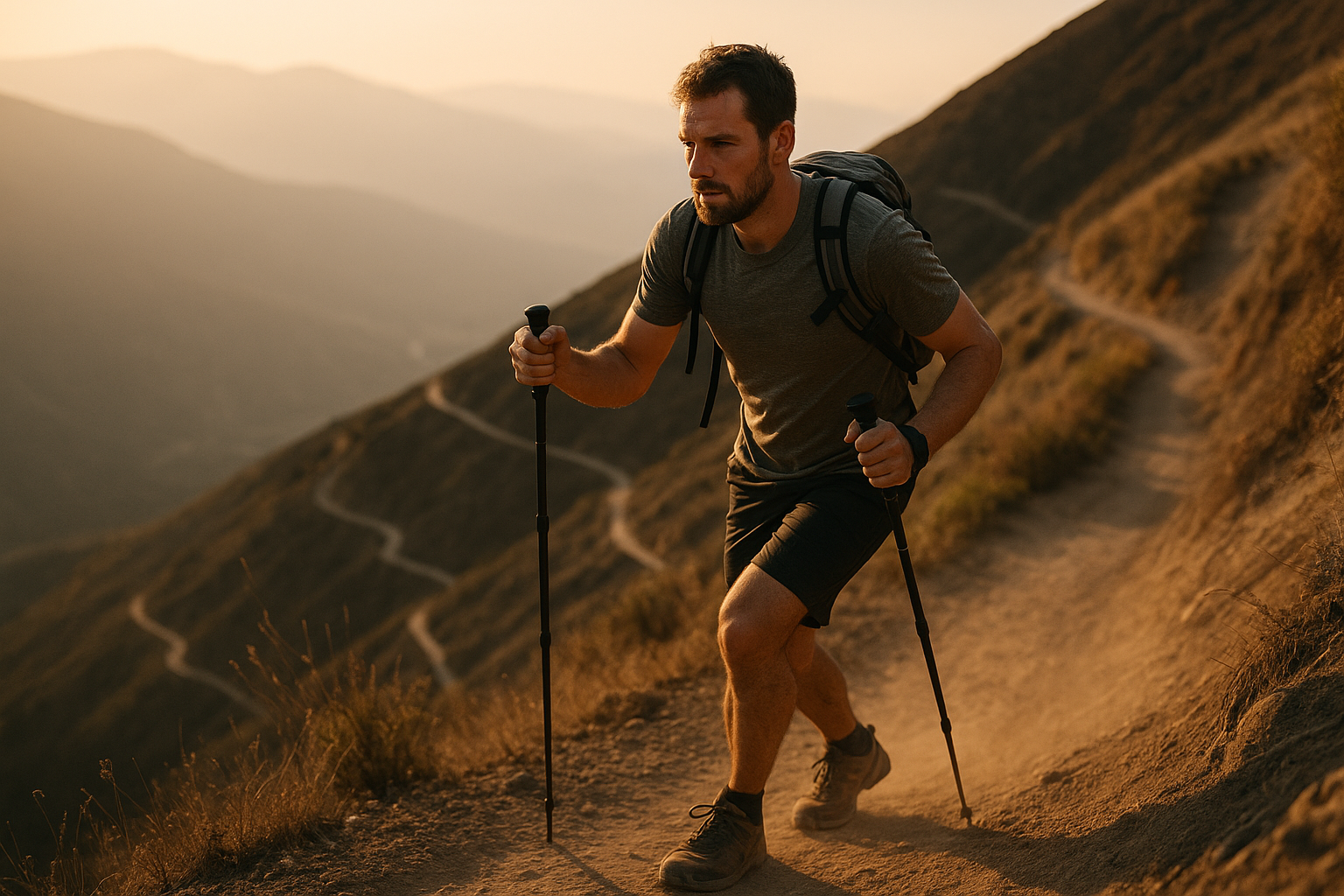
7. Use Trekking Poles Intelligently (Free Stability, Sometimes Free Speed)
Poles can improve stability, offload joints, and, depending on slope and technique, may change energy cost. Studies show mixed effects on oxygen use; some find no energy savings, others show changes in RPE or efficiency. Practically, poles help you drive on steep grades and brake on descents. Set them to roughly elbow-height on flats; shorten 5–10 cm for steeper uphills to increase leverage. REI
7.1 How to do it
- Angle poles slightly behind you and push through straps; don’t jam them vertically.
- Plant-left/step-right rhythm on moderate grades; double-plant on very steep steps.
- Keep shoulders relaxed; if they hike upward, your poles are too long.
7.2 Mini-checklist
- Practice on your base days so technique is second nature on big climbs.
- On rocky tread, plant poles to the side of obstacles, not between loose stones.
Bottom line: Poles are a skill tool—use them well and climbs feel smoother, descents kinder.
8. Prepare for Altitude and Heat (Environment Can Trump Fitness)
Thin air and high heat both raise effort at a given pace. If your objective includes elevation or hot seasons, add environment prep. For altitude, stage your ascent when possible and plan a lighter first day; for heat, build heat acclimation over 1–2 weeks with easy sessions in warmer conditions, hydrate sensibly, and adjust expectations. As of August 2025, public-health guidance emphasizes gradual exposure and conservative pacing when prior acclimation isn’t possible.
8.1 How to do it
- Altitude: Sleep lower than your high point if possible; consider an extra night around 2,000–2,500 m before going higher; learn early signs of AMS.
- Heat: Start with shorter, easier sessions in the heat; avoid peak midday exposure; monitor for cramping, dizziness, or nausea.
8.2 Numbers & guardrails
- Expect pace to slow at altitude; protect the first 24–48 hours.
- If symptoms escalate, descend; no summit is worth your health.
Bottom line: Environment-savvy hikers climb more—and enjoy it more—because they plan for the air and the heat, not just the grade.
9. Fuel and Hydrate for Long Climbs (Small Inputs, Big Outputs)
Nutrition turns training into output. For climbs longer than ~60–90 minutes, aim for 30–60 g carbohydrate per hour, taken early and consistently (gels, chews, bars, or real food you’ve practiced). Hydration should aim to replace some sweat loss without overdrinking; drink to thirst and include sodium—a typical range is 300–600 mg/hour during prolonged efforts, adjusting for your sweat rate and weather. Pre-exercise, having fluids on board and a small sodium dose helps retention in the heat.
9.1 How to do it
- Before: About 500 ml fluids ~2 hours pre-hike; small salty snack if it’s hot.
- During: Sip regularly; target 30–60 g carbs/hour (e.g., one gel + handful of dried fruit).
- After: Replace ~150% of body mass lost over several hours and include carbs (1.0–1.5 g/kg in the first 30 min and every 2 hours for 4–6 hours) plus some protein. andeal.org
9.2 Mini-checklist
- Practice gut training on base days, not summit day.
- In heat, favor electrolytes when you notice salt crust on clothing or stinging eyes.
Bottom line: Consistent carbs and sensible fluids keep your engine from stalling on sustained climbs.
10. Train Your Downhills (Protect the Quads, Save Tomorrow’s Climb)
Downhill conditioning is an uphill strategy: if your quads blow up on the descent, the next day’s climb suffers. Add gentle eccentric work—downhill walking or step-downs with slow lowers—to inoculate muscles against DOMS (the “repeated-bout effect”). Start light; eccentric work is potent, so progression should be patient and planned.
10.1 How to do it
- Downhill treadmill: –5% to –10% for 5–10 min after easy hikes; build to 15–20 min.
- Step-down series: 3×8–12 per leg from a 20–30 cm box; 3–4 s lower.
- Trail focus: On descents, keep cadence high and steps short to reduce braking.
10.2 Common mistakes
- Too much, too soon (monster soreness).
- Heavy downhill the week of an important climb.
- Ignoring downhill technique because “uphill is the hard part.”
Bottom line: Condition for gravity both ways and your legs will still work when the trail tilts up again tomorrow.
FAQs
How many weeks does it take to noticeably improve uphill endurance?
Most hikers feel clear gains in 4–6 weeks with two cardio climbs, one hill-interval day, and two strength sessions weekly. Expect the biggest early wins from consistent aerobic incline time and strength basics. If you’re new or returning, start with 3 days/week and add volume gradually to prevent soreness that derails consistency. ACSM
Is heart-rate training necessary, or is the talk test enough?
You can build excellent uphill fitness using only the talk test to keep easy days easy and hard days controlled. HR monitors add precision, but intensity drift with heat, altitude, and fatigue means HR is one data point. Many public-health and clinical sources validate both methods; pick the one you’ll use consistently. CDC
What grades should I train on?
For most hikers, 5–10% grades deliver the best training mix: steep enough to challenge, gentle enough to sustain form. Sprinkle in short efforts at 10–15% for power if you have that terrain, and use stairwells sparingly (they’re very eccentric-heavy). Progress based on how recovered you feel 24–48 hours later.
How do trekking poles change effort on climbs?
Evidence is mixed: some studies report no energy savings while others show different cardiorespiratory responses and perceived effort changes. Practically, poles improve balance and rhythm and may feel easier on steep or technical grades, especially with a pack. Technique and slope angle matter more than brand. Journal of Sports Science and Medicine
What’s a sensible pack-weight target for training?
Day hikers can start around 10–15% of bodyweight; backpackers might build toward 15–25%, with weight distributed to the hips. The Army’s foot-march doctrine underscores careful load planning; civilians should borrow the mindset—carry essentials, fit the pack well, and progress deliberately.
How do I plan realistic hiking times for routes with big climbs?
Use Naismith’s Rule as a starting point: 1 hour per 5 km + 1 hour per 600 m ascent, then add margin for rough trail, heat, altitude, and rests. It’s a planning tool, not a race target; adjust for your group’s slowest member.
How should I fuel a long, hot climb?
Begin fueling in the first hour and aim for 30–60 g carbohydrate/hour, plus electrolytes. Drink to thirst and include 300–600 mg sodium/hour if you’re a heavy or salty sweater. Pre-hydrate moderately (about 500 ml a couple hours before) and practice your gut strategy in training.
What about altitude—can I train for it at sea level?
You can’t fully replicate thin air, but you can arrive fit, plan a staged ascent, and keep day one conservative. The CDC’s Yellow Book recommends gradual acclimatization and recognizing early symptoms; if you feel worse, descend. Fitness helps, but acclimatization is its own process.
How do I balance strength with hiking so I’m not sore for climbs?
Keep strength 2 days/week, leave 48 hours before your longest climb, and avoid maximal-eccentric experiments in-season. Use moderate loads with good technique; the goal is resilient legs, not gym PRs.
What’s the single biggest mistake people make training for hills?
They “race” every climb. Save hard efforts for one structured day, keep the rest truly easy, and you’ll accumulate more quality volume with less fatigue—exactly what translates to steady uphill endurance.
Conclusion
Uphill endurance is equal parts engine, technique, strength, and systems. Build your aerobic base on inclines you can repeat often. Layer in one weekly hill-interval session to raise the ceiling without beating up your joints. Strength-train for robust quads, glutes, calves, and core, and add a touch of eccentric work so downhills don’t sabotage tomorrow’s climb. Practice with a pack and poles the way you’ll use them on trail, and dial in a fueling and hydration plan that you’ve tested on training days. Finally, respect the environment—altitude and heat will change the rules—so plan your pace and exposure accordingly. Put these 10 strategies to work for 6–8 weeks, retest your hill benchmark, and enjoy the feeling of climbs turning from fight to flow.
Ready to start? Pick your test hill, schedule this week’s base climb, and set a pole-length reminder—then go do rep #1.
References
- High-Altitude Travel and Altitude Illness, CDC Yellow Book (2026 edition online), updated Apr 23, 2025. CDC
- Heat and Cold Illness in Travelers, CDC Yellow Book, updated Apr 23, 2025. CDC
- Position Statement: Exertional Heat Illnesses (2023 update), National Athletic Trainers’ Association. NATA
- American Heart Association – Target Heart Rates, AHA, Aug 12, 2024. www.heart.org
- Kwon Y. et al. The Talk Test as a Useful Tool to Monitor Aerobic Exercise Intensity, Healthcare, 2023. PMC
- Ferley D.D. et al. Uphill vs. Level-Grade HIIT Effects on VO₂max and Threshold, J Strength Cond Res, 2013. PubMed
- Held S. et al. Increased Oxygen Uptake During Uphill High-Intensity Intervals, Frontiers in Physiology, 2023. Frontiers
- Jeukendrup A. Carbohydrate Intake During Exercise, Sports Med, 2014. PMC
- Veniamakis E. et al. Effects of Sodium Intake on Health and Performance in Athletes, Nutrients, 2022. PMC
- Exercise and Fluid Replacement (Position Stand), ACSM via PubMed summary. PubMed
- 9 Facts About Hydration & Electrolytes, ACSM, 2025. ACSM
- Brito J.P. et al. Effects of Backpack Load and Trekking Poles on Energy and RPE, J Hum Kinetics, 2018. PMC
- Giovanelli N. Do Poles Save Energy During Steep Uphill Walking?, 2019. PubMed
- How to Use Trekking Poles, REI Expert Advice, Nov 27, 2023. REI
- Conditioning for Backpacking & Hiking, REI Expert Advice. REI
- Naismith’s Rule – Planning & Following a Route, Mountaineering Scotland. mountaineering.scot
- ATP 3-21.18: Foot Marches, U.S. Army (2017). Intelligence Resource Program
- Hody S. et al. Eccentric Muscle Contractions: Risks and Benefits, Front Physiol, 2019. PMC
- Boyd L. et al. Pre-conditioning and Exercise-Induced Muscle Damage, Sports Medicine, 2023. SpringerLink