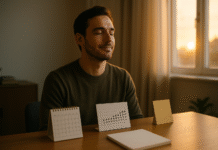

























If your mind revs at bedtime, gratitude can gently shift your attention from “what-if” to “what-is,” helping you unwind and fall asleep easier. Nightly gratitude routines are short, repeatable practices you do in the last 30–60 minutes before lights out to nudge your brain toward calm and contentment. In studies, people who cultivate gratitude report falling asleep faster and enjoying better sleep quality—likely because positive pre-sleep thoughts crowd out worry loops.
Quick-start: pick one practice below, do it at the same time nightly, keep lights dim, and pair the ritual with a consistent bedtime—especially helpful when combined with core sleep-hygiene basics like limiting late caffeine, screens, and heavy meals.
Note: This guide is educational and not medical advice. If you suspect insomnia, sleep apnea, or another sleep disorder, consult a clinician or a sleep specialist.
1. Journal “Three Good Things” (and Why)
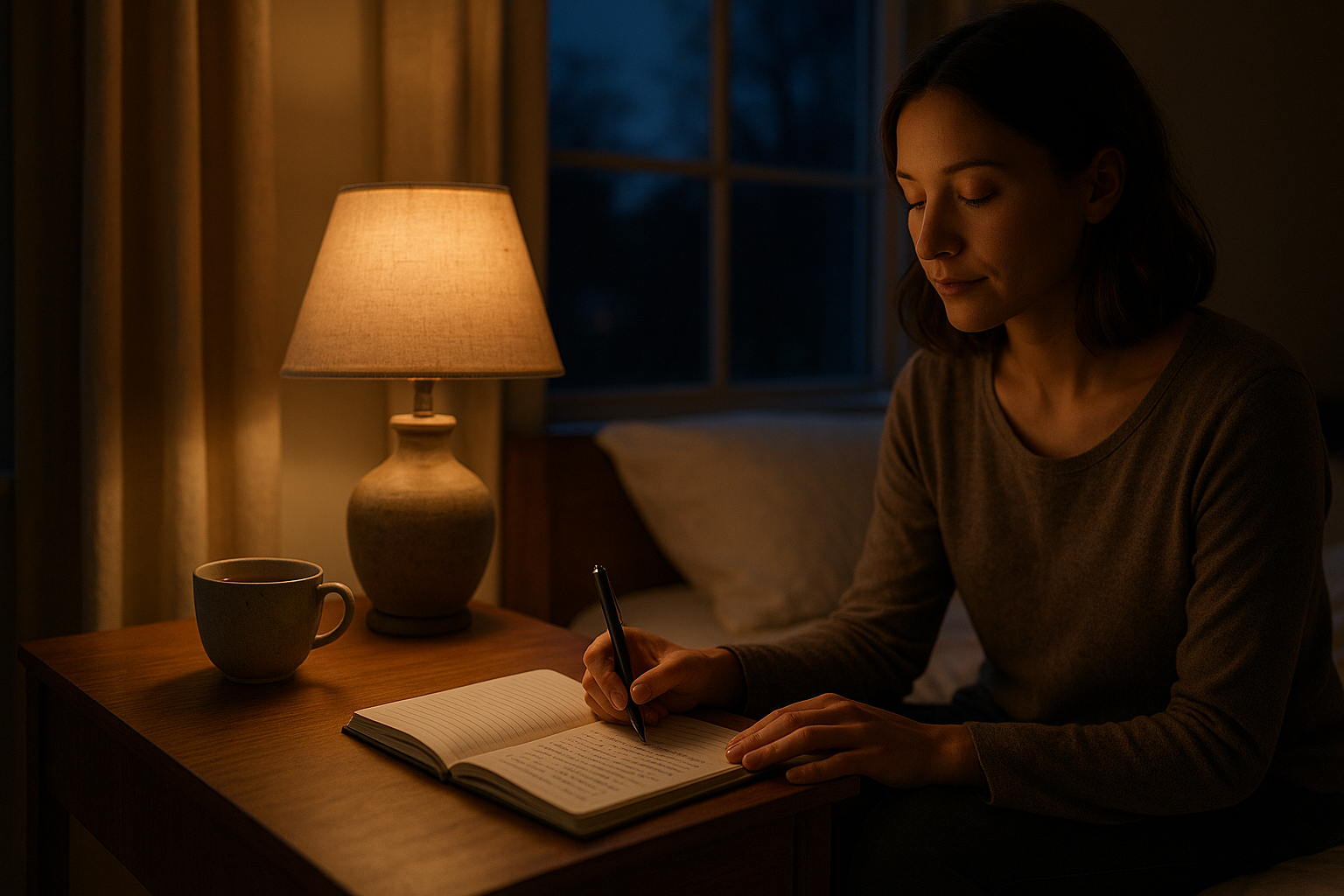
The fastest on-ramp into gratitude at night is a simple reflection: write three good things that happened today and one sentence on why each occurred. This exercise works because it trains attention toward meaningful, specific positives and builds a bank of calming memories to revisit at bedtime. Many people find their mood softening within minutes, which helps reduce rumination—the enemy of sleep. Randomized experiments show gratitude journaling improves well-being, and a cross-sectional sleep study suggests gratitude relates to shorter sleep latency and better sleep quality, mediated by more positive thoughts before bed. In short: end the day by noticing what went right to free your mind for rest. PubMed
1.1 How to do it (5–7 minutes)
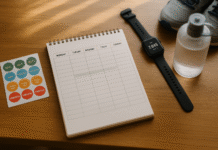
- Open a notebook dedicated to nights only; date the page.
- List 3 good things from today; keep each to one line.
- Under each, add “Why it happened” (a sentence).
- Close by circling one item you want to remember tomorrow.
- Re-read the list once, breathe slowly for 30 seconds, lights out.
1.2 Numbers & guardrails
- Aim for 3–5 minutes; perfection isn’t required.
- Be specific (“My friend called to check in”) rather than vague (“It was fine”).
- If nothing “big” happened, capture micro-moments: warm sunlight, a tasty snack, a kind email.
- Skip screens—use paper to reduce blue-light exposure near bed.
Synthesis: Nightly repetition rewires your attention toward positives; over days, this makes pre-sleep thoughts calmer and sleep onset easier.
2. Write a Specific To-Do List to Offload Tomorrow
When you can’t stop replaying tomorrow’s tasks, doing a five-minute to-do list before bed is a powerful cognitive “offload.” In a lab study using overnight polysomnography (the gold standard for measuring sleep), people who wrote a specific to-do list fell asleep faster—about 9 minutes sooner than those who journaled about completed tasks. The more detailed the list, the faster they drifted off. The mechanism: once your brain trusts the plan on paper, it can stop rehearsing it in your head. Pair the list with a closing line such as, “I can relax knowing I’m prepared,” which Sleep Foundation recommends as a helpful sleep affirmation.
2.1 How to do it (exactly 5 minutes)
- Set a timer; keep lights dim.
- Write tomorrow’s 3–7 tasks with verbs, owners, and time windows.
- Star one must-do and one nice-to-do.
- Add the first micro-step for each task (e.g., “open slide deck”).
- End with a one-line reassurance: “List captured; brain can power down.”
2.2 Common mistakes
- Making it a project plan (too long): aim for one page.
- Doing it in bed: write at a desk or table to keep the bed for sleep only.
Synthesis: A short, specific plan reduces mental load, settles pre-sleep worry, and trims sleep-onset time.
3. Gratitude Body Scan (Relax Tension While Thanking Your Body)
A gratitude body scan merges progressive muscle relaxation with appreciative attention. You slowly tense and relax small muscle groups from forehead to toes while mentally saying “thank you” to each part for what it did today (e.g., “thank you feet for carrying me”). Relaxation techniques like diaphragmatic breathing and muscle relaxation are staples in behavioral sleep strategies because they downshift arousal, and layering gratitude adds a soothing, positive narrative to the sensations. This combination is ideal if you carry the day’s tension physically in your jaw, shoulders, or gut.
3.1 How to do it (8–10 minutes)
- Lie on your back, one hand on belly; inhale quietly through your nose so the belly rises more than the chest.
- Forehead: tense 2–3 seconds, release; silently say “thank you.”
- Move to eyes, jaw, neck, shoulders, arms, chest, belly, hips, thighs, calves, and feet.
- Keep the breath slow and even; if thoughts wander, return to the next muscle group.
- Finish with three slow breaths, noticing the whole body resting.
3.2 Mini-checklist
- Keep lights low and warm.
- If pain flares, skip that area and send kind attention instead.
- If you feel drowsy, stop mid-scan—sleepiness is the goal.
Synthesis: By pairing physical release with appreciative thoughts, you reduce arousal and invite the calm mindset linked to smoother sleep onset.
4. Draft a Thank-You (Unsent) to Someone from Your Day
Expressing gratitude to others—writing a short note of appreciation—boosts positive emotion and prosocial feelings, both associated with better mental health and (indirectly) better sleep. You don’t have to send it tonight; the act of drafting is enough to shift mood. Meta-analytic evidence across dozens of randomized trials shows gratitude interventions improve mental health outcomes like anxiety and depression, which often co-travel with insomnia. If pressing “send” would pull you into notifications, draft now and schedule or send tomorrow.
4.1 Tools & examples
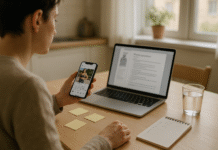
- Open your notes app or a paper card.
- Template: “Today I appreciated [specific action]. It helped me [impact]. Thank you for [quality].”
- Examples: a colleague’s quick fix, a neighbor’s small kindness, a parent’s check-in.
4.2 Guardrails
- Keep it short (3–5 lines).
- Avoid late-night texting; finish the note and put the phone away to protect your sleep window.
Synthesis: A brief, unsent thank-you elevates mood without screen disruptions, priming a calmer mind for sleep.
5. Pair a Sleep Mantra with Slow Breathing
Short, believable affirmations (mantras) paired with slow breathing calm the nervous system and refocus attention. Sleep Foundation suggests using realistic statements (e.g., “Breathing out, I release the day,” or “I’m grateful for this quiet”) and warns against grandiose claims your brain won’t buy. Breathing practices—especially diaphragmatic breathing—can support relaxation; repeating a gratitude-flavored mantra on each exhale integrates the cognitive and physiological benefits. For some, paradoxical intention (“I’ll gently stay awake”) helps release performance anxiety about sleep.
5.1 How to do it (4–6 minutes)
- Sit or lie down; one hand on your belly.
- Choose a short mantra you actually believe.
- Inhale through your nose 4–5 seconds; exhale slightly longer.
- On each exhale, whisper the mantra (or say it mentally).
- After 20–30 breaths, let the words fade; stay with the breath.
5.2 Common mistakes
- Unrealistic affirmations (“I always fall asleep instantly”) can backfire; keep it plausible.
- Phone-based apps in bed: if screens stimulate you, do the practice off-device and then return to bed.
Synthesis: A believable gratitude mantra anchored to slow breathing reduces arousal, quiets looping thoughts, and eases the drop into sleep.
6. Keep a Gratitude Jar (One Slip, Every Night)
A tactile ritual—writing one thankful moment on a small slip and dropping it into a jar—gives your brain a satisfying “completion cue” at the end of the day. The jar becomes a physical archive you can skim on rough nights to spark sleepy, positive imagery. This habit also minimizes over-typing on phones after lights out. While the jar itself hasn’t been trialed independently, gratitude listing and journaling consistently show mental-health benefits across randomized trials; the jar is a simple way to keep the behavior friction-free.
6.1 Mini-checklist
- Keep jar, pen, and slips on the nightstand.
- Write one sentence; avoid analysis paralysis.
- If you miss a night, don’t repay the “debt”—resume with one slip the next evening.
6.2 Why it works
- Cue-routine-reward: the drop sound becomes your nightly “done” bell.
- Future benefit: reading past slips can quickly rekindle positive pre-sleep cognitions, which relate to better sleep.
Synthesis: The jar makes gratitude automatic and screen-free, delivering a reliable wind-down cue your brain learns to trust.
7. Do “Constructive Worry” with a Gratitude Reframe
If worry hijacks bedtime, try constructive worry—a CBT-I technique where you schedule an earlier-evening slot to list worries and one next step for each, so bed stays a worry-free zone. To finish on a calming note, add one line of appreciation (“One thing that still went okay today was…”). Clinicians like Dr. Colleen Carney provide worksheets for this method; research on CBT-I and related cognitive strategies shows it reduces pre-sleep arousal and sleep-onset worry. The gratitude add-on tempers the problem-solving tone and helps your mind feel safer powering down.
7.1 How to do it (10–12 minutes, not in bed)
- Set a worry time 2–3 hours before bedtime.
- For each worry, write a one-sentence definition and a next step (or “park until tomorrow”).
- Close with one appreciative line about something that went fine despite the worry.
- Fold the page, put it away; if thoughts reappear at bedtime, remind yourself the plan is parked for tomorrow.
7.2 Guardrails
- Keep it earlier in the evening so you don’t re-activate your mind right before sleep.
- If worries return in bed, don’t problem-solve—use your mantra or body scan instead.
Synthesis: Moving problem-solving out of the bedroom and ending with appreciation quiets mental noise and preserves your bed-sleep association.
8. Build a One-Minute “Gratitude Tour” of Your Day
Right before lights out, take sixty seconds to replay the day in quick scenes—morning to evening—pausing on 2–3 neutral-to-pleasant micro-moments (the first sip of tea, sunlight on the wall, finishing a small task). Say a silent “thanks” for each. This rapid, top-of-mind tour interrupts catastrophizing and reinforces the link between ordinary moments and contentment. Positive pre-sleep cognitions are a plausible pathway through which gratitude relates to sleep quality and duration; end the tour with one breath and a soft “goodnight.”
8.1 Tips
- Keep expectations low; this is a skim, not a deep reflection.
- If your brain fixates on a negative scene, note it neutrally and move on to the next frame.
- Pair with a consistent lights-out time to anchor your circadian rhythm.
Synthesis: A swift, thankful recap replaces mental doom-scrolling with gentle closure, priming you for easeful sleep.
9. Set a “Gratitude Intent” for Tomorrow (Then Sleep on It)
Close your routine by choosing one small act of appreciation you’ll do tomorrow (e.g., send a two-line thank-you, tip generously, bring a colleague coffee). This forward-looking intention gives your mind a positive, concrete plan to “hold,” which can paradoxically make it easier to let go tonight—especially when combined with adequate sleep. Emerging evidence suggests sleeping a bit longer can increase feelings of gratitude and resilience, and people who feel more grateful show fewer negative pre-sleep thoughts. Treat sleep as the soil and gratitude as the plant; nurturing one supports the other.
9.1 How to do it (1 minute)
- Write a single action you’ll take by noon tomorrow.
- Visualize it briefly; smile (yes, it helps encode the intention).
- Put the note where morning-you will see it.
Synthesis: Ending with tomorrow’s tiny thank-you aligns intention with rest; better sleep and gratitude can reinforce each other in a healthy loop.
FAQs
1) Do nightly gratitude routines really help you sleep, or is it placebo?
There’s real signal beneath the feel-good vibe. A 2009 study found that higher gratitude predicted better subjective sleep quality and shorter sleep latency, explained by more positive pre-sleep thoughts. A randomized experiment showed a two-week gratitude intervention improved sleep quality versus controls. The evidence base is still growing and sometimes mixed across measures, but the low-risk nature of these habits makes them worth trying alongside good sleep hygiene.
2) How long should a bedtime gratitude routine take?
5–15 minutes is plenty. You’re creating a cue that signals “day is done.” Keep practices short, repeatable, and off-screen. The key is consistency—same steps, same order—paired with a stable bedtime and waking time to reinforce your body clock.
3) What if I can’t think of anything to be grateful for on a hard day?
Zoom in to the micro-level: a warm shower, a clean pillowcase, finishing a chore. Research-backed exercises like “Three Good Things” specifically emphasize small, specific positives; the point is practicing attention, not pretending everything is perfect. Greater Good in Action
4) Is it better to journal digitally or on paper at night?
Paper wins near bedtime because screens and bright light can nudge your brain awake. If you must use a device, switch to night mode, dim the brightness, and set a five-minute cap. Keep the bed itself screen-free to protect your bed-sleep association.
5) I worry in bed—won’t gratitude avoid the real problems?
Don’t skip problem-solving; schedule it earlier using constructive worry, then end with a brief gratitude note to settle the mood. This approach respects real-world concerns while preventing bedtime from becoming a planning meeting. drcolleencarney.com
6) Do I need to do all nine practices?
No. Pick one or two that feel natural and run a 14-night experiment. Track how long it takes to fall asleep and how you feel on waking. Adjust based on what’s actually helping. The best routine is the one you’ll repeat.
7) Can teens or older adults use these routines?
Yes—with age-appropriate tweaks. Keep steps shorter for teens; for older adults, pair the routine with a wind-down that addresses comfort (warmth, pain management) and a consistent schedule. If chronic insomnia is present, talk to a clinician; CBT-I is first-line care.
8) What if I wake up at 3 a.m. with my mind racing?
Don’t fight the clock. Get out of bed after ~20 minutes, keep lights low, and do a light, off-screen version of your routine (e.g., reread yesterday’s “Three Good Things” or add a slip to your gratitude jar). Return to bed when sleepy.
9) Are there any nights I should skip gratitude?
Skip only if the ritual feels activating (e.g., drafting an emotional letter at 11 p.m.). In those cases, switch to shorter, purely somatic steps (breath + body scan) and save reflective writing for earlier in the evening. PMC
10) Can sleeping more actually increase gratitude?
Possibly. A 2024 analysis highlighted that extending sleep by ~46 minutes improved mood and gratitude; conversely, sleep restriction reduced gratitude and prosocial feelings. Better sleep may build the emotional resources that make gratitude easier.
Conclusion
Your brain loves patterns. When your nights follow a gentle, repeatable sequence—dim lights, write three good things, offload tomorrow, breathe slowly—you teach your nervous system that the day is complete. Gratitude practices are not magical thinking; they are attention-training drills that crowd out unhelpful pre-sleep loops and deepen the sense of safety that makes sleep possible. Evidence suggests gratitude can influence sleep via more positive pre-sleep cognitions, while structured steps like a specific to-do list measurably shorten sleep-onset time. Anchor these with core sleep hygiene—consistent bed/wake times, low light, and a device-free bedroom—and you’ll compound the gains night after night. Start small, stay steady for two weeks, and let your jar of slips, pages of short entries, and calmer mornings convince you.
Tonight’s next step: choose one routine, set a 5–10 minute timer, and practice. Tomorrow morning, notice the difference—and keep going.
References
- Jackowska, M., Brown, J., Ronaldson, A., & Steptoe, A. “The impact of a brief gratitude intervention on subjective well-being, biology and sleep.” Journal of Health Psychology. 2016 (Epub 2015 Mar 2). PubMed
- Wood, A. M., Joseph, S., Lloyd, J., & Atkins, S. “Gratitude influences sleep through the mechanism of pre-sleep cognitions.” Journal of Psychosomatic Research. 2009. PubMed
- Pires, G. N., et al. “The effects of gratitude interventions: a systematic review and meta-analysis.” Frontiers in Psychology. 2023. PMC
- Sleep Foundation. “Sleep Affirmations.” (Updated July 16, 2025). Sleep Foundation
- American Academy of Sleep Medicine—Sleep Education. “Healthy Sleep Habits.” (Reviewed Aug 2020). Sleep Education
- Sleep Education (AASM). “Sleep and gratitude: The secret to a happier, healthier life.” (Nov 6, 2024). Sleep Education
- Baylor University News. “Snooze Your Way to Well-Being: Baylor Study Finds 46 Extra Minutes of Sleep Boosts Gratitude and Resilience.” (Nov 4, 2024). Baylor News
- Scullin, M. K., et al. “The effects of bedtime writing on difficulty falling asleep: A polysomnographic study comparing to-do lists and completed activity lists.” Journal of Experimental Psychology: General. 2018;147(1):139-146. PubMed
- Walker, J., et al. “Cognitive Behavioral Therapy for Insomnia (CBT-I): A Primer.” Current Sleep Medicine Reports. 2022. PMC
- Carney, C. E. “Constructive Worry Worksheet.” (Resource page). drcolleencarney.com