

























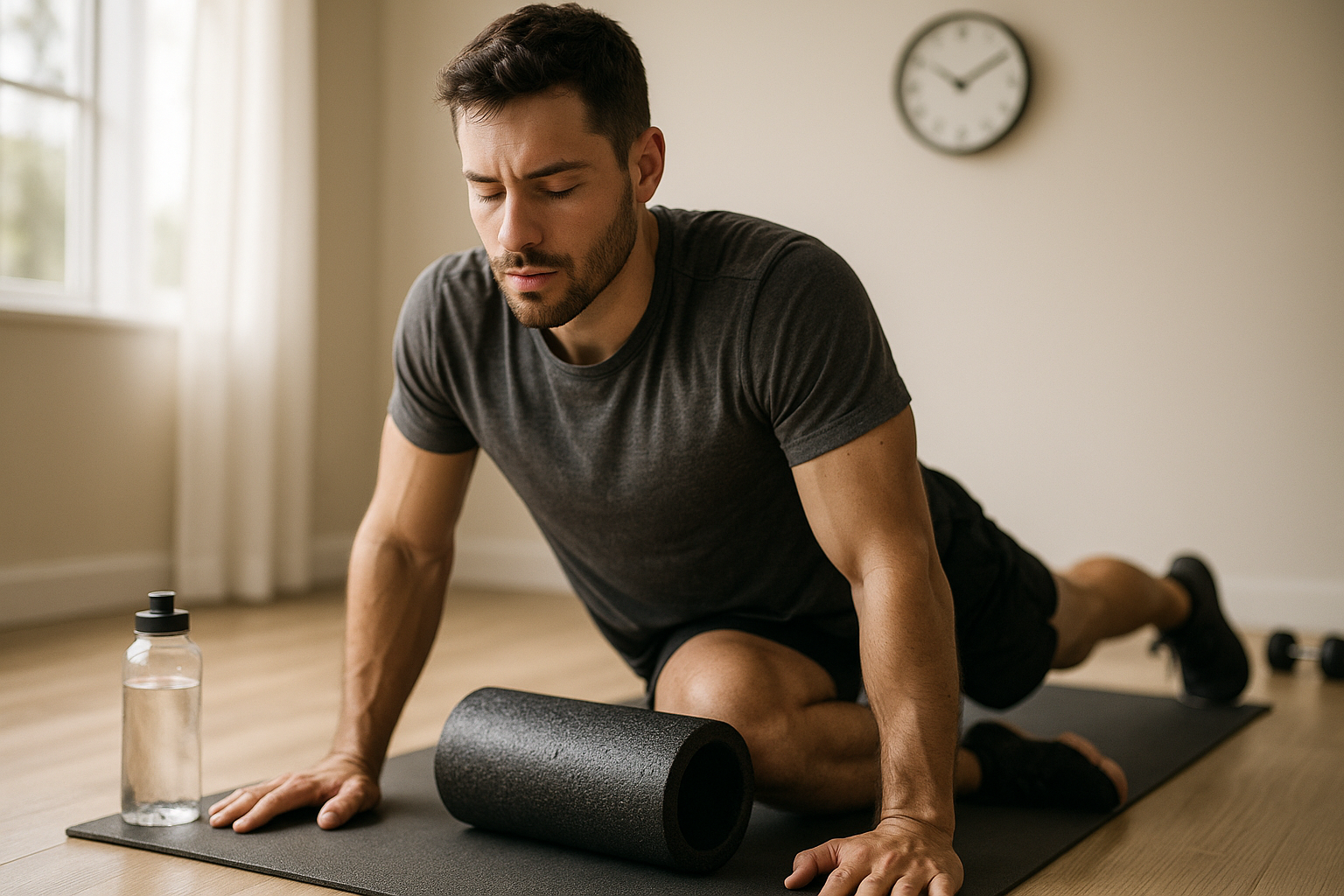
Foam rolling is a simple, research-backed way to ease post-workout soreness and restore comfortable movement. In practice, it’s a form of self-myofascial release: you apply bodyweight over a roller (or similar tool) to coax tense tissue to relax and to improve joint range of motion. For muscle recovery, the short answer is: roll major muscle groups for 30–120 seconds each at a slow, steady pace, focusing on tender spots without pushing into sharp pain. Meta-analyses show small but meaningful improvements in range of motion and soreness with no consistent harm to performance when used properly.
Quick safety note: This guide is educational and not a medical diagnosis. If you have an acute injury, circulatory issues (e.g., DVT/varicose veins), are pregnant, or have a condition affecting bone or skin integrity, check with a clinician before rolling; avoid rolling over joints, bony areas, or the lumbar spine directly.
1. The 5–10 Minute Global Protocol (Timing, Pressure, and Cadence)
The fastest way to make foam rolling work for recovery is to keep it short, specific, and gentle. A total session of 5–10 minutes, split across the day’s most-used muscles, is enough for most people. Aim for roughly 30–90 seconds per muscle, moving at about 2–3 cm (≈1 in) per second, pausing for a few breaths on tender spots, then moving on. Use light-to-moderate pressure—intense discomfort isn’t necessary and sharp or nerve-like pain means stop. For post-workout recovery, rolling fits best after exercise or in a separate easy session; before workouts, brief bouts may help mobility without harming performance for most.
1.1 Why it matters
Across systematic reviews and meta-analyses, foam rolling reliably increases short-term range of motion and can reduce perceived muscle soreness after hard sessions, with neutral-to-trivial effects on most performance measures. That means you can move more freely without compromising your next workout. Chronic (multi-week) programs may also improve ROM, especially when done for more than four weeks, though benefits vary by muscle group.
1.2 How to do it (mini-checklist)
- Total time: 5–10 minutes per session.
- Per muscle: 30–90 seconds; pause 10–20 seconds on a tender spot, then move on.
- Cadence: ~1 inch (2–3 cm) per second; steady, unhurried.
- Pressure: light to moderate; never into sharp pain or tingling.
- Frequency: after training or on rest days; brief warm-up rolls are fine if they feel good.
1.3 Numbers & guardrails (as of August 2025)
- Acute ROM: small-to-moderate gains immediately after rolling.
- Soreness: small reductions in DOMS over 24–72 hours.
- Performance: generally unchanged or trivially improved; no consistent decrements.
- Long-term ROM: more likely after >4 weeks, muscle-dependent.
Bottom line: a short, well-paced session provides the most recovery for the least time cost.
2. Calves (Gastrocnemius & Soleus)
Calf tightness can limit ankle dorsiflexion, affect squatting mechanics, and increase stress on the Achilles and plantar tissues. Foam rolling the calves helps reduce tenderness and restore comfortable ankle motion without needing loaded stretching when you’re sore. Start sitting on the floor with the roller under one calf; lift the hips slightly to control pressure and roll from above the Achilles to just below the knee. When you find a tender band, pause and breathe for 10–20 seconds, then continue. If needed, stack the other leg to increase pressure, but keep pain tolerable and avoid the back of the knee. Evidence suggests acute ROM improvements are common, and soreness relief is achievable with short bouts.
How to do it
- Set up: Sit with hands behind you, roller under one calf.
- Path: Slow rolls from mid-Achilles to just below the knee; rotate the leg to hit medial/lateral calf.
- Dose: 30–60 seconds per side; 1–3 passes.
- Tender spots: Pause for 2–3 gentle breaths, then move on.
- Progression: Add a small ankle pump while paused to mobilize tissue.
Numbers & guardrails
- Pace: ~1 in/sec; pressure light-moderate.
- Sensation: dull pressure OK; sharp pain or tingling—stop.
- Tip: If dorsiflexion is still limited, combine with gentle calf stretching after rolling. Short-term ROM gains with rolling are consistent across muscles.
Rolled calves should feel warm and less “ropey,” improving ankle comfort for walking or squatting.
3. Hamstrings
Sore or stiff hamstrings can tug on the pelvis and limit hip hinge patterns. Foam rolling can down-regulate sensitivity and improve tolerable range, especially after deadlifts or sprints. Sit with the roller under a hamstring, prop your hands behind you, and roll from just above the knee to the sit bone (ischial tuberosity) without pressing directly into the bone. Rotate inward and outward to catch medial and lateral fibers. Brief pauses on tender spots and small knee bends while paused can be helpful. Meta-analyses report ROM gains after foam rolling; pair with easy mobility drills as soreness fades.
How to do it
- Path: Lower hamstring to upper hamstring; avoid direct pressure on the sit bone.
- Dose: 45–90 seconds per leg; 1–2 passes.
- Add-on: While paused on a hotspot, gently extend/flex the knee 3–5 times.
- Option: Use a softer roller if hamstrings are very sensitive.
Numbers & guardrails
- Pre-workout: Short bouts usually don’t harm performance.
- Post-workout: Helps reduce perceived soreness.
- Long-term ROM: possible with multi-week practice, muscle-dependent.
Expect an easier hip hinge and less “pull” at the back of the thigh after this sequence.
4. Quadriceps
The quads take a beating from squats, lunges, and cycling. Rolling can ease the “cement legs” feeling and improve knee comfort by addressing the front thigh and the outer quad (vastus lateralis). Lie face down with the roller under one thigh. Support yourself on forearms, keeping the core gently braced. Sweep from just above the knee to the hip crease. Spend extra time on the outer third of the thigh, rotating slightly inward to find tender bands. Evidence supports short-term ROM gains from foam rolling and a reduction in post-exercise soreness.
How to do it
- Path: Above knee to hip crease; rotate to target outer and inner quad.
- Dose: 60–90 seconds per leg.
- Tender spots: Pause 10–20 seconds; add a small knee bend/straighten while paused.
- Finish: A few gentle heel-to-glute bends to test comfort.
Numbers & guardrails
- Pressure: Start moderate; if breath holds or pain spikes, reduce pressure.
- Pace: ~1 in/sec.
- Performance: Neutral to trivial changes when used pre-workout; fine after workouts.
You should stand up feeling lighter through the knees with less front-thigh stiffness.
5. Glutes & Deep Rotators (Including Piriformis)
Tight or sore glutes and deep rotators can make sitting and hip rotation uncomfortable. Foam rolling here targets a dense area of muscle and tendons around the back of the hip. Sit on the roller with one ankle crossed over the opposite knee; lean toward the crossed leg side to expose the gluteal fibers. Roll slowly over the back-outer hip, pausing where you feel tender, then breathe and let the muscle soften. This area responds well to gentle, patient pressure and can ease hip-related low back tension indirectly. Research indicates foam rolling reduces perceived soreness and improves hip ROM without negative performance effects.
How to do it
- Set up: Sit on roller; cross right ankle over left knee; lean into right glute.
- Path: Back-outer hip, top of pelvis to upper hamstring; avoid direct sacrum pressure.
- Dose: 45–90 seconds per side.
- Add-on: Small hip external/internal rotations while paused.
Numbers & guardrails
- Sensation: broad pressure; avoid nerve-like zings down the leg.
- Option: A massage ball against a wall offers more precision on deep hotspots.
A well-rolled glute feels “roomier,” often easing hip rotation and even making long sits more tolerable.
6. Adductors (Inner Thigh)
Adductors can get cranky from lateral work, lunges, and skating motions. Rolling the inner thigh frees hip motions like deep squats and lateral shifts. Lie face down with the roller parallel to your torso. Bend one knee and place the inner thigh over the roller near the groin (not on it), then sweep toward the knee. Keep the spine neutral and support yourself on forearms. Because this area is sensitive, start with minimal pressure and keep the pace slow. Foam rolling is associated with improved short-term ROM; adductors often respond quickly.
How to do it
- Path: From high inner thigh (avoid groin) toward knee.
- Dose: 45–75 seconds per side; 1–2 passes.
- Tender spots: Pause and breathe; gently straighten/bend the knee.
Numbers & guardrails
- Privacy & clothing: Use thicker fabric to reduce friction.
- Pressure: Err on the lighter side; the tissue is sensitive.
- Combine with: Adductor rock-backs or side lunges after rolling.
Expect easier side-to-side movement and more comfortable deep squats.
7. TFL & Lateral Thigh (IT Band Region—With Care)
The iliotibial (IT) band itself is a tough tendon-like structure; direct, aggressive rolling over it rarely helps and can be sore for no gain. Instead, target the tensor fasciae latae (TFL) at the front-outer hip and the vastus lateralis (outer quad). Lie on your side with the roller just in front of the hip bone. Cross the top leg over for balance, roll slowly a few inches up and down to find tender bands, and pause. Then rotate slightly forward to cover the outer quad from hip to knee. Keep pressure moderate and avoid grinding over the outside of the knee. Evidence supports using foam rolling for lateral thigh comfort and ROM, but technique matters.
How to do it
- Focus zones: Front-outer hip (TFL) and outer quad (vastus lateralis).
- Dose: ~60 seconds TFL + ~60 seconds outer quad per side.
- Tender spots: Pause 10–20 seconds; add small knee bends on outer quad.
- Avoid: Direct, hard pressure over the lateral knee.
Numbers & guardrails
- Pressure: Medium at most; breathe throughout.
- Pair with: Lateral hip strengthening and gentle stretching for lasting change.
Proper targeting reduces “band” tightness feelings without irritating the knee.
8. Hip Flexors (Front Hip)
Long sitting, running, and cycling leave the front of the hip feeling tight and sore. Rolling here can ease the area around rectus femoris and the upper quadriceps near the hip crease. Lie face down with the roller under the upper front thigh of one leg. Support on your forearms and the opposite knee. Sweep from just below the hip bone down several inches. Because sensitive structures live nearby, keep pressure mild and avoid rolling directly over the bony front of the pelvis. Brief pauses and small knee bends while paused help signal the tissue to relax, improving hip extension comfort.
How to do it
- Path: Hip crease downward ~10–15 cm; stay on soft tissue only.
- Dose: 45–60 seconds per side; 1–2 passes.
- Add-on: While paused, gently pull heel toward glute 3–5 times.
Numbers & guardrails
- Sensation: pressure with mild ache; avoid sharp/pinching pain.
- Combine with: Easy hip flexor stretch after rolling for added ROM.
The payoff is smoother hip extension for walking, running, and split-stance work.
9. Thoracic Spine (Mid/Upper Back—Avoid the Low Back)
Foam rolling shines for the mid- and upper-back. It can reduce the “desk hunch” feeling and make pressing and overhead work feel freer. Lie on your back with the roller under your mid-back, hips down or slightly lifted. Support your head with hands, elbows in. Roll from the bottom of the ribcage to just below the base of the neck, pausing to take a slow breath or two at tender or stiff segments. You can also do small thoracic extensions over the roller by gently leaning back, exhaling, and returning to neutral. Avoid rolling the lumbar spine directly; instead, work glutes and upper back to calm the area.
How to do it
- Path: Lower ribs to upper thoracic region; keep ribs down and core lightly braced.
- Dose: 60–90 seconds total with 2–3 extension breaths at 1–2 spots.
- Options: Hips on floor for light pressure; hips off floor for more.
Numbers & guardrails
- Avoid: Direct rolling on the low back (lumbar).
- Pace: Slow; pause and breathe at stiff spots.
- Pair with: Open-book rotations or wall slides after rolling.
Expect easier overhead reach and a lighter, more open posture.
10. Lats (Latissimus Dorsi)
Sore lats restrict overhead mobility and pulling comfort. Rolling the side of the torso under the armpit can release tension that pulls the shoulder down and forward. Lie on your side with the bottom arm overhead and the roller placed just below the armpit on the ribcage. Roll a short zone (5–10 cm), rotating a few degrees forward/back to find the band that feels “ropey.” Pause and breathe, allowing the side body to sink onto the roller. NASM’s practical guidance suggests holding tender spots for 30–90 seconds until discomfort eases.
How to do it
- Path: Below armpit along side-body; avoid direct pressure on ribs if sharp.
- Dose: 45–75 seconds per side; 1–2 passes.
- Add-on: While paused, slowly sweep the top arm from overhead to front 3–5 times.
Numbers & guardrails
- Sensation: Dull, spreading pressure; avoid stabbing rib pain.
- Progression: Use a softer roller or a ball at the wall for precision if needed.
Freer lats often translate to better overhead position and less shoulder tug.
11. Chest/Pecs (With a Small Roller or Ball at the Wall)
Tight pecs can round the shoulders and limit overhead reach. While a long foam roller is awkward here, a short mini-roller or massage ball against a wall works beautifully and still counts within your foam-rolling toolkit. Stand facing a wall, place the tool just inside the front of your shoulder, and lean gently. Sweep small circles or short up-down strokes across the pec major, then shift slightly inward to find the pec minor area below the collarbone. Keep pressure light; this tissue can be sensitive. Short bouts can quickly ease the “chest clamp” feeling after push-ups or presses.
How to do it
- Tool: Mini foam roller or massage ball.
- Path: Shoulder front toward sternum; then under collarbone.
- Dose: 30–60 seconds per side; 1–2 passes.
- Add-on: While paused, slide the arm up a wall as if making a snow-angel.
Numbers & guardrails
- Avoid: Direct pressure on the bony sternum or collarbone.
- Keep pressure light; ribs and nerves are close by.
Expect your shoulders to settle back and pressing positions to feel smoother.
12. Plantar Fascia (Foot) With a Mini Roller or Ball
The feet quietly absorb thousands of steps per day; a quick roll can ease stiffness that echoes up the chain into calves and hamstrings. Sit or stand with a small foam foot roller or firm ball under the arch. Roll from the heel pad to the ball of the foot, covering medial and lateral lines. Spend extra breaths where the tissue feels gritty. Keep the pressure tolerable and avoid pushing on bony prominences. This technique is especially helpful after runs, long walks, or days in stiff shoes.
How to do it
- Tool: Small foam roller or firm ball.
- Path: Heel to ball of foot, inside and outside lines.
- Dose: 45–60 seconds per foot.
- Add-on: Toe splay and ankle circles after rolling.
Numbers & guardrails
- Sensation: Mild ache OK; sharp heel pain—stop and consult a clinician if persistent.
- Pair with: Calf rolling and gentle calf stretching for best results.
Light, quick foot work often makes the whole lower chain feel more supple.
FAQs
1) Does foam rolling actually work for muscle recovery?
Yes—systematic reviews and meta-analyses report small but real reductions in perceived soreness (DOMS) and consistent short-term increases in range of motion without harming performance for most people. Benefits are modest, but the time cost is low, making rolling a useful adjunct to sleep, nutrition, and active recovery.
2) How long should I roll each muscle?
Most practical protocols fall between 30 and 90 seconds per muscle, with total sessions lasting about 5–10 minutes. Pausing for one to two slow breaths on a tender spot, then moving on, is more effective than grinding one area for several minutes. A pace of about 1 inch (2–3 cm) per second works well for control and comfort.
3) Is foam rolling better before or after a workout?
You can do both. Short pre-workout bouts can improve mobility without impairing strength or power for most people; post-workout or separate-session rolling is ideal for easing soreness and calming the nervous system. Choose the timing that matches your goal that day—movement quality vs. recovery.
4) What’s the difference between a soft and hard roller?
Softer rollers distribute pressure and feel gentler—great if you’re new or sensitive. Firmer or textured rollers concentrate pressure for deeper sensation. There’s no universal “best”; pick the least-painful tool that lets you relax and breathe while staying on soft tissue (not bones/joints). Evidence focuses on outcomes more than specific densities.
5) Should I roll the IT band directly?
Aggressively smashing the IT band (a sturdy fascia) is often unhelpful and sore. Instead, target the TFL (front-outer hip) and vastus lateralis (outer quad) that attach to and influence the band; this tends to reduce “band tightness” more comfortably. Keep pressure moderate and avoid the lateral knee.
6) Can vibration foam rollers speed results?
Vibration rollers may produce similar or slightly greater range-of-motion gains in some studies, and many users find them more comfortable at a given pressure. They’re optional—benefits come primarily from dosing (time, cadence, pressure) and consistency.
7) What are the main safety do’s and don’ts?
Stay on soft tissue, avoid rolling directly over joints and the lumbar spine, and skip any area that produces sharp, shooting, or nerve-like pain. People with conditions such as active DVT, significant varicose veins, bleeding disorders, or certain pregnancy-related concerns should consult a clinician first. Don’t use on open wounds, infected skin, or acute injuries.
8) How often should I foam roll?
2–5 sessions per week is common. For long-term mobility gains, consistency over several weeks matters more than marathon sessions. Meta-analytic data suggest programs longer than four weeks can increase ROM in some areas, though results vary by muscle.
9) Is foam rolling better than stretching?
They’re complementary. Compared head-to-head, foam rolling and stretching show similar small effects on performance, while both can improve ROM acutely. Many people prefer a quick roll followed by dynamic movement, then gentle stretching once soreness fades. Frontiers
10) Can foam rolling make me weaker before lifting?
Unlike long static stretches that sometimes reduce peak force briefly, foam rolling alone hasn’t shown consistent strength decrements in the short term. Keep pre-workout rolling brief and follow it with your normal dynamic warm-up.
11) What cadence should I use?
Slow enough to feel texture but not so slow you brace or hold your breath—about 1 inch (2–3 cm) per second is a practical target. Pause briefly on tender spots, breathe, then continue. A metronome app at 60 bpm (one inch per beat) can help.
12) What if rolling hurts a lot or leaves bruises?
Back off the pressure, switch to a softer roller, or roll against a wall to offload bodyweight. Soreness that lingers or bruising are signs you did too much. Mild discomfort is normal; pain isn’t the goal. If pain persists, consult a professional. ACE Fitness
Conclusion
Foam rolling is a small investment that often pays back with smoother movement and less next-day stiffness. The key is smart dosing: 5–10 minutes total, 30–90 seconds per muscle, slow cadence, and gentle pauses on tender spots—always staying on soft tissue and away from joints and the low back. Meta-analyses and expert guidance converge on the same message: rolling can nudge range of motion up and soreness down without sabotaging your performance, especially when paired with simple mobility work and enough sleep, protein, and hydration. Make it a recovery habit you can actually keep—brief, specific, and relaxed.
Try this tonight: pick three muscles you hammered today (e.g., quads, lats, calves), roll each for 60–90 seconds, breathe on two tender spots, then do 30 seconds of easy mobility. Notice how you move tomorrow—then repeat what works.
Ready to move better with less soreness? Commit to 5 minutes of rolling after your next workout and feel the difference.
References
- Wiewelhove T., et al. “A Meta-Analysis of the Effects of Foam Rolling on Performance and Recovery.” Sports Medicine, 2019. and full text: PubMedPMC
- Cheatham S.W., et al. “The Effects of Self-Myofascial Release Using a Foam Roll or Roller Massager on Joint Range of Motion, Muscle Recovery, and Performance: A Systematic Review.” International Journal of Sports Physical Therapy, 2015. PMC
- Wilke J., et al. “Acute Effects of Foam Rolling on Range of Motion in Healthy Adults: A Systematic Review with Multilevel Meta-analysis.” Sports Medicine, 2020. PubMed
- Konrad A., et al. “Foam Rolling Training Effects on Range of Motion.” Sports Medicine, 2022. SpringerLink
- Park S-J., Lee S-I. “Effect of Vibration Foam Rolling on the Range of Motion in Healthy Adults: A Systematic Review and Meta-analysis.” Journal of Exercise Rehabilitation, 2021. PMC
- NASM. “Foam Rolling: Applying the Technique of Self-Myofascial Release.” (Practical guidance with 30–90 s holds). and blog summary: NASMNASM Blog
- UCSF Cardiac Rehab. “A Road Map to Effective Muscle Recovery.” (Cadence guideline ~1 inch/sec; 30–60 s total). cardiacrehab.ucsf.edu
- ACE. “Foam Rolling 101” (Avoid lumbar rolling; general safety). 2015. ACE Fitness
- Bartsch K.M., et al. “Expert Consensus on the Contraindications and Cautions of Foam Rolling—An International Delphi Study.” International Journal of Environmental Research and Public Health, 2021. PMC
- Cheatham S.W. “How to Use a Foam Roller.” NASM blog overview with time ranges (5–10 min total; 30 s–2 min per muscle). NASM Blog
- Skinner B., Moss R., Hammond L. “A Systematic Review and Meta-analysis of the Effects of Foam Rolling on Range of Motion, Recovery and Markers of Athletic Performance.” Journal of Bodywork & Movement Therapies, 2020. ScienceDirect
- Schroeder A.N., et al. “Is Self-Myofascial Release an Effective Pre-exercise and Recovery Strategy?” Sports Health, 2015. europepmc.org