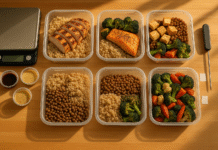




















If you want meal prep that’s fast, safe, and consistently delicious, the smartest move is to build a small, dependable toolkit. The right containers, storage bags, and kitchen gadgets don’t just save time—they protect food quality, control portions, and reduce waste. Below you’ll find the 10 essential meal prep tools that cover cooking, cooling, storing, and reheating without fuss. Essential meal prep tools are the core containers, storage bags, and kitchen gadgets that let you batch-cook, cool quickly, and store food safely and efficiently for the week. Used well, they help you prep once and eat well for days.
Quick start (five steps): pick a durable container set; add silicone bags for flexible storage; cook in big batches on sheet pans; label and date everything; keep the fridge at or below 4 °C/40 °F and reheat leftovers to safe internal temperatures (see References).
Note: Food-safety rules can vary by country; always confirm local guidance where you live.
1. Airtight Glass Containers (Multi-Size Set)
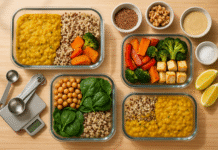
Glass containers are the safest, most versatile base for meal prep because they handle cold, heat, and stains while sealing tightly to protect flavor. Start with a mixed set that includes 1-cup (240 ml), 2-cup (470 ml), and 4-cup (950 ml) capacities plus a few larger 6–7-cup (1.4–1.6 L) options for family-size batches. Their weight and rigidity prevent accidental crushing in the fridge, and most are oven-safe (bases only), which makes reheating straightforward. When you portion hot food into shallow glass containers, it cools faster—helpful for keeping food out of the 4–60 °C (40–140 °F) “danger zone.” Lids should be fully airtight and leak-resistant; gasketed, locking styles travel well and limit odors.
- How to choose:
- Prioritize borosilicate or tempered glass bases rated for oven use (check manufacturer limits).
- Get lids with a silicone gasket and robust latches; look for a stackable profile.
- Mix shapes: rectangular for mains and grains, round for soups and sauces.
- Buy extras of the sizes you use weekly (often 2-cup and 4-cup).
- Mini checklist:
- Fit test: do two stacks fit on a single fridge shelf?
- Vents: microwave vents in lids reduce splatter.
- Spares: keep two spare lids for your most-used size.
Why it matters
Airtight glass minimizes oxygen exposure (slowing staling and oxidation) and tolerates reheating without warping. For food safety, shallower layers dissipate heat quickly in the fridge; plan 3–4 days for most cooked leftovers at ≤4 °C/40 °F, or freeze for longer quality (see References). Glass also avoids lingering stains and odors from tomato sauces or curries, making sanitation simpler.
Numbers & guardrails
- Typical “one meal” capacity: 2–3 cups (470–700 ml).
- Leftovers: generally 3–4 days refrigerated; reheat to 74 °C/165 °F when in doubt.
- Space: 10–12 pieces (bases + lids) are enough for a week of lunches for two.
Bottom line: A varied set of airtight glass containers is the backbone of meal prep—safe reheating, quick cooling, and reliable seals make everything else easier.
2. Reusable Silicone Storage Bags
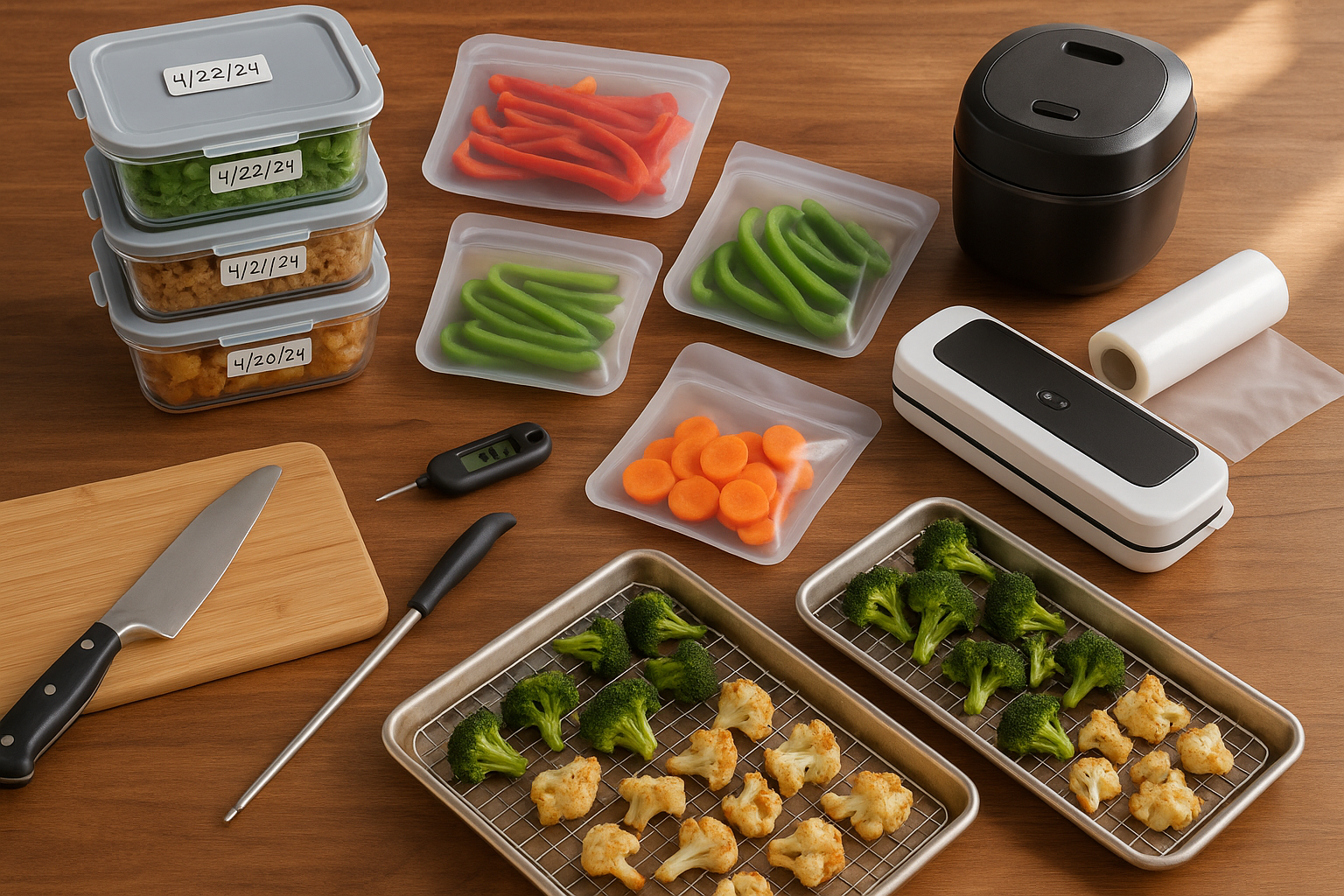
Reusable silicone bags add flexible, space-saving storage that containers can’t match. They stand up for filling, lie flat to freeze, and tuck into tight fridge corners. Use them for sliced veggies, marinated proteins (placed on a tray), freezer smoothie kits, or saucy items that might slosh in a rigid container. Quality bags are thick, heat-tolerant, and truly airtight when pressed and sealed, helping prevent freezer burn. They also reduce single-use plastic and are easy to wash by hand or on the top rack of a dishwasher.
- Tips for best results:
- Label the outside with a grease pencil or removable tape; add the date and contents.
- For freezing, remove excess air by partially sealing, pressing, then finishing the seal.
- Freeze bags flat on a sheet pan; once solid, file them vertically like books.
- Dedicate one bag for aromatics (onion/garlic) to avoid flavor transfer.
- Common mistakes:
- Overfilling to the zipper seam (causes leaks).
- Microwaving sealed bags (always vent first).
- Standing bags upright in the freezer (irregular freezing and leaks).
Why it matters
Silicone bags are a meal-prep “shape-shifter,” handling snacks, liquids, and awkward leftovers without taking extra space. Because they lie flat, food freezes and thaws faster and more evenly than in deep containers. They’re also ideal for portioning proteins or grains into single-meal pouches for quick defrost and cook-through.
Numbers & guardrails
- Core sizes: 1 snack (~250 ml), 1 sandwich (~450 ml), 1 quart (~950 ml), 1 half-gallon (~1.9 L) per person.
- Labeling cadence: write “use by” based on your typical 3–4-day fridge window or planned freezer rotation.
- Cleaning: a bottle brush and warm, soapy water prevent residue in corners.
Bottom line: Silicone bags round out your container set with flexible, freezer-friendly storage that packs flat, seals tight, and dramatically simplifies batch-prep logistics.
3. Compartmented Bento Boxes (Portion-Friendly Lunch Containers)
Bento-style containers with 2–3 compartments make it easy to balance meals and keep textures separate. They’re excellent for work or school lunches: grains stay fluffy, proteins keep their juices, and crunchy items remain crisp. Pick a layout that mirrors your usual plate—one larger compartment for mains (proteins + grains) and one or two smaller for vegetables, fruit, or sauces. A tight-fitting, single lid that seals all compartments minimizes leaks and speeds up packing.
- How to choose:
- Look for a main well ~2 cups (470 ml) plus side wells of ½–1 cup (120–240 ml).
- Prefer gaskets that seal each compartment; test with water before first use.
- Flat bottoms (not curved) keep portions even and are easier to pack.
- Consider weight if you commute—lighter plastics for travel, glass for home.
- Mini checklist:
- Separate sauce pots for dressings/hummus.
- Microwave-safe base (if you reheat at work).
- Stackable lids to save fridge space.
Why it matters
Visual compartments help you serve balanced meals consistently. A simple rule of thumb—half vegetables and fruits, the rest split between grains and protein—keeps portions in check and variety high (see MyPlate messaging in References). Compartmented boxes also prevent sogginess without extra packaging: salads stay crisp away from warm mains, and starches don’t absorb juices until you’re ready to eat.
Numbers & guardrails
- Weekly kit: 4–6 boxes per person will cover most office days with a buffer.
- Portion visual: large well for ~300–400 g of mains; sides for ~100–200 g each.
- Safety: pack cooked foods into the box once they’ve stopped steaming; refrigerate promptly.
Bottom line: Bento boxes turn portion balance into a no-brainer, keeping textures distinct and lunches satisfying without extra steps.
4. Half-Sheet Pans and Wire Cooling Racks
Half-sheet pans (18 × 13 in / 46 × 33 cm) and tight-mesh wire racks are the workhorses of batch cooking and safe cooling. One pan can roast two trays’ worth of vegetables, bake chicken thighs, toast nuts, or crisp tofu—often all on lined parchment for speedy cleanup. Wire racks nested inside pans improve air circulation, which promotes even roasting and allows foods to cool faster post-cook. Fast cooling matters because it reduces time in the “danger zone,” minimizing bacterial growth.
- How to use effectively:
- Roast at high heat (200–230 °C / 400–450 °F) for browning and moisture control.
- Space food with a finger’s width between pieces; use two pans instead of crowding.
- After cooking, spread food in a single layer and cool until steam subsides, then refrigerate.
- Line pans with parchment or a silicone mat for easy release and cleanup.
- Common mistakes:
- Deep piles of hot food in a single pan (slow cooling).
- Using small cookie sheets that warp at high heat.
- Skipping racks—drippings pool and steam instead of crisping.
Why it matters
Batch roasting concentrates flavor while freeing stovetop space for grains and sauces. The half-sheet standard fits most home ovens and refrigerators, so pans double as flat cooling “trays” to ferry food to the fridge. A rack over a pan also keeps meal-prep proteins elevated for crisp, even heat, then doubles for draining and cooling.
Numbers & guardrails
- Baseline kit: two half-sheet pans and two wire racks.
- Yield: a full pan of mixed veg (~1.5 kg / 3.3 lb) produces 4–6 side portions.
- Cooling: aim to get cooked foods into shallow containers and the fridge within 2 hours.
Bottom line: With two half-sheet pans and a pair of racks, you can roast, cool, and store at scale—cleanly and safely.
5. Vacuum Sealer (Plus Rolls/Bags)
A countertop vacuum sealer removes air from bags and heat-seals them, limiting freezer burn and extending quality for cooked proteins, blanched vegetables, and bulk buys. For meal prep, it shines when portioning proteins into single-use packs, marinating efficiently, or sealing cooked items for freezer storage. It also helps keep odors contained and prevents ice crystals from damaging texture.
- Best practices:
- Pre-freeze moist items on a sheet pan before sealing to keep seams dry.
- Leave a generous headspace (5–7 cm / 2–3 in) so the sealer can grip and seal properly.
- Label with contents and date; file bags flat for first freeze, then stand vertically.
- Use textured (embossed) rolls for better air removal with suction-style machines.
- Safety notes:
- Vacuum sealing does not make food shelf-stable; always refrigerate or freeze.
- Chill cooked foods before sealing to shorten time in the danger zone.
- For sous-vide reheating, ensure bags and seals are rated for the target temperature.
Why it matters
Removing air slows oxidation and freezer burn, preserving flavor and texture so your reheated meals taste fresher. Portioning raw proteins also reduces food waste—thaw only what you’ll cook. For frequent batch cookers, the time saved on portioning and the quality bump in frozen meals is substantial.
Numbers & guardrails
- Roll width: 20–28 cm (8–11 in) covers most portions.
- Batch size: sealing 1–1.5 kg (2–3 lb) of chicken into 4–6 single-meal pouches takes ~10 minutes once you’re set up.
- Rotation: use a “first in, first out” (FIFO) bin to eat the oldest sealed meals first.
Bottom line: A vacuum sealer is the freezer-quality multiplier—less air means better texture, longer quality, and less waste.
6. Instant-Read Digital Food Thermometer
An instant-read thermometer is the simplest way to guarantee safe, juicy results. Doneness is about temperature, not guesswork. When you pierce chicken, reheat casseroles, or check batch-cooked rice, temperature confirms both safety and consistency. Modern probes read in seconds and are small enough to live in your knife drawer, encouraging everyday use.
- What to look for:
- Fast read (≤3 seconds), clear display, and a thin probe tip.
- Waterproof or at least water-resistant construction for easy cleaning.
- A calibration or ice-water test mode is a bonus.
- Auto-hold or backlight for checking temps inside the oven.
- How to use:
- Insert into the thickest part of the food, avoiding bone or pan contact.
- For reheated leftovers, aim for 74 °C/165 °F throughout.
- Clean the probe with hot, soapy water between checks to prevent cross-contamination.
Why it matters
Safe minimum internal temperatures vary by food type, and hitting them consistently avoids both overcooking and risk. In meal prep, you’ll often cook large batches or reheat dense dishes; an instant-read removes uncertainty and protects both taste and safety.
Numbers & guardrails
- Poultry (all parts, ground): 74 °C/165 °F.
- Ground meats (beef/pork): 71 °C/160 °F.
- Whole cuts (beef/lamb/veal/pork): 63 °C/145 °F + 3-minute rest.
- Casseroles/reheated leftovers: 74 °C/165 °F.
Bottom line: The thermometer is your insurance policy—fast checks, safer food, and repeatable results every time.
7. Rice Cooker or Multicooker
A dedicated rice cooker or multicooker (with rice and pressure functions) turns staple carbs into a “set-and-forget” task. Brown rice, quinoa, farro, steel-cut oats—batch them while your oven handles proteins and vegetables. Many models include keep-warm modes and delay timers, letting you synchronize starches with roasts and stews. For kitchens with limited burners, this single tool frees space and attention.
- How to use for prep:
- Rinse grains (unless the package says otherwise) to reduce surface starch and foaming.
- Batch cook 4–6 cups dry (yields 8–12 cups cooked) for a week of sides and bowls.
- Portion hot grains into shallow containers for faster cooling, then refrigerate.
- Reheat with a splash of water in the microwave, covered and vented.
- Region notes:
- If you’re in a 220–240 V region, verify voltage compatibility; dual-voltage or local models avoid transformer hassles.
- Steaming baskets let you cook dumplings or vegetables on top of rice for energy efficiency.
Why it matters
Consistent, fluffy grains are the backbone of a lot of meal-prep meals. With a cooker, the texture is reliable, timing is predictable, and cleanup is easy. It also shines for beans and lentils, which pressure-cook quickly and store beautifully.
Numbers & guardrails
- Common ratios: white rice 1:1 to 1:1.25 (rice:water), brown rice 1:1.5 to 1:1.75; adjust per grain.
- Portion guide: ~½–1 cup (90–180 g) cooked grains per serving.
- Storage: cool quickly, refrigerate ≤4 °C/40 °F, and use within 3–4 days or freeze.
Bottom line: A rice or multicooker streamlines the starch side of meal prep, creating reliable bases that reheat well and round out balanced plates.
8. Chef’s Knife + Color-Coded Cutting Boards
A sharp 8-inch (20 cm) chef’s knife paired with two or more cutting boards (ideally color-coded) speeds prep and improves safety. Use one board for raw proteins and another for produce and ready-to-eat foods to prevent cross-contamination. The right knife makes uniform cuts, which cook evenly on your sheet pans and look better in bento boxes. Add a honing rod to keep edges aligned between sharpenings.
- Setup tips:
- Choose medium-grit (1000–2000) sharpening stone or use a professional service twice a year; hone weekly.
- Stabilize boards with a damp towel underneath; replace deeply scored boards that trap residue.
- Keep a small paring knife handy for trimming and peeling.
- Hygiene checklist:
- Wash boards with hot, soapy water; sanitize periodically (per local guidance).
- Designate one board for raw meat/poultry and another for produce.
- Air-dry upright; don’t stack wet boards.
Why it matters
Good knife work is the hidden time saver in meal prep. Even dice cooks uniformly; thinly sliced vegetables roast in the same time; consistent strips of chicken finish together. Separate boards reinforce safe habits: “raw” never touches “ready-to-eat.”
Numbers & guardrails
- Board sizes: 30 × 45 cm (12 × 18 in) for mains; 20 × 30 cm (8 × 12 in) for small tasks.
- Replacement: plastic boards with deep grooves should be replaced; wood boards get resurfaced as needed.
- Safety: wash hands and tools between raw and ready-to-eat tasks; keep sanitizer handy.
Bottom line: One sharp knife and two dedicated boards elevate speed, consistency, and food safety in every prep session.
9. Digital Kitchen Scale and Measuring Set
A compact digital scale paired with measuring cups and spoons turns portioning and recipes into a precise, repeatable system. Weighing cooked grains, proteins, and sauces ensures each container gets the same amount, which keeps macros and calories consistent if you track them—and prevents the “last box is tiny” problem. Scales also streamline recipe scaling (double or halve) without guesswork.
- How to integrate:
- Tare the container, then add components by weight in a simple pattern: 150 g grain, 150–200 g protein, 150–250 g vegetables per meal (adjust to your needs).
- Convert favorite recipes to grams for speed and accuracy.
- Use spoons for small items (spices, oils) to keep flavors consistent across batches.
- Mini checklist:
- Look for a 1-gram resolution, 5 kg (11 lb) capacity, and an easy-to-clean surface.
- Auto-off delay ≥3 minutes prevents shutdown mid-portion.
- Keep spare batteries or a USB-rechargeable model.
Why it matters
Consistency is the engine of meal prep. A scale makes it trivial to portion evenly, reducing over- or under-serving and ensuring predictable nutrition. It also reduces dishes: weigh directly into the storage container.
Numbers & guardrails
- Typical lunch macro split example: 40–60% carbs, 20–30% protein, 20–30% fats—customize to your goals; the scale makes any target easy to hit.
- Time saved: portioning 8 meals by weight often takes <10 minutes with practice.
- Accuracy: volumetric measures can vary; grams don’t.
Bottom line: A scale and measuring set bring professional-level repeatability to home meal prep—fair portions, predictable nutrition, and fewer surprises.
10. Labels, Markers, and a Simple Date System
Labels are the tiny tool that prevents big waste. A roll of freezer-safe labels (or masking tape) and a bold, smudge-resistant marker give every container a clear identity: what it is, when you cooked it, and how to reheat it. With dates on everything, “mystery boxes” disappear, and you naturally adopt FIFO (first-in, first-out), which keeps meals in their best window.
- A simple labeling formula:
- Name: “Chicken tikka + brown rice”
- Date cooked: “21 Aug 2025”
- Reheat cue: “Microwave 3–4 min, stir; 165 °F”
- System tips:
- Color code: blue tape for fridge (short-term), green for freezer (long-term).
- Put labels on the side (not just the lid) so you can read them when stacked.
- Add a “use by” date based on your typical rhythm (e.g., +3 days for fridge meals).
Why it matters
Most food waste in meal prep comes from ambiguity—unlabeled containers get forgotten. Clear dates make weekly audits fast and help you plan your next cook based on what’s left. They also reinforce safe habits: you’ll learn how long dishes actually last in your fridge and build menus around those windows.
Numbers & guardrails
- Fridge: most cooked leftovers last 3–4 days at ≤4 °C/40 °F; freezer storage maintains safety indefinitely but quality is best within a few months.
- Reheating: target 74 °C/165 °F in the center for casseroles and mixed dishes.
- Power outages: keep doors closed; a refrigerator holds safe temps up to ~4 hours; a full freezer up to ~48 hours (see References).
Bottom line: Labels and a date system turn your fridge into an organized inventory—less guessing, less waste, and safer, tastier meals.
FAQs
1) What counts as an “essential” meal prep tool?
An essential tool is something you’ll use weekly that meaningfully improves safety, speed, or food quality. For most home cooks, that means airtight containers, silicone bags, sheet pans, a thermometer, a reliable knife and boards, a scale, and labels. Extras (like a multicooker or vacuum sealer) upgrade capacity and convenience. Start with the basics; add specialized tools once you know your routine.
2) Glass or plastic containers—what’s better for meal prep?
Glass bases are oven-friendly, resist stains, and cool hot food quickly in shallow layers. Plastic can be lighter for commuting and less breakable. If you choose plastic, prioritize high-quality, microwave-safe options and inspect for wear. Either way, well-sealing lids matter most. Many people use glass at home and lighter containers for travel.
3) How long do cooked meals last in the fridge?
A practical guideline for most cooked leftovers is 3–4 days at or below 4 °C/40 °F. That window balances safety and quality across casseroles, cooked proteins, grains, and vegetables. If you won’t eat something within that time, freeze it promptly in shallow containers or flat silicone bags. When reheating, aim for 74 °C/165 °F in the center.
4) Do I need a vacuum sealer if I already have containers and silicone bags?
No—but it helps. Vacuum sealing reduces air exposure, which slows freezer burn and flavor loss. It’s particularly useful for bulk proteins, soups, and long-term freezer storage. If you mostly eat everything within a week, a vacuum sealer is optional; if you freeze a lot, it can pay for itself in saved food and improved texture.
5) How many containers should I buy to meal prep for one person?
A flexible starter set is 8–12 pieces (bases + lids): two 1-cup, two 2-cup, two 4-cup, and one or two larger family-size containers. Add 3–4 silicone bags (snack, sandwich, and quart sizes). If you pack lunches, 3–5 bento boxes let you prep several days at once with a spare for leftovers.
6) What’s the safest way to cool big batches fast?
Spread food in shallow containers so heat dissipates quickly, avoid deep stacks of hot food, and refrigerate promptly. Wire racks help air circulate around hot pans; once steam subsides, portion and chill. Keep your refrigerator at or below 4 °C/40 °F, and try to get cooked food into the fridge within 2 hours.
7) Which thermometer should I buy, and how do I use it for meal prep?
Choose an instant-read with a thin probe and quick read time (≈3 seconds). Insert the probe into the thickest part of the food, avoiding bone and pan contact. Check multiple spots in casseroles. Clean the probe between tests. For reheats, aim for 74 °C/165 °F; for whole meats and poultry, follow safe minimums in the References.
8) Are silicone bags safe for hot foods and reheating?
High-quality silicone bags are designed for food contact and can handle a wide temperature range; always follow the manufacturer’s instructions. Vent before microwaving, don’t seal hot liquids without allowing steam to escape, and place bags on a plate in case of leaks. For boiling or sous-vide-style cooking, confirm temperature limits on your specific bag.
9) Do labels really matter if I can recognize what’s inside?
Yes—labels prevent guesswork and waste. Contents can look similar once chilled or frozen, and dates keep you within the best quality window. A simple label (“Dish + date + reheat note”) takes seconds and saves money over time. Color-coding for fridge vs. freezer makes audits fast.
10) What about power outages—how do I keep prepped food safe?
Keep fridge and freezer doors closed as much as possible. Food generally stays safe up to ~4 hours in a closed refrigerator; a full freezer holds temp for up to ~48 hours (about 24 hours if half-full). Use appliance thermometers to verify temperatures and discard perishable foods held above 4 °C/40 °F for 4 hours or more.
11) Can I rely on color (like “no pink”) to judge doneness?
Color is unreliable. Use a thermometer. Poultry must hit 74 °C/165 °F; ground meats 71 °C/160 °F; whole cuts like steaks and roasts 63 °C/145 °F with a 3-minute rest. You’ll get safer, juicier results and avoid overcooking.
12) How do I keep roasted vegetables from getting soggy in the fridge?
Roast hot and spread out for browning, cool on racks so steam escapes, and store in shallow containers. Reheat uncovered or loosely covered to restore edges. Keep sauces separate until serving to preserve texture.
Conclusion
A great meal-prep routine is really a systems upgrade for your kitchen. With airtight glass containers, flexible silicone bags, and a handful of smart gadgets—sheet pans and racks, a thermometer, a multicooker, a sharp knife with dedicated boards, a scale, and simple labels—you’ll cook bigger batches with less stress and better results. These tools standardize the steps that matter most: quick cooling, safe storage, even portioning, and fast reheat. They also protect quality—crisper vegetables, juicier proteins, and grains that reheat like new—while keeping your fridge organized and waste low.
Start small if you need to. Choose one or two gaps to fill (often containers and a thermometer), practice for a week, then add the next tool that removes the most friction. Within a month, you’ll have a routine that’s faster, safer, and tastier—and a fridge that looks and works like a calm, well-run pantry. Ready to gear up? Pick two tools from the list, label your next batch, and enjoy stress-free lunches by next week.
References
- Leftovers and Food Safety, USDA Food Safety & Inspection Service (FSIS), July 31, 2020. Food Safety and Inspection Service
- About Four Steps to Food Safety, U.S. Centers for Disease Control and Prevention (CDC), April 29, 2024. CDC
- Safe Minimum Internal Temperature Chart for Cooking, FoodSafety.gov (HHS/USDA/CDC), November 21, 2024. FoodSafety.gov
- Cold Food Storage Charts, FoodSafety.gov (HHS/USDA/CDC), September 19, 2023. FoodSafety.gov
- Refrigerator Thermometers: Cold Facts about Food Safety, U.S. Food & Drug Administration (FDA), March 5, 2024. U.S. Food and Drug Administration
- Food and Water Safety During Power Outages and Floods, U.S. Food & Drug Administration (FDA), March 5, 2024. U.S. Food and Drug Administration
- Bisphenol A (BPA): Use in Food Contact Application, U.S. Food & Drug Administration (FDA), April 20, 2023. U.S. Food and Drug Administration
- Should I Vacuum Package Food at Home?, National Center for Home Food Preservation (University of Georgia), 2025. Home Food Preservation
- What Is MyPlate?, U.S. Department of Agriculture (MyPlate.gov), n.d. MyPlate
- 4 Steps to Food Safety, FoodSafety.gov (HHS/USDA/CDC), September 18, 2023. FoodSafety.gov
- Keep Food Safe After a Disaster or Emergency, U.S. Centers for Disease Control and Prevention (CDC), April 24, 2024. CDC
- Refrigeration & Food Safety, USDA Food Safety & Inspection Service (FSIS), March 23, 2015. Food Safety and Inspection Service