



























Portioning at home doesn’t have to be confusing or joyless. With a few reliable tools—measuring cups and spoons, a digital kitchen scale, food labels, and simple visual cues—you can serve satisfying amounts that fit your goals without obsessive counting. In plain terms, measuring portions at home means using simple tools and visual methods to match what you serve to evidence-based serving sizes and plate proportions. Below you’ll learn nine practical, kitchen-tested methods that work on busy weeknights and special occasions alike, with international notes for US, UK, EU, and AU/NZ readers.
Quick-start steps: Weigh or measure once to learn a true portion; use hand-size and plate visuals for everyday meals; check the label’s serving size; pre-portion snacks; and keep a small scale and cups within reach. This guide is educational, not a medical prescription—if you live with a condition like diabetes, follow your care team’s advice and local dietary guidance.
1. Use a Digital Kitchen Scale for Fast, Accurate Portions
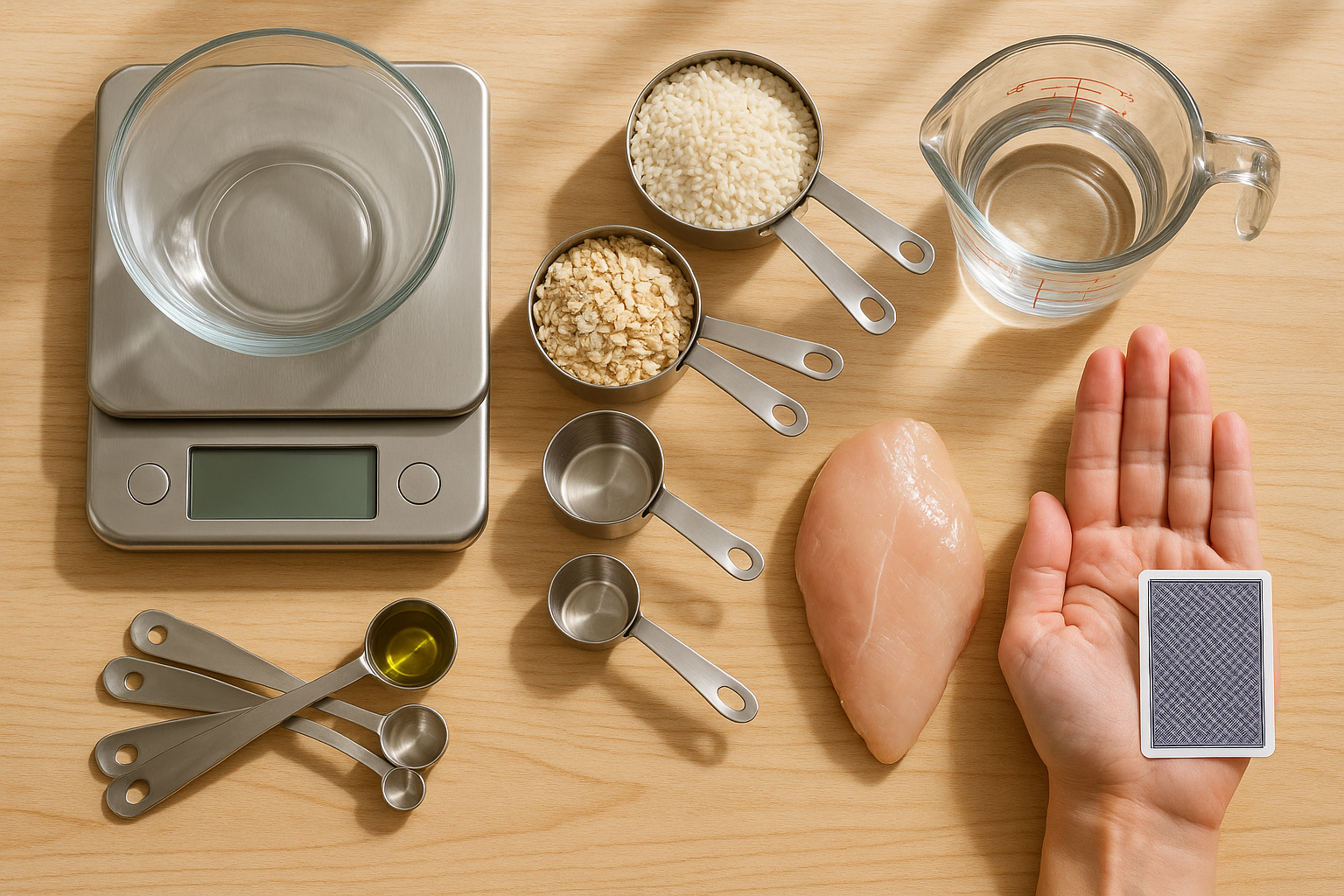
A digital kitchen scale is the most precise way to portion foods—especially energy-dense items (cheese, nuts, oils), proteins, and grains. Accuracy matters because small misjudgments add up over the week. A scale shows the actual grams or ounces, bypassing the inconsistencies of volume for irregular or compressible foods (like grated cheese or flour). With modern scales, portioning is faster than you think: place a bowl on the scale, press tare/zero to subtract the bowl’s weight, add food to the target number, and you’re done. As a habit, weigh a new food a few times to calibrate your eye; then you can eyeball more confidently on non-weighing days.
Many home scales read in 1 g (or 0.1 oz) increments, which is more than enough for everyday portioning. Tare between ingredients for one-bowl prep. For best results, put the scale on a stable, level surface and keep it free of crumbs or liquids that can affect readings. Periodically check accuracy with a known weight (e.g., a sealed 500 g sugar bag or a calibration weight). If you cook for multiple people or batch-prep, weighing once per container can prevent creeping portion sizes.
1.1 How to do it
- Keep the scale on the counter so you’ll use it.
- Place your dish or container on the scale, press tare/zero, and add food until you reach the target weight.
- For mixed meals, tare between components (rice → protein → veg) to track each part.
- Convert label portions to grams/ounces (most labels list both) and aim for that number.
- For consistent results, portion cooked items after draining off obvious liquid/fat.
1.2 Numbers & guardrails
- Common “everyday” protein servings: 85–100 g cooked meat or tofu (~3–3.5 oz).
- Rice: labels often define ½ cup cooked; one cup cooked white rice weighs about ~158 g (so ½ cup ≈ ~79 g).
- Oils/nut butters: weighing 10–15 g can be more honest than calling it “one spoonful.”
1.3 Mini-checklist
- Resolution to 1 g / 0.1 oz
- Tare button works reliably
- Switches between g/oz
- Easy-to-clean platform
Bottom line: A scale makes portioning objective and quick. Learn a few benchmark weights now, and future eyeballing gets dramatically better.
2. Get Cups Right: Dry vs. Liquid, and Why Region Matters
Measuring cups are convenient, but they’re not universal. In the US, for nutrition labeling, 1 cup equals 240 mL; in many metric countries (AU/NZ), a standard cup equals 250 mL. Recipes also distinguish dry measuring cups (flat top for “scoop-and-level”) from liquid jugs (with a spout, read at eye level). For liquids, volume measures are dependable; for compressible dry goods (like flour), variability is high—how you fill the cup changes the amount. That’s why a cup of all-purpose flour can weigh ~120 g using the fluff-scoop-level method, but can climb far higher if packed down.
At home, use liquid jugs for broths, milk, and water; use dry cups for grains and chopped foods when a scale isn’t handy. Know your region’s standard: a metric recipe written in Australia assumes a 250 mL cup and often a 20 mL tablespoon (see Section 3). If your kit is mixed, label your cups with their volume (e.g., “240 mL” or “250 mL”). When precision matters (baking, calorie tracking), switch to grams.
2.1 How to do it
- Liquids: pour into a glass measuring jug and read at eye level.
- Dry goods: spoon into the cup, level with a straight edge (“scoop-and-level”).
- Know the standard: US labeling cup = 240 mL; AU/NZ cup = 250 mL.
- Convert when following foreign recipes, or default to a scale for exactness.
- For sticky ingredients (honey), lightly oil the cup/spoon or weigh instead.
2.2 Numbers & guardrails
- US label definitions: 1 tsp = 5 mL, 1 Tbsp = 15 mL, 1 cup = 240 mL.
- All-purpose flour benchmarks: ~120 g per US cup using standard fill methods (varies with packing).
- Don’t interchange AU 250 mL cups with US 240 mL cups in sensitive recipes without adjusting.
2.3 Common mistakes
- Reading liquid jugs from above (parallax error).
- Packing flour by dipping the cup deep (adds 20–40% more).
- Assuming “cup” means the same everywhere.
Bottom line: Cups are fast, but standards differ and dry volumes vary. Know your regional cup, read liquids at eye level, and weigh when precision counts.
3. Master Measuring Spoons—Especially for Oils, Dressings, and Spreads
Measuring spoons control the small but mighty calorie-dense add-ins. A tablespoon of olive oil is about 15 mL in most regions (and 20 mL in Australia). For nut butters and sauces, casual “heaping spoons” creep upward—level spoons keep things honest. Spoons also shine for baking additives (salt, baking powder) and powerful flavors (soy sauce, sesame oil), where precision ensures consistent taste.
Because spoons are tiny, technique matters: level off dry ingredients; for viscous items (tahini, honey), dip the spoon in hot water or give it a micro-spritz of oil so it releases cleanly. If you’re tracking macros or managing a condition, consider weighing oils (10–15 g) for spot-checks—many people unknowingly pour 1.5–2 tablespoons when they intend one.
3.1 How to do it
- Keep a ring of spoons (¼ tsp to 1 Tbsp/20 mL) on the counter.
- Use level measures for dry ingredients; fill to the brim for liquids.
- For oils/dressings, measure before pouring onto food; for nut butters, weigh 15–30 g when learning your true spoonful.
- In AU/NZ, check that your tablespoon is 20 mL; elsewhere, assume 15 mL unless marked.
3.2 Numbers & guardrails
- US label spoon sizes: 1 tsp = 5 mL, 1 Tbsp = 15 mL.
- Australian tablespoon: 20 mL (equals 4 teaspoons).
- For dressings, many people enjoy 1–2 Tbsp (15–30 mL) per salad; measure once to find your preference without overshooting.
3.3 Mini-checklist
- Clear mL markings; consider magnetic spoons for drawer storage.
- Include an odd-shaped spoon for narrow spice jars.
- For sticky items, weigh instead of fighting the spoon.
Bottom line: Spoons keep high-impact ingredients in check. Level them, know your region’s tablespoon, and weigh sticky items when in doubt.
4. Use Your Hand as a Built-In Portion Guide
Your hand is always with you and scales with your body size, making hand measures a personalized visual guide. A classic framework: palm for protein (~85–100 g cooked meat/fish or a palm-sized block of tofu), fist for starchy carbs (roughly a cup of cooked grains or chopped starches), cupped hand for snacks like nuts or dried fruit, and thumb or thumb-tip for fats (butter, oil, cheese). For fruit and veg, many public-health guides equate a fist or cupped hands with a typical portion (about 80 g for fruit/veg in UK guidance).
Hand measures aren’t millimeter-precise, but they help you stay consistent without tools—especially at restaurants, buffets, or family dinners. Combine them with the plate method (next section) and you’ll get even better balance with minimal math. If you’re taller or more active, you may naturally need larger or more frequent portions; conversely, smaller adults may aim for smaller hand-based servings.
4.1 How to do it
- Palm (no fingers): lean protein portion.
- Fist: starchy carbohydrates or chopped fruit (~1 cup).
- Two open hands: generous vegetables (greens, salad mix).
- Thumb: about a tablespoon of fats/cheese; thumb-tip ≈ teaspoon.
- Use your own hand—don’t borrow someone else’s!
4.2 Numbers & guardrails
- Many UK resources define a fruit/veg portion as ~80 g; dried fruit ~30 g.
- Oily fish portions often ~140 g cooked, roughly a palm.
- Hand sizes vary; treat this as a consistent personal yardstick rather than a universal law.
4.3 Common mistakes
- Counting the fingers with the palm for protein (overestimates).
- Using someone else’s hand as the reference.
- Treating hand estimates as precise when baking or carb-counting—use a scale for that.
Bottom line: Hand measures are the simplest always-available tool. Use them to keep portions realistic when you can’t weigh or measure.
5. Build Balanced Plates: Half Veg, Quarter Protein, Quarter Quality Carbs
The plate method is an easy way to portion without measuring: on a ~9-inch (23 cm) plate, fill ½ with non-starchy vegetables, ¼ with lean protein, and ¼ with quality carbohydrates (starchy veg, whole grains, fruit, or dairy). This visual template supports fiber, volume, and satisfaction while moderating calorie-dense components. It’s recommended widely for everyday healthy eating and adapted by diabetes organizations for blood-sugar management.
Use the plate method to assemble meals quickly at home: start by piling on vegetables (roasted, sautéed, or raw), add a palm-sized protein, and round out with a fist of whole-food carbs. Sauces and dressings fit into the fat “thumb” guideline from Section 4. If your plate is much larger than 9 inches, consider serving on the inner rim or downsizing the plate to avoid “portion inflation.”
5.1 How to do it
- Choose a 9-inch plate (or mentally draw a 9-inch circle on a larger plate).
- Fill ½ plate with non-starchy vegetables (greens, broccoli, peppers).
- Fill ¼ plate with lean protein (fish, chicken, tofu, beans).
- Fill ¼ plate with quality carbs (brown rice, quinoa, potatoes, whole-grain pasta).
- Add a small portion of fats (olive oil, avocado, nuts) and water or a zero-calorie drink.
5.2 Numbers & guardrails
- Non-starchy veg: 1 cup raw or ½ cup cooked counts as a typical veg portion.
- Keep carb portions aligned with activity; very active days may justify a larger carb quarter.
- Use smaller bowls for grains if large plates make portions drift upward.
5.3 Mini-checklist
- Stock frozen veg for instant volume.
- Pre-cook whole grains to drop into bowls.
- Keep a protein rotation (beans, eggs, fish, tofu) for variety.
Bottom line: The plate method is a visual autopilot for balanced meals—no math, minimal measuring, and easy to maintain.
6. Read Food Labels: Serving Size, Servings per Container, and Household Measures
Food labels are a built-in portioning tool—if you read them. In many countries, labels list Serving Size in common household measures (cup, tablespoon, piece, slice) and grams (g) or milliliters (mL), plus Servings per Container. In the US, serving sizes are anchored to Reference Amounts Customarily Consumed (RACCs) from national intake data; regulations also define the volume of household units used on labels (e.g., cup = 240 mL, tablespoon = 15 mL). For multi-serve packages, some labels must show dual columns—per serving and per package—so you can see totals if you eat the whole thing.
At home, match what’s on your plate to the label’s serving. If the label says ½ cup cooked rice is one serving, weigh or measure that amount to “learn” the look. For items like cereal, compare the stated cup measure to the grams—use grams for accuracy because shape/size varies widely by product. For beverages, remember that a “cup” on US labels is 240 mL; metric labels may use 250 mL cups or simply list milliliters.
6.1 How to do it
- Check Serving Size and grams/mL.
- Note Servings per Container; reality-check if you’ll eat more than one.
- For variable items (chips, cereal), weigh the serving once to calibrate your eye.
- Use dual columns (per serving and per container) to avoid surprises.
- For children, look for age-specific portions on trusted public-health sites.
6.2 Numbers & guardrails
- US labeling household units: cup = 240 mL, Tbsp = 15 mL, tsp = 5 mL.
- Some packages must use dual columns when the container reasonably could be eaten in one sitting.
- For infants/toddlers, some beverage RACCs are 120 mL (4 fl oz); check age-specific tables where relevant.
6.3 Common mistakes
- Treating “per serving” numbers as the whole package.
- Ignoring gram weights for airy foods (cereal) where cups mislead.
- Assuming all “cups” are the same worldwide.
Bottom line: Labels quietly do the math for you—use serving size, grams, and (when present) dual columns to portion what you actually plan to eat.
7. Pre-Portion with Containers: Batch Once, Eat Consistently All Week
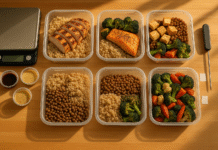
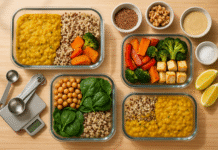
Pre-portioning turns portion control into a one-time decision. Cook a pot of grains, a protein, and a tray of vegetables; then divide into labeled containers with your target amounts. This prevents drift during busy weekdays and makes “what’s for lunch?” effortless. It also helps families: everyone grabs a consistent portion rather than scooping freely from a shared dish.
For grains and starches, you can portion cooked (easiest at home) or dry (useful when packaging uncooked meal kits). If a typical serving is ½ cup cooked rice, you might portion ~80–100 g cooked into each container based on preference and energy needs. Sauces and dressings go in mini containers measured by tablespoons or grams. For snacks, pre-bag nuts or trail mix into single cupped-hand portions to avoid handful creep.
7.1 How to do it
- Pick a container size that matches your portions (e.g., 400–600 mL for lunches).
- Weigh or measure into each container once while you learn your benchmarks.
- Label lids with food + grams (e.g., “chicken 100 g, rice 90 g, veg free”).
- Store salad dressings, oils, and dips in 30–60 mL mini cups; measure with spoons.
- Keep a couple of “free veg” containers—go big on these by design.
7.2 Numbers & guardrails
- Typical cooked starch add-on per meal: ½–1 cup (≈ 80–160 g for rice).
- Protein per meal: ~85–140 g cooked depending on needs and cuisine.
- Dressings: 1–2 Tbsp (15–30 mL) per container to taste.
7.3 Mini-checklist
- Transparent containers to see portions.
- Microwave-safe and leakproof.
- A small labeling system (masking tape + marker).
Bottom line: Pre-portioning removes guesswork on busy days and keeps portions consistent—do the work once, benefit all week.
8. Estimate on the Go with Everyday Objects (When You Can’t Measure)
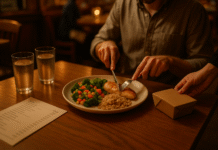
Sometimes you’re eating out, traveling, or at a friend’s table. Use object analogies to keep portions sensible: deck of cards for a protein portion, baseball or your fist for about a cup of starch or chopped fruit, two thumbs for a small cheese portion, and a thumb-tip for a teaspoon of butter or oil. Combine these with the plate method: half the plate in non-starchy veg and divide the rest between protein and carbs.
These analogies are approximations, but they anchor your choices. If the entrée arrives with a mountain of fries, swap half for salad. If the protein looks like two decks of cards, consider boxing half to go. Choose smaller plates at buffets when available; it’s easier to keep the halves and quarters visually aligned on a compact surface. And remember: drinks count—juice and sugary beverages can quietly add up.
8.1 How to do it
- Protein ≈ deck of cards (palm without fingers).
- Carbs/starch ≈ your fist (about a cup).
- Cheese/fats ≈ two thumbs (~30 g cheese) or thumb-tip (= teaspoon).
- Use a smaller plate when you can; default to the plate method.
- Ask for sauces/dressings on the side; measure by spoon or limit to a light drizzle.
8.2 Numbers & guardrails
- Fruit/veg portions in UK guidance: ~80 g; dried fruit ~30 g.
- Oily fish portions often around 140 g (palm-sized).
- Alcohol and sugar-sweetened beverages quickly add extra servings—factor them into your plan.
8.3 Common mistakes
- Treating one restaurant serving as one “portion” when it’s two or more.
- Assuming “healthy” dishes are light—sauces and oils still count.
- Forgetting beverages.
Bottom line: Everyday objects and the plate method keep you oriented when measuring isn’t possible—good enough beats perfect.
9. Use Simple Tech & Tools to Make Portioning Effortless
A few low-friction tools make portioning stick. Keep a compact digital scale on the counter and a set of measuring cups/spoons in the top drawer. Save label photos of your most-eaten foods (cereal, pasta, yogurt) so you can recall serving sizes instantly. If you prefer apps, many barcode scanners pull serving sizes from official databases—still, verify the portion once with your scale. Consider portion-control plates (with faint dividers) for kids learning balanced meals or adults who like visual cues.
If you cook internationally, label your tools: “cup = 240 mL” or “cup = 250 mL,” and note whether your tablespoon is 15 mL or 20 mL. For baking and precise recipes, default to grams, and save a quick-ref note: flour ~120 g per US cup (but weight varies by packing); sugar ~200 g per cup (granulated, US). Keep a short tare habit: every time you swap bowls or add ingredients, zero the scale—it speeds up and reduces errors.
9.1 How to do it
- Keep scale, cups, and spoons within arm’s reach.
- Make phone notes (or sticky notes) of your top 10 label portions.
- Use tare between ingredients; weigh oils and nut butters occasionally.
- For international recipes, translate to grams and stick with weight.
- Teach the household the plate method so everyone portions consistently.
9.2 Numbers & guardrails
- 1 cup (US label) = 240 mL; metric cup (AU/NZ) = 250 mL.
- Tablespoon: most regions 15 mL; Australia 20 mL.
- Flour by volume varies wildly; weigh for accuracy.
9.3 Mini-checklist
- Scale with 1 g resolution and reliable tare.
- Dry cups, liquid jug, and spoons clearly marked in mL.
- A small conversion card taped inside a cupboard.
Bottom line: Make it easy to do the right thing—good tools, quick references, and a little tare habit remove friction so portioning becomes automatic.
FAQs
1) What’s the difference between a “serving size” and a “portion”?
A serving size on a label is a standardized amount based on population data (e.g., RACCs in the US). It’s there for comparison and nutrition facts. A portion is what you actually decide to eat at that moment. They can match—or not. For example, a label might say ½ cup cooked rice is one serving, but you might portion 1 cup based on your hunger and activity. Using tools here helps your portion match your goals.
2) Are dry and liquid cups really different?
Yes—liquid jugs are designed to be read at eye level and are best for fluids. Dry cups are meant to be filled to the rim and leveled. Beyond the tool, beware regional standards: US labeling defines a cup as 240 mL, whereas many metric countries use 250 mL. For precise cooking and baking, weighing in grams avoids confusion and improves consistency across regions.
3) How accurate do I need my kitchen scale to be?
For home use, a scale with 1 g (or 0.1 oz) resolution is plenty. What matters most is a reliable tare function and a stable, level surface. If accuracy drifts, check against a known weight (e.g., a sealed 500 g package) or a calibration weight. Professional tolerances exist for commercial scales; at home, consistency is the goal, not lab-grade precision.
4) Can I use my hand measures if I’m trying to lose weight?
Hand measures are great for consistency and work well alongside the plate method. Start with a palm of lean protein, a fist of carbs, and two open hands of vegetables, then adjust based on progress and hunger. If your plan calls for tight macro tracking, weigh a few times per week to ensure your hand estimates align with targets.
5) Is a tablespoon 15 mL or 20 mL?
It depends on where you are and the tools you own. In the US (and most places), a tablespoon equals 15 mL (and a teaspoon is 5 mL). In Australia, the standard tablespoon is 20 mL (equal to four teaspoons). Check your measuring spoon markings or buy a set labeled in mL to avoid confusion when following recipes or portioning oils.
6) How do I portion pasta and rice without a scale?
Learn a visual: dry pasta two handfuls is often a single adult portion in UK/AU guidance; cooked rice portions are commonly ½ cup per serving (roughly your fist for a cup). At home, measure once (e.g., ½ cup cooked rice ≈ ~80–100 g depending on variety) and note how it looks in your usual bowl. That one-time check pays off when eyeballing later.
7) Do smaller plates actually make me eat less?
Plate size can influence perception, but it’s not magic. The plate method is what truly helps: dedicating half of any plate to vegetables and splitting the rest between protein and carbs. If giant plates cause you to overserve, switch to a ~9-inch plate or keep food on the inner rim. Visual structure—not plate size alone—drives better portions.
8) Should I weigh food raw or cooked?
Either works—just be consistent. Labels sometimes list raw weights (meats) or cooked volumes (rice, pasta). If your plan gives targets in raw weights, weigh before cooking. If you batch-cook, weighing cooked portions into containers is simpler. Remember that water loss or gain during cooking changes weight; don’t compare raw to cooked directly without a reference.
9) How do I portion snacks so I don’t overeat?
Pre-portion snacks into single servings. Use a cupped hand for nuts or dried fruit as a quick visual, or weigh 25–30 g into small containers. Keep snacks out of line-of-sight and pair them with fruit or veg for volume. For dips, spoon 1–2 Tbsp into a ramekin instead of eating from the tub.
10) What’s the best way to portion salads and dressings?
Use a big bowl for greens (volume helps), then measure dressing by tablespoon—or weigh 10–15 g if you’re curious about your usual pour. Toss thoroughly so a small amount coats more leaves. Add texture with lean proteins and crunchy veg so you rely less on heavy dressings for satisfaction.
11) Are app databases reliable for serving sizes?
They’re a good starting point, often sourced from official databases. Still, verify the serving size on your specific product’s label and measure once. Save your verified entries or label photos so you can reuse them. Apps can be wrong due to product variations or user submissions.
12) I cook from US and Australian recipes—how do I keep measures straight?
Label your tools and keep a conversion card: US label cup = 240 mL; AU/NZ cup = 250 mL; US tablespoon = 15 mL; Australian tablespoon = 20 mL. When accuracy matters, convert the recipe to grams and stick with weight. For everyday home portioning, consistency beats exact unit choice.
Conclusion
You don’t need complicated math to serve smart portions—just a few repeatable habits. A scale gives you honest benchmarks; cups and spoons are fast for liquids and simple items; your hands and the plate method provide visual guardrails at the table; labels show built-in serving sizes that you can weigh once and then recognize forever. Pre-portioning turns portion control into a one-time setup, and a little tool labeling prevents international mix-ups. Start by weighing a few go-to foods this week to calibrate your eye—rice, pasta, cheese, oil, and your favorite protein. Then lean on the plate method and hand cues most days, with cups/spoons for liquids and dressings. Consistency, not perfection, delivers results.
Try this today: weigh one serving of your usual grain, measure your typical oil spoonful, and build tonight’s dinner with half the plate in vegetables. Small steps, repeated, make portioning second nature.
Ready to right-size your meals? Keep a small scale on the counter and use the plate method at your next dinner—no calorie counting required.
References
- 21 CFR §101.9 — Nutrition labeling of food (household unit definitions and serving size rules), eCFR (U.S. Government Publishing Office), current as of August 2025. eCFR
- Guidance for Industry: Serving Sizes of Foods That Can Reasonably Be Consumed At One Eating Occasion, U.S. Food & Drug Administration, 2020 (PDF). U.S. Food and Drug Administration
- Food Labeling Guide (serving size examples and beverage “cup” at 240 mL), U.S. Food & Drug Administration (PDF), 2018. U.S. Food and Drug Administration
- What Is MyPlate? U.S. Department of Agriculture, MyPlate.gov, accessed August 2025. MyPlate
- Plan Your Portions (Diabetes Plate Method, 9-inch plate visual), American Diabetes Association, 2024 (PDF). American Diabetes Association
- Portion sizes: everything you need to know (hand-size visuals and examples), British Heart Foundation, July 3, 2025. British Heart Foundation
- Portion sizes (Food Facts), British Dietetic Association, accessed August 2025. British Dietetic Association
- Portion sizes (adults & children; hand measures and weighing advice), British Nutrition Foundation, accessed August 2025. British Nutrition Foundation
- Nutrition Facts for Cooked White Rice (1 cup ≈ 158 g, data from USDA FoodData Central), MyFoodData, accessed August 2025. My Food Data
- Ingredient Weight Chart (flour and other common ingredients; recommendation to weigh), King Arthur Baking Company, accessed August 2025. King Arthur Baking
- How to measure flour the right way (variability of volume measures), King Arthur Baking Company, Oct 13, 2023. King Arthur Baking
- Metric Kitchen: Cookware and Tools (tare your kitchen scale; home measurement tips), National Institute of Standards and Technology (NIST), Mar 1, 2023. NIST
- Weights & Measures (metric standards; AU tablespoon 20 mL; metric cup 250 mL), Edmonds (New Zealand), accessed August 2025. edmondscooking.co.nz
- 5 A Day portion sizes (fruit & veg; palm/fist cues), NHS (UK), accessed August 2025. nhs.uk
- What Is the Diabetes Plate? (consumer explainer of plate method), American Diabetes Association — Diabetes Food Hub, Jan 15, 2025. diabetesfoodhub.org