























Meal prepping on a budget means planning a week of simple, repeatable meals that maximize low-cost staples, minimize waste, and keep nutrition on track. You’ll batch-cook base components, portion them into containers, and rotate flavors so you don’t get bored. This guide is for anyone who wants practical ways to save money and time while still eating well. In short: plan a week, shop with a list and unit-price mindset, cook once to eat multiple times, and track cost per serving to keep spending honest.
Quick-start steps: 1) Set a weekly food budget and cost-per-serving target, 2) choose 3–4 base meals to rotate, 3) build a precise shopping list, 4) batch-cook grains/beans/protein, 5) portion and label, 6) freeze extras and schedule one “use-up” night.
Brief safety note: this article shares general budgeting and cooking tips; it isn’t medical or financial advice. Always follow reputable food-safety guidance for storage and reheating.
1. Lock Your Weekly Budget and Cost-Per-Serving Target
Start by deciding exactly how much you can spend this week and what that translates to per serving. This one decision anchors every other choice—from recipes and store brands to portion sizes and freezing. A weekly cap forces trade-offs (e.g., eggs over steak), while a cost-per-serving target keeps portions realistic and prevents “budget creep.” The beauty is that cost-per-serving is simple math you can do on your phone, and it turns vague goals into measurable decisions in the aisle. You’ll quickly see that small swaps—dried beans instead of canned, chicken thighs instead of breast, seasonal veg instead of out-of-season—compound into big savings over a month.
1.1 How to do it
- Pick a weekly budget (e.g., $60/£50/PKR equivalent for 1–2 people) and write it at the top of your list.
- Divide your budget by the number of planned portions. That’s your cost-per-serving guardrail.
- Use a calculator to check major items (rice, lentils, eggs, chicken) against your target.
- Track spend in a notes app or spreadsheet as you add items to the cart.
- Leave a 5–10% buffer for spices/condiments you’ll use across weeks.
1.2 Numbers & guardrails
- Example: $60 budget ÷ 24 servings ≈ $2.50/serving target.
- If chicken thighs are $3.00/lb and you get 4 servings/lb, protein costs $0.75/serving; add rice ($0.20) and veg ($0.60), you’re at $1.55/serving before seasonings.
Bottom line: when you measure cost-per-serving, smart choices become obvious—and you’ll waste less food and money.
2. Build a 3–4 Meal Rotation to Reuse Ingredients
The cheapest meal-prep weeks repeat ingredients across 3–4 core dishes. Repetition lets you buy larger, cheaper packs, reduces leftover odds, and speeds cooking. Instead of seven totally different dinners (which bloat your cart with half-used items), choose a few flexible meals—say, chickpea curry, roasted chicken bowls, and veggie egg fried rice—and vary sauces or toppings. This keeps flavor variety without wrecking your budget. Rotations also simplify your prep day: batch rice once, roast a full tray of vegetables, simmer a large pot of lentils, and you’ve prepped components that assemble into several meals with different personalities.
2.1 Tools/Examples
- Rotation A: Lentil dahl, chicken-rice-veg bowls, pasta with tomato-lentil sauce, egg-veggie fried rice.
- Rotation B (vegetarian): Chana masala, roasted veg & couscous, bean chili over baked potatoes, hummus wraps.
- Flavor toggles: yogurt raita, chili oil, chutney, hot sauce, lemon-herb dressing.
2.2 Mini-checklist
- Choose 2 starches (rice + pasta or flatbread).
- Choose 2 proteins (e.g., lentils + eggs; or chicken thighs + beans).
- Choose 3–4 vegetables that cook together on one sheet pan.
- List 3 sauces you can mix in 5 minutes.
Synthesis: a lean rotation multiplies output, slashes waste, and turns Sunday prep into weekday calm.
3. Shop With a List and Compare Unit Prices
A precise shopping list prevents impulse buys, but the real savings kick in when you compare unit prices (cost per kg/lb/liter). Shelf tags often show this; if not, divide price by weight/volume on your phone. Store brands are frequently cheaper with no meaningful quality loss, and larger sizes often win—if you’ll actually use them before they expire. Pair the list with a “no-duplicate” rule: don’t buy a new sauce or spice until you finish a similar one. For produce, pick versatile items (onions, carrots, cabbage) that last and work across meals.
3.1 How to do it
- Write ingredients by department (produce, dry goods, protein, dairy).
- For each item, check the unit price; note the winner on your list.
- Favor store brands for staples (rice, oats, beans, pasta, canned tomatoes).
- Buy bulk only for items you truly use weekly (rice, lentils, oats).
- Keep a running total to avoid checkout surprises.
3.2 Common mistakes
- Choosing “deal” sizes that you can’t finish—false economy.
- Buying specialty items you’ll use once.
- Ignoring unit prices on multi-packs vs single units.
Takeaway: unit pricing and a disciplined list are the backbone of budget meal prep.
4. Plan Around Seasonal Produce and Local Specials
Seasonal produce is cheaper, fresher, and tastier. Planning your week around what’s abundant lowers your baseline spend while boosting flavor. Scan flyers or apps for weekly specials, then swap recipes accordingly—think cabbage slaw instead of pricey lettuce, or sweet potatoes instead of imported asparagus. In many regions (including South Asia), markets offer competitive prices on staples like onions, potatoes, tomatoes, citrus, and greens. Frozen fruit/veg also shine when out-of-season produce spikes; they’re picked ripe and often cheaper per serving.
4.1 Numbers & guardrails
- Favor items with ≥5 days refrigerated life (cabbage, carrots, beets) to reduce waste.
- Use frozen veg for stir-fries and soups; it’s usually prepped and ready.
- Plan “fast-to-spoil” produce (leafy greens, berries) for the first 2–3 days.
4.2 Region notes (quick swaps)
- When tomatoes are expensive: use canned tomatoes for curries/sauces.
- When greens are cheap: batch-cook saag/palak and freeze in portions.
- When bananas are abundant: freeze ripe ones for smoothies or oatmeal.
Synthesis: let prices guide the menu, not the other way around—your budget (and taste buds) will thank you.
5. Choose Budget Proteins and Stretch Them Smartly
Protein drives costs, so pick value options and stretch them with legumes and eggs. Chicken thighs, canned fish, dried beans/lentils, paneer or firm tofu (where affordable), and eggs are cost-effective anchors. Cook once, then repurpose: roast a tray of chicken thighs for bowls, shred leftovers into wraps, simmer bones into broth. Pair every animal protein with a legume-based meal elsewhere in the week to balance cost and nutrition. Don’t sleep on lentils—red for quick soups, brown/green for salads and dals.
5.1 How to do it
- One meat, one seafood, two legume meals per week (mix to budget).
- Buy family packs of chicken thighs/drumsticks; trim and freeze in portions.
- Rotate beans: chickpeas, kidney beans, black beans, masoor/moong dal.
- Add an egg meal (shakshuka, masala omelet wraps) for low-cost protein.
5.2 Mini case (stretch math)
- 1 lb (450 g) chicken thighs → ~4 portions.
- 1 lb (450 g) dried lentils → ~6–8 portions cooked.
- Blend the two across the week and you’ll keep protein quality high while holding costs down.
Bottom line: mixing animal and plant proteins hits the sweet spot of cost, nutrition, and variety.
6. Batch-Cook Once, Eat 3–4 Times
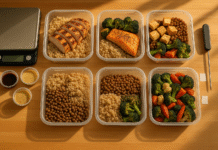
Batch cooking concentrates effort into one prep window and pays out through the week. Make a pot of rice (or another grain), a tray of roasted vegetables, a large stew/chili/curry, and one quick protein (eggs, chicken, tofu). Portion into containers right away so meals are “grab-and-heat” ready. This slashes takeout temptation and reduces energy costs by using the oven/stove efficiently.
6.1 Mini-checklist
- Cook 6–8 cups cooked grain (rice, bulgur, couscous, quinoa).
- Roast 2 sheet pans of mixed veg (oil + salt + spice mix).
- Simmer 1 big-batch stew/chili/curry (8–10 servings).
- Prep one cold option (salad kits, yogurt + fruit + oats).
- Portion in 1–2 cup containers; cool, label, and refrigerate/freeze.
6.2 Tools/Examples
- Large Dutch oven or stock pot, two sheet pans, rice cooker (optional), digital scale.
- Timer and labels (masking tape + marker).
- App: Paprika, AnyList, or Google Sheets for tracking.
Synthesis: one focused session gives you a week of “fast food” you can feel good about.
7. Use the Freezer Like a Savings Account
Your freezer preserves value by pausing the clock. Cooked grains, beans, soups, stews, tortillas/flatbreads, and pre-portioned meats freeze beautifully. Cool foods quickly, package in flat, labeled bags or lidded containers, and keep a simple inventory. Aim to freeze in single-meal portions to avoid thawing excess, and schedule one “freezer clean-out” night every 1–2 weeks. For safety, refrigerate or freeze leftovers within 2 hours (or 1 hour if above 32 °C/90 °F), and reheat leftovers to 74 °C/165 °F; keep cold foods below 4 °C/40 °F.
7.1 How to do it
- Spread hot food in shallow pans to cool faster; refrigerate within 2 hours.
- Label with name + date; first-in, first-out rotation.
- Freeze rice, beans, and sauces flat in bags to save space.
- Use ice-cube trays for pesto, lemon juice, curry bases.
7.2 Numbers & guardrails
- General guide: many cooked leftovers keep 3–4 days refrigerated; longer in the freezer.
- Avoid refreezing thawed, perishable foods unless they were thawed in the refrigerator and kept cold.
Takeaway: a well-managed freezer converts weekend effort into month-long savings.
8. Prep Versatile Base Components (Mix-and-Match)
Instead of prepping seven distinct meals, prep building blocks that assemble into many. Cook a grain (rice/bulgur), a pot of beans or lentils, roasted mixed vegetables, and a simple protein. Then mix and match with quick sauces. This approach keeps flavors fresh and helps households with different preferences eat from the same base. It also means you can pivot midweek based on cravings without buying new ingredients.
8.1 Base kit (example)
- Grain: rice or bulgur (8 cups cooked).
- Legume: chickpeas or lentils (8 servings).
- Veg: roasted carrots, onions, peppers, cauliflower (2 trays).
- Protein: chicken thighs/tofu/eggs.
- Sauces: yogurt-garlic, chili oil, lemon-herb, peanut or tahini sauce.
8.2 Quick assemblies
- Rice + chickpeas + roasted veg + yogurt-garlic.
- Bulgur + chicken + pickled onions + lemon-herb.
- Lentils + sautéed greens + chili oil over toast.
- Cauli “tacos” with beans and tahini drizzle.
Synthesis: components keep prep efficient and meals flexible—budget-friendly without boredom.
9. Turn Leftovers Into New Meals (a.k.a. “Leftover Alchemy”)
Leftovers aren’t repeats; they’re ingredients in disguise. Rework cooked items into new dishes so you feel variety without extra shopping. Rice becomes fried rice or stuffed peppers; roast chicken becomes soup or flatbread wraps; oversoft tomatoes become sauce. Schedule one “use-up” night every week to combine odds and ends into frittatas, quesadillas, soups, or grain bowls. This habit dramatically reduces waste and gives you permission to be creative.
9.1 Ideas to try
- Soup builder: sauté onion + garlic + leftover veg + broth; finish with beans/pasta.
- Egg magic: fold stray veg into omelets/frittatas.
- Wrap hack: shred leftover protein with slaw and a quick sauce.
- Potato upgrade: dice and crisp in a pan; top with beans/yogurt/chili sauce.
9.2 Mini case
- Leftover chickpea curry + broth = spiced soup; add noodles and greens for a new meal.
- Roasted veg + couscous + lemon = bright salad for lunch boxes.
Bottom line: if you plan to repurpose, leftovers become a feature, not a chore.
10. Lean on Flavor Boosters and Pantry Spices
Flavor keeps budget food exciting. Stock a small, high-impact set of spices and condiments that layer quickly: cumin, coriander, turmeric, chili flakes, smoked paprika, garlic/ginger (fresh or paste), soy sauce, vinegar, lemon, tomato paste, and a neutral oil. With these, you can pivot a base of rice/beans/veg into Indian-, Middle Eastern–, or East Asian–leaning meals in minutes. Make 2–3 house sauces on prep day; they’re cheap and transform bowls, wraps, and salads.
10.1 Pantry list (starter)
- Spices: cumin, coriander, turmeric, chili, paprika, cinnamon.
- Aromatics: garlic, onion, ginger.
- Acids: vinegar (white or apple), lemon/lime.
- Umami: soy sauce or tamari, tomato paste.
- Fats: neutral oil, a small bottle of olive oil if affordable.
10.2 House sauces (5-minute)
- Yogurt-garlic-lemon
- Peanut or tahini sauce (thin with water + lemon)
- Chili oil or chili crisp
- Herb-lemon dressing (parsley/cilantro + lemon + oil)
Synthesis: a modest pantry unlocks global flavors without global prices.
11. Choose the Right Containers and Portion Sizes
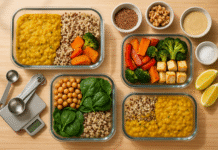
Good containers turn a pot of food into a week of ready meals. Choose microwave-safe, leak-resistant containers in 1–2 cup (250–500 ml) sizes for mains and ½-cup (120 ml) cups for sauces/snacks. Clear glass or BPA-free plastic helps you see contents; divided containers can keep sauces separate. Label lids or use masking tape to date and identify meals. If you pack lunches, standardize sizes so portions match your cost-per-serving target and calorie needs.
11.1 How to do it
- Standardize 8–12 containers of the same size to simplify stacking.
- Use small lidded cups for sauces/dressings.
- Keep a few freezer-ready containers just for soups and stews.
- Wash containers right after eating to keep the rotation flowing.
11.2 Numbers & guardrails
- Typical adult lunch: 400–700 kcal depending on activity; scale portions accordingly.
- Liquids expand when frozen—leave headspace to prevent cracks.
- Reheat thoroughly; stir midway to avoid cold spots.
Takeaway: the right container setup streamlines your week and protects your food (and budget).
12. Track Pantry Inventory and Cut Waste to Near-Zero
Budget control and waste reduction are two sides of the same coin. Keep a simple inventory of your pantry, fridge, and freezer so you buy what you’ll use and use what you already have. A whiteboard on the fridge, a spreadsheet, or a shared notes app works. Organize shelves with “first in, first out” and group similar foods together (all beans in one bin, all grains in another). Plan one weekly “clear-the-fridge” meal that uses aging produce and partial containers.
12.1 Mini-checklist
- Maintain a list of what’s open (with dates).
- Keep “use soon” items on an eye-level shelf.
- Batch-wash greens and store with paper towel to extend life.
- Freeze bread slices and extra cooked rice/beans.
12.2 Tools/Examples
- Apps: Google Keep/Apple Notes, Notion, or a simple printout.
- Labeling: masking tape + marker; color-code freezer vs fridge.
- Rule: anything you toss gets logged—learn and adjust next week.
Synthesis: clear inventory = fewer duplicates, less waste, and more money left in your pocket.
13. Affordable Recipes and a 7-Day Sample Plan
To prove how far basic staples can go, here are budget-friendly recipes that share ingredients. Costs vary by region and season, so treat the cost-per-serving as a method rather than a guarantee; plug in your local unit prices to get precise numbers.
13.1 Recipes
A) Red Lentil Dahl (8 servings)
- You need: 2 cups red lentils, 1 onion, 3 cloves garlic, 1 tbsp ginger, 1 can tomatoes (or 3 fresh), 1 tsp each cumin/coriander/turmeric, chili to taste, 1–2 tbsp oil, salt, 6–7 cups water.
- Do this: Sauté onion, garlic, ginger in oil; add spices, toast 30 seconds. Add lentils, tomatoes, water. Simmer 20–25 minutes until creamy; salt to taste.
- Serve with: rice and quick yogurt-cucumber raita.
- Cost method: price lentils by kg, divide by ~8 servings; add rice and aromatics.
B) Sheet-Pan Chicken, Veg, and Rice Bowls (8 servings)
- You need: 1.5–2 lb (700–900 g) chicken thighs, 6 cups mixed vegetables (carrots, onions, peppers, cauliflower), 2 cups dry rice, oil, salt/pepper, paprika or garam masala.
- Do this: Roast seasoned chicken and veg at 220 °C/425 °F for 25–35 minutes; cook rice. Portion bowls with rice + chicken + veg; add yogurt-lemon sauce.
- Stretch tip: shred leftover chicken for wraps.
C) Chickpea Tomato Curry (6–8 servings)
- You need: 2 cans chickpeas (or 3 cups cooked), 1 onion, garlic/ginger, 1 can tomatoes, curry powder/garam masala, oil, salt, optional coconut milk or yogurt.
- Do this: Sauté aromatics; add spices, tomatoes, chickpeas, and a splash of water. Simmer 15 minutes; finish with coconut milk or yogurt if using.
- Serve with: rice or flatbread.
D) Egg Fried Rice with Vegetables (4–6 servings)
- You need: 4 cups day-old rice, 4–6 eggs, 3 cups mixed veg (frozen ok), soy sauce, garlic, oil, scallions/chili.
- Do this: Scramble eggs; set aside. Stir-fry garlic and veg, add rice, soy, return eggs. Finish with scallions/chili.
13.2 7-Day sample plan (mix-and-match)
- Mon: Red lentil dahl + rice + raita.
- Tue: Chicken-veg-rice bowl + lemon-herb dressing.
- Wed: Chickpea tomato curry + flatbread.
- Thu: Egg fried rice with extra veg.
- Fri: Leftover remix soup (use-up night).
- Sat: Chicken wraps with slaw and yogurt sauce.
- Sun: Dahl with sautéed greens and chili oil.
13.3 Numbers & guardrails
- Batch-cook the rice (8 cups cooked) and share across meals.
- Aim for 20–30 g protein in main meals by pairing legumes with eggs or small portions of meat.
- Freeze extra portions from each recipe to build a “bank” for busy weeks.
Synthesis: a shared pantry and four cornerstone recipes can feed you all week with variety—and stay within your cost-per-serving target.
FAQs
1) What is “meal prepping on a budget” in one sentence?
It’s planning and cooking multiple simple meals at once using low-cost staples, then portioning and storing them safely so you can eat well all week while staying within a set cost-per-serving target.
2) How many meals should I prep at once?
Most people do best with 3–4 different meals spread across 6–10 total portions. That balance keeps variety without overcomplicating your prep day. Freeze anything you won’t eat within 3–4 days to maintain quality and safety.
3) Is canned or frozen produce worse than fresh?
Not necessarily. Frozen produce is picked at peak ripeness and can be more affordable and nutritious than out-of-season fresh options. Canned tomatoes and beans are budget heroes; rinse canned beans to reduce sodium and use herbs/acids to brighten flavor.
4) How do I keep cooked rice and leftovers safe?
Cool quickly, refrigerate within 2 hours (1 hour if above 32 °C/90 °F), store in shallow containers, and eat refrigerated leftovers within 3–4 days. Reheat leftovers to 74 °C/165 °F and keep cold foods below 4 °C/40 °F.
5) What’s the cheapest protein for meal prep?
Eggs, lentils, and chickpeas are consistently low-cost per serving. Chicken thighs are usually better value than breasts. Mix plant and animal proteins to keep costs low while meeting protein needs and maintaining variety.
6) How do I avoid boredom with repeated meals?
Prep neutral bases (rice/beans/roasted veg) and rotate 2–3 sauces and toppings. Small flavor switches—lemon-herb vs. yogurt-garlic vs. chili oil—make bowls feel different without new shopping lists.
7) Should I buy in bulk?
Only for items you use weekly (rice, oats, lentils, oil). Bulk is a win when you’ll finish it before quality declines. For perishables, the cheapest unit price can still be expensive if you throw half away.
8) What container sizes work best?
For mains, 1–2 cup (250–500 ml) containers fit typical lunches; use ½-cup cups for sauces/snacks. Clear, stackable containers help you see what to eat next and reduce forgotten leftovers.
9) How do I set a realistic cost-per-serving target?
Divide your weekly budget by planned portions (e.g., $60 ÷ 24 = $2.50/serving). Use unit prices to test whether ingredients fit that target. Adjust portions or swap ingredients until the math works.
10) Can I meal prep if I have dietary restrictions?
Yes. Build around your safe staples—gluten-free grains (rice, quinoa), lactose-free yogurt, or plant proteins if you’re vegetarian/vegan. Use the same method: a few base components plus sauces, portioned and stored safely.
Conclusion
Meal prepping on a budget is a repeatable system: decide your weekly cap, set a cost-per-serving target, and build a simple rotation of meals that share ingredients. Shop by unit price with a disciplined list, batch-cook core components, and let the freezer act like a savings account for future you. Flavor boosters keep your bowls lively, and an inventory habit keeps waste near zero. The payoff is more than savings: you’ll eat better food with less stress, and you’ll have a plan that survives busy weeks and price swings. Start this weekend with one grain, one legume, one protein, and two sauces—label, portion, freeze—and you’ll feel the benefits by Wednesday.
CTA: Pick your budget number, choose three recipes from this page, and schedule a 90-minute prep session—your wallet (and weeknights) will thank you.
References
- Refrigeration and Food Safety, U.S. Department of Agriculture (USDA), updated 2020 — https://www.fsis.usda.gov/food-safety/safe-food-handling-and-preparation/food-safety-basics/refrigeration-and-food-safety
- FoodKeeper App: Storage Times for the Refrigerator and Freezer, FoodSafety.gov (USDA, FDA, CDC), accessed 2025 — https://www.foodsafety.gov/foodkeeper
- Danger Zone (40 °F–140 °F), USDA Food Safety and Inspection Service — https://www.fsis.usda.gov/food-safety/safe-food-handling-and-preparation/food-safety-basics/danger-zone-40f-140f
- Healthy Eating Plate, Harvard T.H. Chan School of Public Health, updated 2024 — https://www.hsph.harvard.edu/nutritionsource/healthy-eating-plate/
- Eatwell Guide, NHS (UK National Health Service), reviewed 2018 — https://www.nhs.uk/live-well/eat-well/food-guidelines-and-food-labels/the-eatwell-guide/
- How to Understand and Use the Nutrition Facts Label, U.S. Food & Drug Administration, revised 2020 — https://www.fda.gov/food/nutrition-facts-label/how-understand-and-use-nutrition-facts-label
- Calculating Unit Prices to Compare Value, Consumer.gov (U.S. Federal Trade Commission) — https://consumer.gov/articles/shopping-smart-and-saving-money#unitprice
- Freezing and Food Safety, USDA FSIS, updated 2010 — https://www.fsis.usda.gov/food-safety/safe-food-handling-and-preparation/food-safety-basics/freezing-and-food-safety
- Using Leftovers Safely, FoodSafety.gov — https://www.foodsafety.gov/keep-food-safe/food-safety-by-types-of-food/leftovers
- Food Loss and Food Waste, Food and Agriculture Organization (FAO), 2011/2019 — https://www.fao.org/food-loss-and-food-waste/en/