






















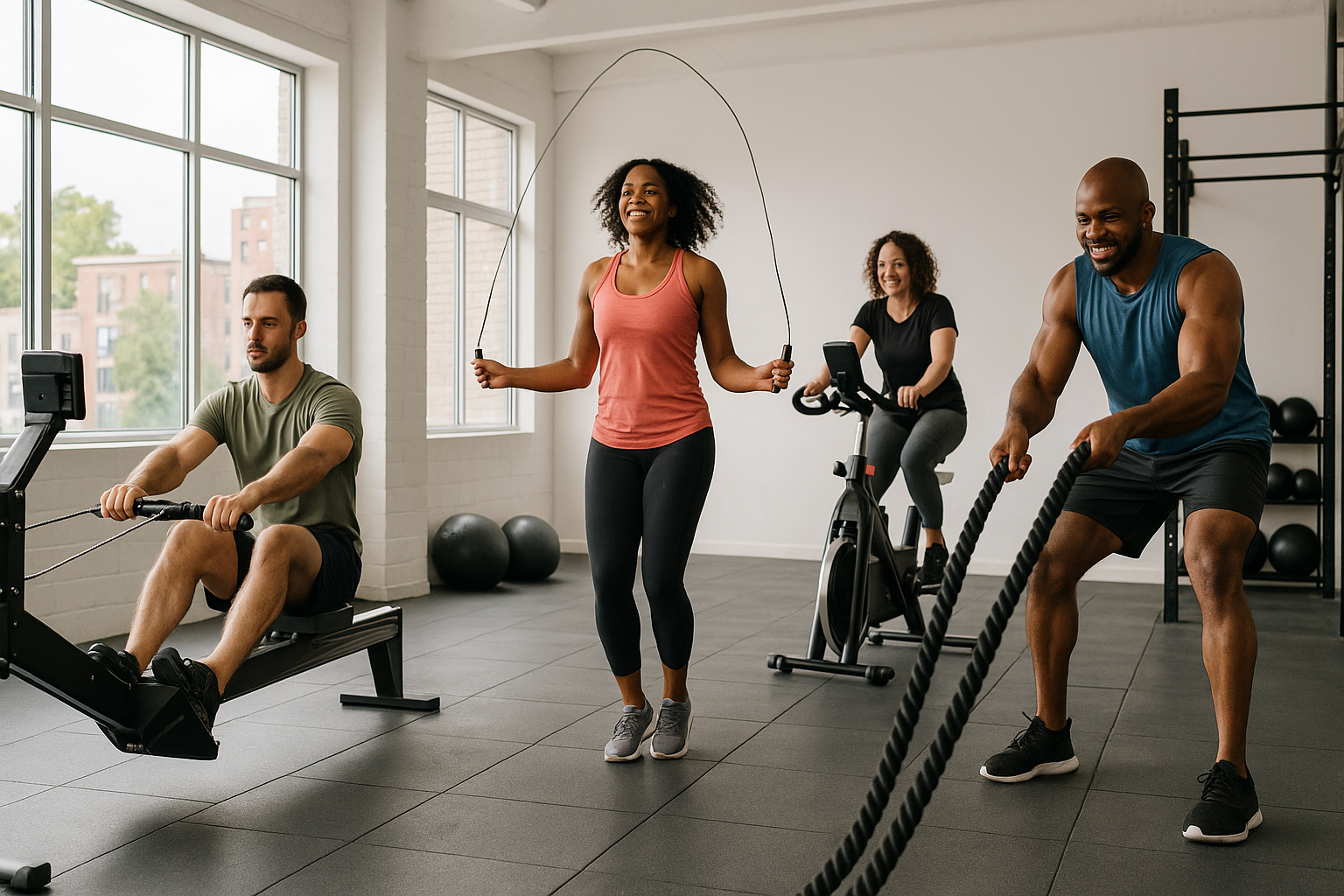
You don’t have to run to get a strong heart, powerful lungs, and serious calorie burn. The most effective non-running cardio options pair steady, repeatable movement with enough intensity to raise your heart rate and keep it there safely. In short: cycling, rowing, jump rope, swimming, elliptical training, stair climbing, kettlebell swings, boxing, battle ropes, low-impact HIIT circuits, and incline walking/rucking all deliver. Aim to collect the recommended weekly total of moderate or vigorous activity in ways your joints will love.
Quick start (skim this): choose one modality you enjoy, work in 20–40 minute blocks (or short intervals), keep most sessions at a conversational pace with brief harder pushes, and progress either time, distance, or resistance by ~5–10% weekly. If you track heart rate, spend most time in Zones 2–3 and sprinkle in short Zone 4–5 efforts once or twice per week.
Friendly note: If you have a medical condition, are returning after injury, or are pregnant, chat with a qualified professional before starting or progressing workouts.
1. Indoor Cycling (Stationary Bike/Spin)
Indoor cycling is a low-impact, joint-friendly way to raise your heart rate, build aerobic capacity, and torch calories without pounding your knees. It works because the bike lets you dial in resistance precisely, so you can target easy endurance or high-intensity efforts without the eccentric impact of running. Expect a smooth learning curve: basic form, cadence (rpm), and resistance get you 90% of the way there. Bikes are widely available—from upright and spin bikes to smart trainers that control resistance automatically—so you can ride year-round regardless of weather. And because you’re seated, you can sustain longer sessions that accumulate weekly cardio minutes while minimizing soreness next day.
1.1 How to do it
- Set up: Saddle roughly hip height; with the pedal at bottom-dead-center, maintain a slight knee bend (~25–35°). Align knees over mid-foot.
- Cadence targets: 80–95 rpm for endurance; 60–80 rpm for climbs/sprints (add resistance).
- Intensity anchors: Use RPE 4–6/10 for most rides; include brief RPE 7–9 surges for intervals.
- Breathing: Inhale through the nose if comfortable; exhale fully to clear CO₂ during harder efforts.
- Progression: Add 5% time each week or 1–2 intervals; deload every 4th week.
1.2 Numbers & guardrails
- Starter session: 5-min warm-up → 4×3-min at RPE 7/10, 2-min easy → 5-min cool-down (total ~30 min).
- Endurance day: 35–60 min at steady RPE 5/10; finish with 3×20-sec fast legs.
- Form cues: Relax shoulders, soft hands; hinge slightly at hips; keep a quiet upper body.
Finish each ride finishing one gear easier than you started; you should leave feeling better than when you clipped in.
2. Rowing Machine (Erg)
Rowing is a full-body, low-impact cardio option that challenges legs, core, and back while driving your heart rate up efficiently. It’s especially effective if you want maximal conditioning in minimal time because every stroke engages large muscle groups. Compared with many machines, a rower rewards technique: once you learn to sequence legs → hips → arms on the drive and reverse on the recovery, your pace, split, and consistency improve fast. Many people also find rowing meditative—its rhythm helps you maintain Zone 2 for endurance or execute precise interval sets when you need intensity. Rowing supports the same weekly cardio targets you’d chase with running, but with far less impact.
2.1 How to do it
- Set damper around 3–5 to start; adjust for feel, not ego.
- Stroke rate: 20–24 spm for endurance; 26–30 spm for threshold work.
- Stroke sequence: Drive with legs, then open hips, then finish with arms; recover arms → hips → legs.
- Metrics to watch: 500-m split time, stroke rate (spm), and consistency across intervals.
- Progression: Add one interval or +250 m to total work each week; deload every 3–4 weeks.
2.2 Numbers & guardrails
- Starter set: 10×1-min @ RPE 7, 1-min easy (or 5×500 m with equal rest).
- Endurance: 20- to 30-min continuous at a comfortable split you can hold +/- 2 sec.
- Technique tip: Keep shins vertical at the catch, neutral spine, and avoid overreaching.
Rowing offers a strong return on time; precision in form magnifies your fitness gains while keeping your lower back happy.
3. Jump Rope
Jump rope delivers sprint-level cardiovascular demand in a tiny footprint, making it ideal for short, potent workouts. Its efficiency comes from the elastic rebound of your lower legs and the coordination challenge that raises heart rate quickly. It’s also scalable: you can alternate basic bounces with high knees, side-to-side, or double-unders as your skill improves. Short bouts sprinkled into strength days keep your heart rate honest without adding heavy joint stress. Because intensity ramps fast, beginners should start with micro-sets to build tendons and rhythm safely. Historic lab work shows rope skipping can push a high percentage of VO₂max—one reason boxers love it.
3.1 How to do it
- Rope fit: Handles to armpits when standing on the center.
- Posture: Tall chest, elbows close, rotate from the wrists (not shoulders).
- Footwork: Soft, low jumps (1–2 cm off floor); land mid-foot under hips.
- Cadence: Aim 100–140 turns/min for steady work; faster for sprints.
- Surface: Shock-absorbing mat or wooden floor; avoid concrete when possible.
3.2 Mini-progression & checklist
- Week 1–2: 10×20 sec on/40 sec off
- Week 3–4: 8×30 sec on/30 sec off
- Week 5–6: 6×45 sec on/15 sec off
Checklist: Warm up calves, stop at first sign of Achilles tightness, and alternate foot patterns to distribute load.
Jump rope rewards consistency; keep sessions short at first and your coordination—and cardio—will climb rapidly.
4. Swimming
Swimming is joint-friendly, full-body cardio with built-in cooling that lets you work hard without overheating. The buoyancy reduces impact on hips, knees, and spine, making it excellent for heavier athletes, cross-training, or anyone with impact sensitivity. Because water density adds resistance in every direction, even steady laps elevate heart rate while strengthening shoulders, lats, and core. Stroke choice matters: freestyle and butterfly are the most taxing, breaststroke is gentler. Pools also make intervals simple—use lengths or time at the wall. For many, the quiet rhythm of breathing sides alternately turns laps into moving meditation with a profound aerobic payoff.
4.1 How to do it
- Warm-up: 200–300 m easy pull and kick; include 4×25 m drills (catch-up, fingertip drag).
- Main set (starter): 10×50 m @ moderate pace, :20 rest; or 6×100 m with :30 rest.
- Pacing: Breathe every 3 strokes to balance; use a tempo trainer if you own one.
- Equipment: Pull buoy for technique, fins for kick sets, paddles sparingly to avoid shoulder overload.
4.2 Numbers & guardrails
- RPE guide: Keep most sets at RPE 5–6/10; sprinkle in 25–50 m hard efforts.
- Breathing cue: Exhale continuously underwater; inhale quickly at the turn of the head.
- Safety: Learn lane etiquette; stop at flag markers if dizzy or short of breath.
Swimming scales from rehab to elite training—pick strokes and rest that let you exit the pool feeling strong, not wiped.
5. Elliptical Cross-Trainer
The elliptical offers weight-bearing, low-impact cardio that mimics running’s movement pattern without the impact spikes. It’s ideal if you’re protecting joints, want to multitask (hello, audiobook), or need steady Zone 2 time. At a given perceived effort, research shows energy expenditure on an elliptical can be similar to a treadmill, even if heart rate runs a bit higher—so you’re getting comparable work with less pounding. Vary incline and resistance to target glutes and hamstrings or keep it flat for quads and calves. Use the handles lightly; legs do the work.
5.1 How to do it
- Set stride so knees track over toes without hip rocking.
- Grip: Light touch; avoid death-gripping handles which elevates HR artificially.
- Cadence: 50–70 strides/min for steady work; 70–90 for intervals.
- Incline: Low for turnover; higher to bias posterior chain.
5.2 Mini-workouts & checklist
- Pyramid: 3-2-1-2-3 min hard with equal easy recoveries.
- Tempo: 15–25 min continuous at RPE 6–7.
- Checklist: Keep posture tall, ribs stacked over pelvis, heels weighted; breathe rhythmically.
Ellipticals shine when you need reliable, repeatable cardio sessions that respect your joints and your schedule.
6. Stair Climbing (Machine or Real Stairs)
Stair work is brutally effective: it spikes heart rate quickly, hammers the largest muscles in your lower body, and builds uphill capacity that transfers to hiking and daily life. Because steps demand concentric force without the eccentric pounding of downhill running, soreness is often manageable if you pace yourself. The stepmill (revolving stairs) lets you set an exact speed; real stairs add balance and footwork challenge. Short sessions pack a punch, and even “micro-bouts” at the office can add meaningful cardio volume over a week. Observational data link regular stair use with lower mortality risk, though stair use alone shouldn’t replace all other activity.
6.1 How to do it
- Step pattern: Start single-step; progress to double-steps for glute emphasis.
- Hands: Light rail touch for balance, not support.
- Posture: Slight forward lean from ankles; avoid slumping on rails.
- Cadence: Find a pace you can sustain; add 10–20 sec surges every few minutes.
6.2 Numbers, progressions & safety
- Starter session: 10×1-min climbs, :60 easy walking between.
- Hill simulation: 6×2-min double-steps @ RPE 7, :90 easy.
- Safety: Watch foot placement, especially when fatigued; keep laces secure; on real stairs, descend slowly.
Treat stairs like “strength cardio”: it’s simple, scalable, and the payoff for daily life (groceries, hills, travel) is immediate.
7. Kettlebell Swings
Hard-style kettlebell swings are a hinge-driven, ballistic movement that marries strength and cardio. The rapid hip extension and relaxation cycles create a potent heart-rate response with minimal equipment. Swings train posterior chain power (glutes, hamstrings) while your grip and core stabilize, and the interval-friendly cadence makes programming straightforward. Evidence suggests kettlebell protocols can drive high heart-rate percentages and meaningful aerobic demand when structured in work/rest formats (e.g., Tabata), offering an impact-free path to vigorous cardio. That’s why swings slot neatly between lifting days or as a finisher.
7.1 How to do it
- Set up: Feet shoulder-width; hinge, pack lats, neutral spine.
- Hike & snap: Hike bell high between thighs; snap hips to float the bell to chest height.
- Arms: They’re hooks; power comes from hips.
- Breathing: Sharp exhale at hip snap; inhale on the backswing.
7.2 Mini-progression & checklist
- EMOM: 10–15 min @ 10 swings each minute (choose a bell you can swing cleanly).
- Ladders: 10-15-20 swings × 3–4 rounds with :60 rest.
- Checklist: Stop before form degrades; no squatting the swing; maintain a vertical shin at the bottom.
Swings give you a high-return stimulus in tiny time blocks—perfect when life is busy but fitness still matters.
8. Boxing (Shadow Boxing or Heavy Bag)
Boxing-style cardio combines coordination, footwork, and high-tempo upper-body output to elevate heart rate fast—without a single step of running. Shadow boxing is equipment-free, while a heavy bag adds resistance and an addictive “round” structure. Because combinations, slips, and pivots tax multiple systems at once, sessions feel shorter than the clock says. Research on boxing-specific protocols shows high heart-rate responses during pad and bag work, which supports cardio development even in short, structured rounds. Scale easily: shorter rounds, longer rests, and lighter combos for beginners; add head movement, defense, and power shots as you advance.
8.1 How to do it
- Stance: Dominant hand back (orthodox or southpaw); chin tucked; hands up.
- Warm-up: 3×2-min shadow rounds (jab, cross, slip, pivot).
- Bag rounds (starter): 6×2-min with :60 rest—alternate 30 sec combos / 30 sec light movement.
- Footwork: Small steps; stay balanced; reset stance often.
8.2 Combinations & checklist
- Basic flow: 1–2, 1–2–3, 1–2–3–2; add slips/rolls between.
- Power shots: Keep elbows in; rotate hips; exhale on impact.
- Checklist: Wrap wrists, use quality gloves, keep wrists straight on straight punches.
Boxing trains cardio, coordination, and confidence in one go; rounds make it easy to track progression week to week.
9. Battle Ropes
Battle ropes provide a ferocious cardio hit without loading the lower body. Alternating waves, double waves, slams, and circles hammer the shoulders, arms, and core while your heart rate spikes. They’re perfect “finishers” or interval tools when you need intensity but want to spare your knees and ankles from impact. Laboratory data show rope protocols can generate substantial metabolic demand in short bouts; manipulating work-to-rest ratios lets you bias aerobic or anaerobic targets while keeping sessions brief. Use heavier/longer ropes for slower, stronger waves; lighter ropes for speed and cadence.
9.1 How to do it
- Setup: Anchor rope center; take slack out; athletic stance, soft knees.
- Core: Brace rib-cage over pelvis; keep a tall spine.
- Patterns: Start with alternating waves; progress to doubles, power slams, circles.
- Cadence: Think “fast hands, quiet feet.”
9.2 Workouts & checklist
- On/off: 10×20 sec on / 40 sec off; then 10×30/30 as you progress.
- Ladders: :15 on / :15 off × 5, rest 2 min; repeat 3 ladders.
- Checklist: Don’t shrug; keep shoulders away from ears; finish reps you can control.
Ropes are sneaky-effective: short sets, honest intensity, and zero impact equals big conditioning dividends.
10. Low-Impact HIIT Circuits
You can get HIIT’s benefits without jumping or running by stringing low-impact moves into interval circuits. Think: cycling sprints, rowing sprints, fast step-ups, speed skaters, kettlebell swings, medicine-ball slams, and plank-to-push-ups. Keep work intervals short (20–60 seconds), rests equal or slightly longer, and total work sets modest. The goal is quality, not collapse; you should leave one or two reps “in the tank” per interval. This format builds VO₂, lactate tolerance, and mental toughness in tiny time windows—ideal on busy days or as a complement to steady endurance sessions. (Use HIIT 1–3× weekly, not daily.)
10.1 Sample circuits
- Bike + bodyweight (20 min): 5 rounds → :40 hard bike / :80 easy, then 8 alternating sets of :30 speed skaters / :30 plank-to-push-up.
- Kettlebell + step-up (18–22 min): 6 rounds → :30 swings / :30 rest, :30 step-ups / :30 rest, :30 med-ball slam / :60 rest.
10.2 Guardrails & checklist
- Warm-up: 6–8 min of easy cardio + dynamic hips/shoulders.
- RPE cap: Keep peaks ~8/10; if you can’t maintain output, extend rest or cut a round.
- Recovery: 24–48 hours between hard HIIT days; prioritize sleep and protein.
- Checklist: Moves should be pain-free at slower speeds before you speed them up.
HIIT circuits are your “express lane” to fitness—just respect recovery so the fast lane doesn’t become a breakdown lane.
11. Incline Walking & Rucking (Weighted Walking)
Incline walking and rucking (walking with a weighted backpack or vest) elevate heart rate and calorie burn without leaving a walking gait. Adding grade or load pushes the cardiovascular system while staying low-impact; it’s a smart choice if you want outdoor training, prefer long Zone 2 hikes, or need a realistic entry point after time off. Military researchers model ruck energy costs precisely; simply put, steeper terrain, faster speed, and more load escalate energy use. Start conservatively—light weight, short distance—and progress slowly to protect feet, shins, and lower back. Over time, you’ll build robust endurance and practical strength.
11.1 How to do it
- Incline walking (treadmill): 5–12% grade at a brisk pace you can maintain for 20–45 min.
- Ruck setup: Use a backpack with a stable plate or sandbag; pack high and tight; snug the hip belt.
- Starting load: ~5–10% of body weight for beginners; progress by 1–2 kg as tolerated.
- Footwear: Supportive trail shoes or boots; consider wool socks to reduce hot spots.
11.2 Numbers & guardrails
- Starter session: 30–40 min incline walk at RPE 5–6; or 2–4 km ruck with light load.
- Progression: Add 5–10% distance or 1–2% grade (or +2 kg) every 1–2 weeks, not all at once.
- Safety: Keep posture tall; avoid excessive forward lean; if feet hot-spot, stop and tape.
Incline walking and rucking turn everyday movement into potent cardio; the mountains—or the neighborhood—become your training ground.
FAQs
1) How many minutes per week should I aim for if I don’t run?
You’re chasing totals, not a specific exercise. Adults should accrue 150–300 minutes of moderate or 75–150 minutes of vigorous cardio weekly (or a mix), plus two days of muscle-strengthening. Break it into any modalities you enjoy: cycling, rowing, swimming, etc. Consistency beats intensity spikes. World Health Organization
2) Which option burns the most calories per minute?
Calorie burn varies with your body size and effort. High-intensity intervals on rowing, ropes, jump rope, or stair work typically rank near the top because they recruit large muscle groups fast. Long, sustained sessions like cycling or swimming can match or surpass total burn simply by lasting longer. Use rate of perceived exertion (RPE) or heart-rate zones to calibrate effort rather than chasing machine readouts.
3) Is elliptical work “as good as” treadmill running for cardio?
For aerobic stimulus at a matched effort, they’re comparable. Research comparing treadmill and elliptical exercise found similar energy expenditure at the same perceived exertion, though heart rate may read higher on the elliptical. That makes the elliptical a solid substitute when you want running-like stimulus without impact.
4) I’m new—what’s the safest starting plan?
Pick 2–3 modalities you enjoy. Do 3 days/week of 20–30 minutes at easy-to-moderate intensity (you can speak in sentences). Add 5–10 minutes total each week. Sprinkle in one short interval day (e.g., 6×1-minute efforts) after 2–3 weeks. If a joint hurts during or after, regress the movement or swap modalities until pain-free.
5) Can jump rope replace running for conditioning?
For many people, yes—especially for shorter, intense sessions. Rope work can drive a high percentage of VO₂max in brief bouts, though it stresses calves and Achilles tendons more than cycling or swimming. Start with micro-sets, use a forgiving surface, and progress gradually to avoid overuse.
6) Is stair climbing enough on its own?
Stairs are powerful, but variety is wise. Observational studies link frequent stair use to lower mortality risk, but stair climbing alone may not provide an optimal total training mix for everyone. Combine with steady endurance (bike, swim) and mobility/strength for a balanced plan.
7) What’s the best way to structure low-impact HIIT?
Keep work intervals brief (20–60 sec), use equal or slightly longer rest, and cap total hard time at 6–12 minutes within a 20–30 minute session. Use cyclical, safe moves—bike sprints, rowing, step-ups, swings, speed skaters—and aim to finish feeling challenged but not obliterated.
8) How do I know if I’m in the right zone without a heart-rate monitor?
Use RPE: Zone 2 ≈ RPE 4–5/10 (steady conversation), Zone 3 ≈ RPE 6 (short phrases), Zone 4 ≈ RPE 7–8 (single words), Zone 5 ≈ RPE 9–10 (hard, unsustainable). Over a week, spend most time in Zones 2–3 and add short Zone 4–5 intervals once or twice.
9) Are kettlebell swings “cardio” or “strength”?
Both. Swings are a power movement that, when programmed as intervals, drive heart rate and respiration into vigorous territory while reinforcing hip hinge mechanics. Keep reps crisp, rest enough to maintain form, and treat them like sprint repeats rather than a marathon set.
10) What’s rucking, and how heavy is heavy enough?
Rucking is walking with a weighted pack or vest—think hiking with purpose. Load increases cardio demand significantly; military models (LCDA) estimate energy cost by load, speed, grade, and terrain. Start with ~5–10% body weight for 2–4 km, then add distance or 1–2 kg as you adapt.
Conclusion
Running is just one road to a stronger heart; these 11 options build the same engine without the joint pounding. Cycling and elliptical sessions deliver steady, repeatable endurance. Rowing, jump rope, boxing, and battle ropes provide compact intensity when time is tight. Swimming and stair work build whole-body capacity with minimal impact, while kettlebell swings and low-impact HIIT circuits bridge strength and conditioning elegantly. Incline walking and rucking turn daily movement into real training, especially if you love the outdoors. The key thread across all of them is consistency: find two or three you enjoy, set modest progression targets, and accumulate the weekly cardio minutes your body thrives on. Put one session on your calendar today, prepare your space or gear, and protect 30 minutes for yourself—your heart will pay you back for years to come. Start with one pick from the list above and schedule it for this week.
References
- Adult Activity: An Overview — Centers for Disease Control and Prevention (CDC). Updated Dec 20, 2023. https://www.cdc.gov/physical-activity-basics/guidelines/adults.html
- Physical activity — Fact sheet — World Health Organization (WHO). Updated Jun 26, 2024. https://www.who.int/news-room/fact-sheets/detail/physical-activity
- Comparison of Energy Expenditure on a Treadmill vs. an Elliptical Device — Journal of Strength and Conditioning Research. Brown GA et al., 2010. https://journals.lww.com/nsca-jscr/fulltext/2010/06000/comparison_of_energy_expenditure_on_a_treadmill.29.aspx
- Effects of Rest Interval Length on Acute Battling Rope Exercise — Journal of Strength and Conditioning Research. Ratamess NA et al., 2015. https://pubmed.ncbi.nlm.nih.gov/26049794/
- Heart rate response during a simulated Olympic boxing match — Journal of Sports Science & Medicine. de Lira CAB et al., 2013. https://pmc.ncbi.nlm.nih.gov/articles/PMC3871409/
- Anaerobic and aerobic responses to rope skipping — Research Quarterly for Exercise and Sport. Quirk JE & Sinning WE, 1982. https://pubmed.ncbi.nlm.nih.gov/7070253/
- Swimming and Your Health — CDC Healthy Swimming. Updated May 8, 2024. https://www.cdc.gov/healthy-swimming/about/index.html
- Stair climbing and mortality: a prospective cohort study — Scandinavian Journal of Medicine & Science in Sports. Sánchez-Lastra MA et al., 2021. https://pmc.ncbi.nlm.nih.gov/articles/PMC8061405/
- Modeling the Metabolic Costs of Heavy Military Backpacking (LCDA) — Military Medicine. Looney DP et al., 2021. https://pmc.ncbi.nlm.nih.gov/articles/PMC8919998/
- Cardiovascular and Metabolic Demands of the Kettlebell Swing (Tabata vs Traditional) — International Journal of Exercise Science. Fortner HA et al., 2014. https://pmc.ncbi.nlm.nih.gov/articles/PMC4831858/
- Compendium of Physical Activities — Ainsworth BE et al. (resource site). Accessed Aug 2025. https://pacompendium.com/
- Physical response to pad- and bag-based boxing-specific training — Journal of Strength and Conditioning Research. Finlay MJ et al., 2020. https://pubmed.ncbi.nlm.nih.gov/30358696/